BRICS in 2017: No longer just an acronym







It is time for BRICS' moment of global recognition. Now it must demonstrate a collective vision for its diverse membership
The Brazil-Russia-India-China rubric, or BRIC, as it was originally devised about a decade ago left people a bit mystified. This wasn't helped much when South Africa was subsequently added. What was the connection between these disparate countries?
The original deviser of the idea, British economist Jim O'Neill, largely talked up the fact that each member was a high-growth potential market. It was their future possibilities that most engaged people. BRICS was about the future and, as we well know, the future is much more exciting than the past, because so much can happen in it we don't yet know!
Even with a narrative, BRICS still lacked solidity. People like to have an institutional framework to hang things on - an office to go to, a number to call, a figurehead to look at. BRICS was an idea that was shared across a large number of very different stakeholders and interested parties. But it never went much beyond that in the beginning. It was very abstract. And it was hard to see who would be able to set up such an institutional backbone.
Invariably, it was finally China that took a more pro-active role. It did so for a number of reasons. First, in terms of raw economic size, by 2010 it was the largest. Second, it had the strongest incentives - it was becoming the largest outward investor, and was already the largest exporter and importer among the partners. BRICS also gave China a further way of talking to other countries which were very important to it, but which it lacked a great deal of multilateral contact with outside of entities like the United Nations or the World Bank or the World Trade Organization dominated by the US and its allies.
BRICS since 2012 has been burnished with a bank, now based in Shanghai. It has, however, continued to lack profile. That is largely because of the ways in which other multilateral stories have tended to muscle in and distract people. ASEAN, APEC, the G20, and then China's own contributions to this alphabet soup of organizations - the Asia Infrastructure Investment Bank and the Belt and Road Initiative. All of these pushed BRICS into the background, sucking publicity and attention from it.
Despite this, the grouping is still an important one, if only because it constitutes almost half the world's population, and a significant part of its landmass. The BRICS governments are stewards of the fates of over 3 billion people. And their success in managing to lift as many of these to prosperity and success will pretty much determine the economic fate of mankind.
What is the common challenge that the BRICS leadership will be facing at their meeting this month? India's growth has been strong - stronger than any other member. China's continues to be stable but is less dramatic than it used to be. Russia has the highest per capita GDP, and may constitute the most developed of the partners - but with sanctions and its reliance on resources rather than other sectors, it is facing significant problems. South Africa is facing some political turbulence and uncertainty.
These parties come together now against an international background that is less than optimal. The United States and Europe continue to be beset by uncertainty about their domestic politics. What the world does offer, however, despite the gloomy news in the media, is relatively strong growth, low inflation, and improved general economic indicators. So BRICS feeds into this.
The pressure is on now for BRICS members to articulate something more of a shared vision which is tangible and seen as offering a common mission and identity. The opportunity is around delivering fair growth, and better sustainability in ways others have so far failed to do. As the US withdraws into a more protectionist shell, BRICS countries have a space to move into - one which defends action against climate change and the defense of the Paris Convention, but also delivers something for widespread concerns about globalization leading to inequality and imbalances. This is in some ways the BRICS partnership's moment for greater global recognition. The question that will be partially answered at this meeting is whether the partners will deliver on this, and become much more than just a nifty acronym. It's very much in the world's interest that they do succeed.
The author is professor of Chinese Studies and director of the Lau China Institute at King's College, London; and author of China's World: What Does China Want?, which has recently been published. The views do not necessarily reflect those of China Daily.
(China Daily European Weekly 09/01/2017 page9)




Today's Top News
- US actions fail to match its words on Taiwan question
- China's diplomacy to blaze new trails
- Visits point way to better future for all
- PLA tests joint combat strength for second day
- Xi stresses advancing rural areas' vitalization
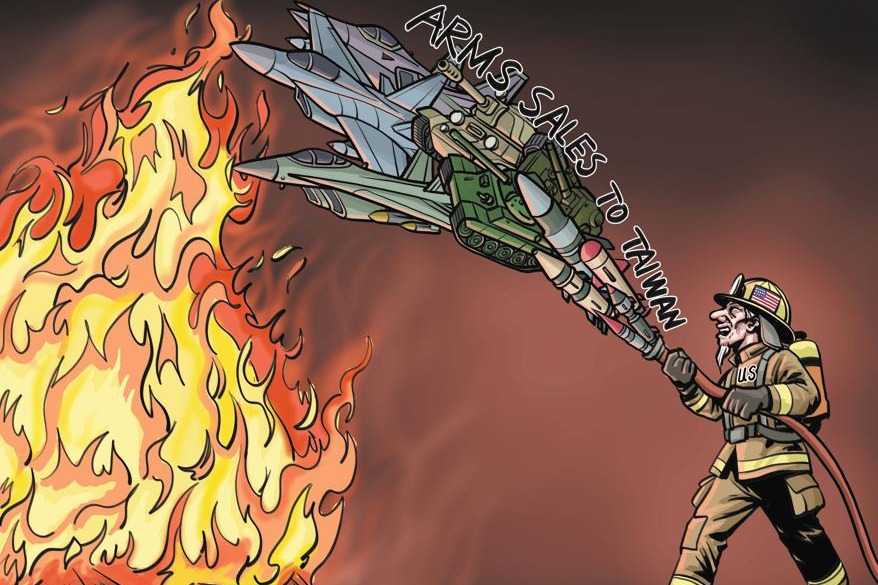
- US arms sale to Taiwan will lead secessionists toward destruction