Work begins to clean up Beijing's 'dirty streets'







The municipal government has begun a long-term project to remove illegal constructions and restore the city's traditional appearance, as Cui Jia reports.
"Dirty street" in Sanlitun was once famous for cheap food and drinks. Tian Liming, who has lived in the area for more than 50 years, knows all too well how the bar-and-restaurant-strewn thoroughfare lived up to its nickname.
The Sanlitun South No 42 apartment building stands at one end of the 200-meter-long Tonglihou street - Dirty street's official name - which connects the two parts of the Taikoo Li shopping complex. "Small businesses grew out of these apartments like aggressive tumors," the 60-year-old said.
The rise of the street in Chaoyang district began when the number of visitors surged after the southern section of the popular complex was opened in 2008 as the city hosted its first Olympic Games. Many entrepreneurs saw great business opportunities, Tian recalled.
Since it was much cheaper to rent apartments than retail premises in nearby high-end commercial spaces, serving holes appeared in a number of street-facing exterior walls of the building's ground floor apartments. A large number of apartments, including many above ground level, were converted into bars, eateries and stores.
Soon, the illegal construction reached a point where it was impossible to see the real exterior walls, prompting concerns among local residents that some buildings' structural integrity had been damaged and posed a safety risk, according to Tian.
|
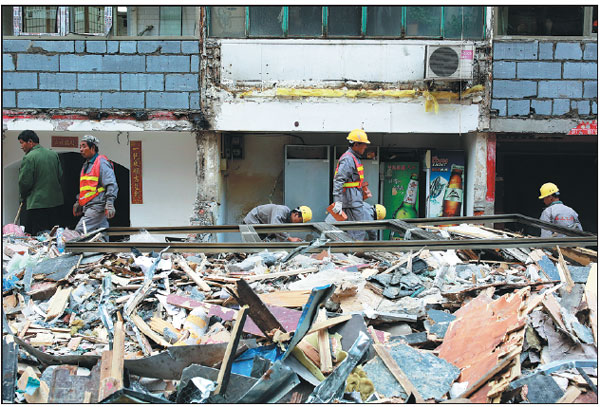
Workers tear down unauthorized exterior walls on Tonglihou street, aka “Dirty street”, in Beijing’s Sanlitun Photos By Feng Yongbin and Zou Hong / China Daily |
'Smelly and sticky'
Soon, the street in front of his residential building was constantly covered by trash, as well as vomit and urine from drunken late-night revelers. "The street became smelly and sticky. People then started to call it 'Dirty street', and it became famous among young people and expats," Tian said.
He witnessed the removal of the "tumors" on April 24, when the Beijing government launched a citywide campaign to block unauthorized business openings in the walls of buildings in residential areas.
On the first day, 33 businesses situated in Tian's apartment building were stripped of their unauthorized constructions and the original walls were restored. He said he was delighted, but was wary of showing his feelings in front of people who were sad to see the street lose its former "glory".
"For years, those businesses that some treasured deeply had been a nightmare for local residents - if they could sleep at night, that is. A friend in my building called the police five times in one night to complain about the loud noise coming from the bars," he said, as he stood in front of a belt of grass that was previously covered by several small eateries. Now, only the electricity cables covered in evaporated grease remind people of the outlets' existence.
Like many residents, Tian's friend decided to move. Only about a dozen original residents of the building stayed. After the renovation, people began to move back. Moreover, the incidence of crime on the street fell by one-third, according to Liu Zhe, deputy director of the Sanlitun police station.
Tian believes the authorities should have tackled the situation a long time ago, but taking action was not as easy as he imagines.
The process of converting ground-floor apartments or courtyards in hutong - traditional alleyways - into private businesses began as China pursued the reform and opening-up policy in the 1980s and '90s, said Zhao Yong, deputy director of the Sanlitun urban management team.
"This unauthorized behavior gradually became a common practice all over the city. Beijing has clearly grown out of that phase and things need to be strictly regulated from now on," he said. "The removal of illegal constructions in the infamous 'Dirty street' demonstrates the Beijing government's determination, and the business owners know that."
He added that some businesses in apartment buildings remain open because their business licenses and rental contracts are still valid, but unsurprisingly business has plummeted as they are no longer visible from the street and customers have to approach them through residential entrances.
"Who knows how much longer they can survive?" he said.



- Exhibition highlighting the 'Two Airlines Incident' opens in Tianjin
- Average life expectancy in Beijing rises to 83.93 years
- Energy drink overdose sends delivery worker to hospital
- GBA and Hainan deepening cooperation to boost innovation and sustainable growth
- Beijing mulls including the costs of embryo freezing and preservation in medical insurance
- Rocket developed by private Chinese firm fails, loses three satellites