A recipe for success







Iconic sauce maker Lee Kum Kee finds its way into more UK kitchens as the British mainstream embraces the delights of Chinese home cooking
Inside a packed cooking classroom, a group of teenage students are busy making oyster sauce noodles with pride and great care. With a stirring spoon in one hand and fresh ingredients in the other, they work on their dishes as if creating artworks, and within 30 minutes they present their teachers with an authentic Chinese noodle dish that lives up to restaurant standards.
The cooking class at St Michael's Catholic College in London is typical of Chinese cooking lessons sponsored by the Chinese sauce maker Lee Kum Kee, which is emerging as a popular sauce choice for United Kingdom consumers.
| British people cook Chinese food with Lee Kum Kee sauces at the cooking classes of Chinese Food Festival in London. Provided to China Daily |
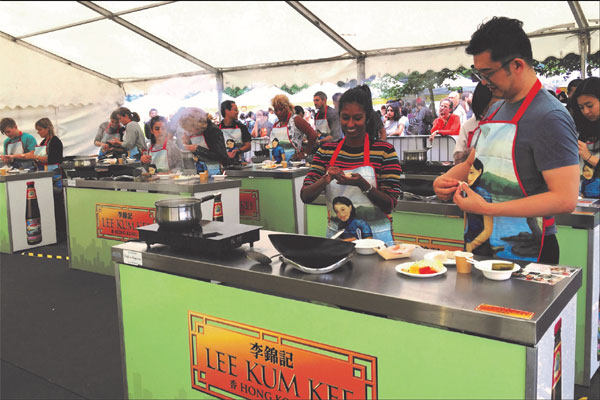
In collaboration with the London-based Ming-Ai (London) Institute, it launched the Healthy Chinese Cooking Ambassadors campaign in 2013 to help British schoolchildren learn Chinese cooking. The campaign has so far reached more than 200 schools across the country and educated about 4,000 students between the ages of 11 and 16.
"Promoting Chinese cuisine worldwide is our company mission, so the healthy food ambassador cooking program came naturally," says Maria Chong, managing director for Europe at Lee Kum Kee.
Lee Kum Kee, a popular brand of cooking sauce in Chinese homes, started to be sold on a small scale in Chinese supermarkets in the UK decades ago. The company established a subsidiary in London in 1995 to promote the brand's UK growth.
In more recent times, its UK sales have not only grown quickly, but its consumer base has broadened to include many British and other international consumers, thanks to the brand's campaigns to promote home-cooked Chinese food in the UK and the British public's increasing willingness to try new flavors, Chong says.
"There has been a massive shift from the UK's perception of Chinese food. Gone are the days of ordering a Chinese takeaway with a movie," she says.

"These days, consumers are much more adventurous. Consumers are willing to try new exotic tastes and starting to experiment with Oriental flavors and ingredients in their kitchens".
Chong says that over the past five years, Lee Kum Kee sauces have expanded into mainstream British supermarkets such as Tesco, Sainsbury's, Waitrose and Morrisons, most of which stock about 30 different sauces in their chain stores in the UK. The brand offers around 60 sauces in the UK.
"With world food development as a major retail trend (for British supermarkets), all professional retailers were looking for the right brands to offer better selections for their shoppers, and we captured the opportunity," Chong says.
In the past year, Lee Kum Kee has also begun to supply mainstream restaurants, professional caterers and food manufacturers.
Lee Kum Kee's profile in recent months also received a big boost among the UK public when its subsidiary LKK Health Products Group bought London's landmark commercial property 20 Fenchurch Street for £1.28 billion ($1.68 billion; 1.43 billion euros), which marked the largest single commercial property transaction in the UK.
Although the deal was aimed at capturing rental income and stable capital appreciation, the transaction nonetheless increased awareness of the Lee Kum Kee brand in the UK.
Lee Kum Kee is a brand that grew big from humble beginnings. Its journey of growth and internationalization is also a fascinating story of how a Chinese family business strengthened through the generations.
Lee Kum Kee was established in 1888 by Lee Kum Sheung, a chef at a small eatery that sold cooked oysters in Guangzhou, Guangdong province. However, the family moved to Macao in 1902 after his production lines were razed by fire. His third son, Lee Siu-nam, took over the business in 1920 and opened a branch office in Hong Kong in 1932, later moving the headquarters to Hong Kong.
After gaining domestic market share, the brand started expanding overseas in 1920, targeting the overseas Chinese population. Lee Waichung, the fourth-generation heir of the family business, is now chairman of the company.
Although the brand's private shareholding nature means its revenue is not publicly disclosed, its success and scale can be imagined, given that it now has sales in more than 100 countries, together providing more than 200 flavors of sauces.
Perhaps one factor that supported its international expansion success is the company's willingness to invest in corporate social responsibility projects, which shapes its brand image in consumers' minds.
The Healthy Chinese Cooking Ambassadors program in the UK is one such example. Another is its $21 million donation to Harvard University to fund the Lee Kum Sheung Center for Health and Happiness, which conducts research on topics including relationships, employment and exercise and their links to health.
In the UK, the improvement in quality and popularity of Chinese cuisine in recent years also provided fertile ground for the growing popularity of Lee Kum Kee oyster sauces.
Many Chinese chefs are also becoming celebrities in the UK. One is 37-year-old Ching He Huang, well known for transforming the British public's perception of Chinese food with her popular BBC cooking show Chinese Food Made Easy in 2008. She has also written six Chinese cookbooks.

Meanwhile, London Chinatown's collection of restaurants is becoming more diverse, featuring food from many Chinese cities. Quality has improved so much that some Chinese restaurants, such as Yauatcha and Hakkasan, are now recognized by France's Michelin star rating system.
"Chinese food's image has dramatically changed, thanks to the rise of Chinese celebrity chefs and Chinese recipe books in recent years. The British public is also becoming keener to try new things, and it sees Chinese food as different and exciting," says Jeremy Pang, founder of the London-based School of Wok, which offers Chinese cooking lessons.
Pang works extensively with Lee Kum Kee to teach students Chinese cooking, and he hosts cooking lessons at the annual Chinese Food Festival in London, which is sponsored by Lee Kum Kee.
Chong, the managing director for Europe, says: "We hope that in the consumer's mind, key words would be real taste, high quality, the best Chinese sauce they have experienced. I do believe UK consumers find the brand fun."
Initiatives to grow the popularity of Chinese food among Britain's mainstream audience have worked. For instance, children at St Michael's Catholic College loved their Chinese cooking lessons so much that the school decided in the same year to incorporate Chinese cooking into its year eight cooking curriculum.
"The students love Chinese cooking and, from a school's perspective, we are keen to promote it. Ingredients like Lee Kum Kee's sauces make the food really tasty and encourage students to eat more vegetables and maintain a balanced diet that way," says Jonathan Lewis, who is in charge of the school's food technology curriculum.
Looking to the future, Chong says Lee Kum Kee has big ambitions to tap further into the UK's mainstream market, promoting Chinese food quality and experience. "It is only through our passion in promoting great taste and healthy cooking can we deliver our mission," she says.
At the same time, she is keen to see that Lee Kum Kee continues to satisfy the needs and expectations of its loyal immigrant Chinese consumer market, by constantly launching new products to create fresh surprises, to ensure that Britain's Chinese consumers continue to see Lee Kum Kee as their kitchen essentials.
"Wherever there are Chinese, there is Lee Kum Kee. As our Chinese tagline says, 'Lee Kum Kee stands by you in every meal'," she says.
cecily.liu@mail.chinadailyuk.com
(China Daily European Weekly 10/13/2017 page30)




Today's Top News
- Spanish king on first state visit to China
- Japan must stop playing with fire on the Taiwan question: China Daily editorial
- The one who tied knot must untie it: China Daily editorial
- Xi congratulates Ouattara on re-election as president of Cote d'Ivoire
- Supercarrier to be put through paces
- Game changers for China's sports industry