Rebound puts machinery on a roll







Tech-savvy Chinese firms ride global boom in construction equipment
Laypersons may not be aware, but construction machinery, an industry where China has a significant presence, is used not just for basic construction but in advanced projects such as wind power farms, housing for industry workers, development of smart cities and medical equipment factories these days.
There is increasing demand for excavators, bulldozers, pipe-layers, road rollers and wheel loaders in the countries and regions participating in the Belt and Road, or B&R, Initiative.
Besides, demand for such machinery is also growing in China itself due to nationwide urbanization, new infrastructure projects, the booming industrial upgrading and steady economic growth overall, experts and business leaders said in the run-up to the 19th CPC National Congress.
"The industry is blossoming, even thriving, thanks to sound economic fundamentals, various key projects and national urbanization campaigns," said Zhang Yongjun, a researcher at the China Center for International Economic Exchanges in Beijing.
New railroad and mining projects; a surging number of works related to environmental protection, agriculture and public service; and public-private partnerships are all using a variety of machines, according to Zhang.
Jim Umpleby, chief executive officer of Caterpillar, the world' largest construction machinery maker, said, "China has vast infrastructure and housing needs.
"And we believe it will remain an important construction equipment market for Caterpillar for the foreseeable future."
In the second quarter of this year, the Illinois, US-based Caterpillar Inc saw sales revenue of $11.3 billion, compared with $10.3 billion in the second quarter of 2016, thanks to an increase in construction equipment sales in China, where new infrastructure projects and investments in residential realty boosted sales.
The key industrial segment is expected to see an overall 50 percent year-on-year jump in sales in China to 120,000 units this year.
Sales surge will be helped also by the fact that the sector has entered a fresh replacement cycle after its last peak year in 2011.
The country's ongoing effort to promote the "Made in China 2025" strategy is stimulating sales of high-end products, especially those related to projects of informatics industries, in both home and B&R markets.
This, in turn, is helping the construction machinery sector overcome the quiet market of the last five years, which has kept the available stocks at a low level now, said business leaders.
The incipient market rebound in China has, however, helped brighten the mood.
For long, machinery manufacturers had to deal with problems like production overcapacity, credit-availing buyers who delayed final payments, and stiff environmental standards.
Now, industry discussions focus on rising sales and future prospects.
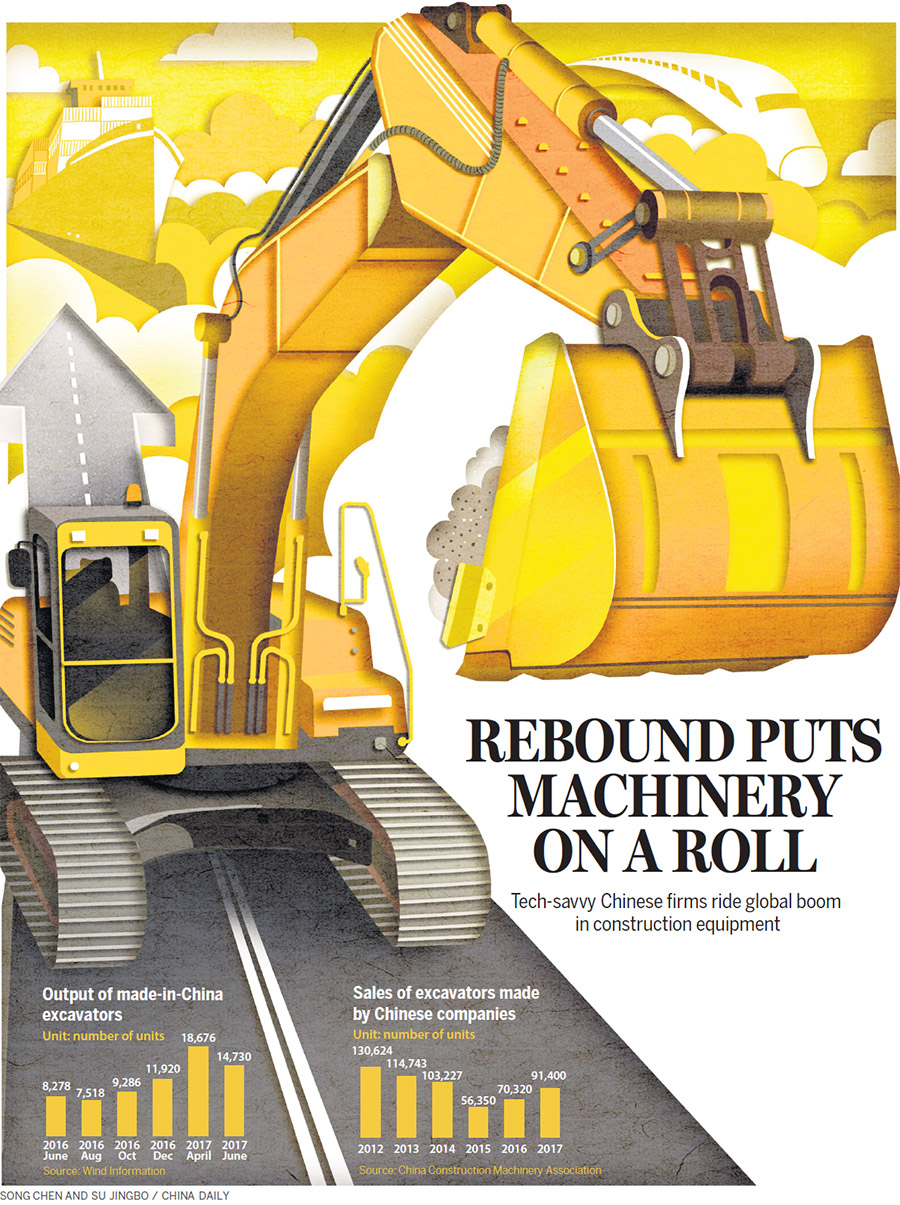
The excavator branch of the China Construction Machinery Association reported that the country's major construction machinery makers sold 91,400 units in both domestic and overseas markets between January and August, up over 100 percent year-on-year.
The eight-month sales surpassed the full-year figure of 70,320 units of 2016. Qi Jun, president of the Beijing-based CCMA, said the excavator segment will likely continue to grow robustly in the second half of this year, given China's ongoing railroad, highway and airport projects in lower-tier cities, as well as urbanization.
Excavator sales have surged since the second half of 2016. The monthly growth rate topped 70 percent year-on-year from September to November 2016.
Most companies in the global sector have seen their sales rise robustly, especially major ones such as Sany Heavy Industry Co of China, Liebherr Group of Germany and Hitachi Construction Machinery Co of Japan.
Umpleby of Caterpillar said: "Sales in our construction and mining segments are doing well. In fact, we have seen a noticeable uplift in sales of excavators."
The company celebrated the sale of 20,000 mini hydraulic excavators in China in August.
Several factors are responsible for the industry's expectations of a bright future.
The mining industry, which uses construction machinery heavily, is seeing heigtened activity due to price rise.
Zeng Guangan, president of Guangxi Liugong Group, a major Chinese construction machinery maker, said the international price rise in commodities like coal, metals, ferrous metals and nonferrous metals has stimulated sales of excavators and other types of construction machinery, especially in cities such as Tangshan in Hebei province and Panzhihua in Sichuan province.
An interesting fallout of rising labor cost has been the shift to smaller machinery.
"The (Chinese) government's ongoing efforts to tackle pollution and build sustainable agricultural and forestry facilities have all saved the industry; and the rise in labor cost will also boost the demand for smaller construction machinery throughout the country," said Zeng.
Technological breakthroughs at home are spurring glad tidings too. "Domestic machinery manufacturers have made notable technological breakthroughs in terms of product life cycle, durability, new materials and hydraulic technology," said Sun Changjun, vice-president of Hunan-based Zoomlion Heavy Industry Science and Technology Co.
These achievements will help them to supply products to big-ticket projects like smart cities, nuclear power plants, ultra-high-voltage supply lines, hydro-electric plants and wind power farms.
Such demand is particularly strong in fast-growing markets such as Saudi Arabia, Ethiopia, Kenya, Angola and Brazil.
Chen Bin, executive vice-president of the China Machinery Industry Federation, said Chinese construction machinery makers have already shifted their focus from selling their products to developing markets through dealerships to building after-sales service centers and staff training centers overseas.
For good measure, they are also printing user manuals in French, Portuguese and Russian.
"As many developed countries adopted trade protectionism measures to protect their own industries, diversifying market channels in countries and regions participating in the Belt and Road Initiative can help companies ease export pressure," said Chen.
Zhao Chi, secretary-general of the CMIF, said: "Strengthening the dealership network in markets involved in the Belt and Road Initiative can be another effective way to cut financial risk in many emerging markets. Foreign dealers partnering Chinese companies are familiar with both market environment and customers. They are both out to make a profit, and they want a return on their investment as soon as possible."
He said Chinese companies, in order to be successful, need to build logistics and after-sales service centers in emerging markets, especially in Africa, Southeast Asia and Latin America.
Zhao Ying, a researcher at the Beijing-based Institute of Industrial Economics, which is part of the Chinese Academy of Social Sciences, said even though more than 80 percent of the domestic market share is held by Chinese manufacturers, foreign companies have already entered China's lower-tier markets through diversified and affordable product categories, customer-friendly dealerships and world-class after-sales service.
For instance, Hitachi's 100-strong team at its Hefei plant in Anhui province offer customized services to Chinese clients across the country. This, industry insiders said, helped the Japanese company to build a stronger valuechain.
"China's construction machinery producers are gradually losing their low-cost labor advantage and do not yet have the best technologies to lead the industry on a global scale. Chinese companies must act quickly to retain their domestic market lead," said Zhao of the IIE.
More than 40,000 machines are used on a rental basis currently. This indicates potential for fast growth of aerial work platform, or AWP, in the China market, said Yin Xiaoli, deputy secretary-general of the CCMA.
The industry's leading players agree the size of China's AWP rental fleet will grow tenfold by 2025 as they seek new growth points.
"However, the nature of future competition between large scale companies and specialized manufacturers, and the division between domestic companies and global brands, is still not clear," Yin said.