Supply-side reform set to safeguard future







The government is restructuring the industrial sector to lower costs and promote efficiency, as Zhong Nan, Ren Xiaojin and Jing Shuiyu report.
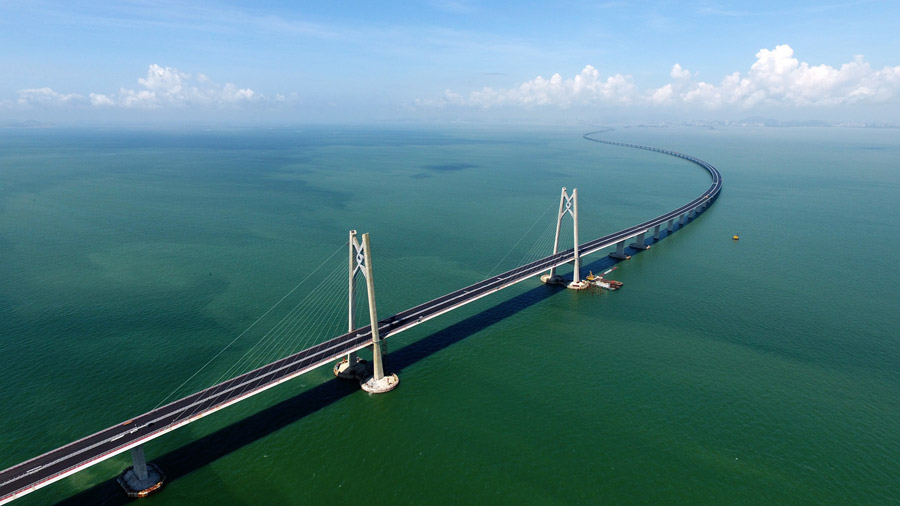 |
| The Hong Kong-Zhuhai-Macao Bridge, completed in July, is the longest of its kind in the world. [Photo/Xinhua] |
When the 23 kilometer main section of the Hong Kong-Zhuhai-Macao Bridge was completed in July and rose above the waters of the ocean to connect the three cities, the new form of steel used in its construction was hailed as a prime example of China's continuing development in the field of materials science and manufacturing.
The bridge, which has a full span of 55 km and is the longest of its kind in the world, is a great advertisement for the duplex stainless steel developed by Taiyuan Iron and Steel, which was being used for the first time.
Meanwhile, in March, the company, which specializes in developing high-tech materials, began supplying stainless steel for Hualong One, a domestically developed third-generation nuclear power station in Fujian province, one of 10 either completed or being constructed with stainless steel made by the company.
Many new growth points such as these are the result of the nation's ongoing supply-side structural reform, which is focused on increasing high-tech production while reducing low-end capacity, along with the Made in China 2025 strategy designed to support innovative and sustainable development.
"Our products will shine on the global stage through integration with markets related to the Belt and Road Initiative and huge advances in infrastructure and trade," Li Xiaobo, Tiaiyuan Iron and Steel's chairman, said.
Seeking growth
Liu Peilin, deputy director and a research fellow at the Department of Development Strategy and Regional Economy at the State Council's Development Research Center, explained the strategy.
"Supply-side reform aims to raise the labor force participation rate, optimize the allocation of labor and capital, and accelerate technological development," he said. "If we only stimulate the demand side, it will just lead to inflation. The current challenge we face, from my point of view, is to satisfy the higher demand by providing a higher level of supply to jump over the middle income trap."
Li Guanghui, vice-president of the Chinese Academy of International Trade and Economic Cooperation in Beijing, noted that other countries are adopting similar measures: "Under the current global business conditions, the world's major economies are actively seeking to rejuvenate their manufacturing sectors for future growth."
To that end, the United States has proposed a manufacturing industry renaissance program, Germany has the Industry 4.0 strategy and Japan, France and the United Kingdom have their own programs to revitalize manufacturing and stimulate exports.
To improve the manufacturing sector's earning potential, China aims to make breakthroughs in high value-added products, such as next-generation computer numerical control machines, large passenger jets, complex ships, offshore engineering products, sensors and industrial software. That would improve the country's capabilities in key manufacturing technologies and allow companies to compete with rivals such as South Korea, Japan and Germany.
Progress has already been made in shipbuilding. Chinese shipyards are outperforming their South Korean rivals in the construction of high-end mega-container ships, cruise liners and other special-purpose vessels, having already sharpened their manufacturing edge and grabbed a larger share of the global market, said Jin Peng, secretary-general of the China Association of the National Shipbuilding Industry in Beijing.
Between January and August, China's shipbuilders received new orders amounting to 13.34 million dead weight tons, accounting for more than 32.9 percent of new orders worldwide and surpassing the 27 percent held by South Korean companies during the same period, according to the association's data.
For example, COSCO Ship-ping Heavy Industry is building four of the world's biggest subsea support vessels for Maersk Supply Service. The first of the four, Maersk Installer, was delivered this month.
Lin Zhongqin, an industry expert and president of Shanghai Jiaotong University, said it is the first time a Chinese shipyard has built a vessel for Maersk, which usually buys ships from South Korea and Europe.
Meanwhile, Hudong-Zhonghua Shipbuilding in Shanghai delivered the first of four 174,000-cubic-meter trifuel diesel electric liquefied natural gas carriers to an Australian client on Oct 13.
Dong Liwan, a shipping industry professor at Shanghai Maritime University, said capable Chinese shipyards are now focusing on higher-value vessels, such as LNG and liquefied petroleum gas carriers. Some have also started to develop new sectors, including fishing vessels and ocean farming facilities.