


A sci-fi history of over a century







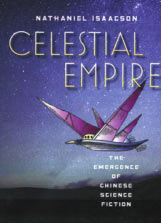 |
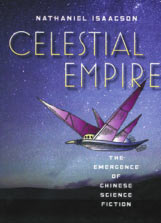
| The cover of Nathaniel Isaacson's book, Celestial Empire. [Photo provided to China Daily] |
When American Nathaniel Isaacson began research on Chinese science fiction as a doctoral student at the University of California, Los Angeles, a decade ago, he thought it would be easy for him to cover the development of Chinese sci-fi in the 20th century.
"Ten years ago, most people didn't know about Chinese science fiction," says Isaacson. "And there were little available materials to study."
However, the more he looked into the field, the more material he dug up.
Early this year, Isaacson presented his findings with analysis in a new book, Celestial Empire: The Emergence of Chinese Science Fiction, which examines the birth of the genre in China in the late Qing Dynasty (1644-1911) to the early years of the Minguo period (1912-49).
Since Chinese award-winning sci-fi writer Liu Cixin's works have been translated into English in 2014, more people want to know about Chinese sci-fi.
"But I think it's very important to understand its origin. This was something China has had for 100 years," says Isaacson.
Song Mingwei, a modern Chinese literature scholar at Wellesley College, recommends the book.
"It's a landmark in the study of science fiction. It presents new interpretations of the emergence of Chinese science fiction in the context of colonialism," says Song.
The idea of studying Chinese science fiction came to Isaacson during a course on Chinese modern literature in UCLA, where he was asked to write a paper about a novel, The New Story of the Stone, by late Qing writer Wu Jianren.
At first, Isaacson didn't know what to write, and got no grade for the course, but later on he thought that one could understand this novel through the point of view of science fiction.
The novel is a "sequel" to Cao Xueqin's classic The Story of the Stone, better known as A Dream of Red Mansions, and could be considered a time-travel novel as it takes the main character Jia Baoyu from the early Qing, the possible setting of Cao's original work, to the late Qing period.