ASEAN gold - rush for the big bucket







HK investors making a beeline for Southeast Asia's emerging economies as Belt and Road Initiative takes off
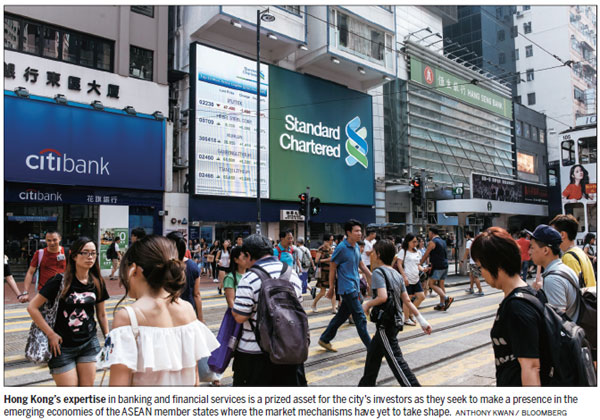
With the China-led Belt and Road Initiative fast gaining momentum, member states of the Association of Southeast Asian Nations (ASEAN) - a key component of the initiative - have emerged as hotspots for Hong Kong investors.
Hong Kong investments in the 10-member grouping have seen a phenomenal rise in recent years, particularly in emerging economies like Vietnam, Cambodia, Thailand and Indonesia which, according to a recent report by the Hong Kong Trade Development Council (HKTDC), are undergoing a development process similar to that which transformed the Chinese mainland three decades ago.
The report sees ASEAN becoming a major economic force in Asia, whose immense growth potential presents tremendous opportunities for Hong Kong's business and financial sector.
"Take Indonesia and Cambodia, for instance, where local companies have yet to build up their expertise and business portfolios and are desperately in need of foreign investment and expertise across a wide variety of sectors and projects. This is clearly something Hong Kong is well positioned to help out with," said HKTDC Principal Economist (Asian and Emerging Markets) Dickson Ho.
The prospects may seem tempting, but the challenges may be equally daunting for Hong Kong investors in a region with diverse ethos and social backgrounds, not to mention the evident administrative hurdles involved in setting up a business.
Hong Kong companies are not oblivious to the political and financial risks, especially when a country's market mechanism has yet to take shape in their respective sectors, mindful of both success stories and failures.
Lawrence Kook, managing director of First Asia Merchants Bullion Ltd, or First Gold, was a pioneer in Cambodia's fledgling derivatives market. He helped the Cambodian government build up a legal and regulatory infrastructure and system for derivatives trading and set up the country's first derivatives exchange - Golden FX Link - in mid-2016.
"Although starting from zero requires a lot of efforts, the profits from such a niche market are impressive. The first one to get into it has the advantages," said Kook, who was the first person to be awarded both the 'Central Counterparty' and 'Derivatives Broker' licenses by the Securities and Exchange Commission of Cambodia.
He told China Daily the first year's profits from Golden FX Link reached $10 million.
Kook attributed his success in Cambodia to a combination of luck and hard work, such as having a reliable partner, his dedication to professionalism, plus the willingness to integrate into the local culture.
"I stayed in Cambodia for more than one year to prepare for the opening of the local office. Although some people say you don't need to go there yourself, you can just find a reliable person to do the job, but I think I should be there to attend to the details of everything so that we can succeed."
"And, of course, the timing was good. A Cambodian friend of mine referred me to a Cambodian finance official in 2013. We met for a lunch when the official came to Hong Kong, and I introduced our company to him, but nothing happened then. Two years later, when the Cambodian government was thinking of issuing its first derivatives broker license, my Cambodian friend called me saying they'd like to talk to us on setting up a derivatives exchange," said Kook.
Besides Cambodia, First Gold is scouting for opportunities to develop in other ASEAN countries, such as Laos, Thailand and Vietnam, and saw the prospects in China's development strategy under the Belt and Road Initiative.
Success stories, however, often come at a price.
Kook said he had actually tried to start a business in Vietnam with a local partner in 2014, but he eventually backed out after discovering that the potential partner was trying to develop an internal pricing system behind his back to manipulate prices of gold derivatives in order to exploit investors' money.
"At the time, the fundamentals of the Vietnamese economy were quite sound, and many of my friends were running factories there, so we found a local partner and started a derivatives trading company there. The business was quite good. We employed more than 300 employees in three months at various offices in Ho Chi Minh and Danang, raking in a profit of $2 million each month."
As a rule, the trading prices of gold derivatives were based on international gold prices, but the Vietnamese partner thought it would be more lucrative if they had their own pricing mechanism. So, they secretly bought a new trading system to set up an internal price mechanism. After Kook found out what they did, he talked to the Chinese management team and decided to quit the business, because "the risks of doing such things are too high".
Although his first attempt to tap an ASEAN market flopped, Kook had gained experience in seeking partnerships and got to know the ropes in dealing with local governments and staff. In Cambodia, he managed to convince the local government to lift the transaction cap of $10,000 on gold derivatives trading, and showed his care for the staff by visiting their homes.
With Hong Kong and ASEAN having completed their negotiations on a free trade agreement in July this year, and both sides set to ink the pact in November, experts are hopeful business links between Hong Kong and the grouping would be strengthened.
Mergermarket Hong Kong Bureau Chief Wong Ka-chun said the signing of the free trade agreement should lead to measures that would motivate more Chinese mainland and Hong Kong companies to invest in the ASEAN states.
He said clearer guidelines would make new investors more comfortable when making future investments in those countries. Professional service providers, such as legal and accounting companies, would benefit from the pact.
Merchandise trade between Hong Kong and ASEAN amounted to HK$833 billion last year, while total services trade between the two sides reached HK$121 billion in 2015.
Mooted by President Xi Jinping in 2013, the Belt and Road Initiative is a $1.5-trillion dollar project spanning 65 countries and regions and aimed at creating a trade and infrastructure network connecting Asia with Europe and Africa along the ancient trade routes of the Silk Road.
cherrylin@chinadailyhk.com
(HK Edition 11/10/2017 page8)





Today's Top News
- Supercarrier to be put through paces
- Game changers for China's sports industry
- EU should not give platform to 'Taiwan independence' separatists
- Nation drives global energy transition
- Tariff-troubled US fears not-so-happy holidays
- 'Looking China' brings American youth closer to Chinese culture