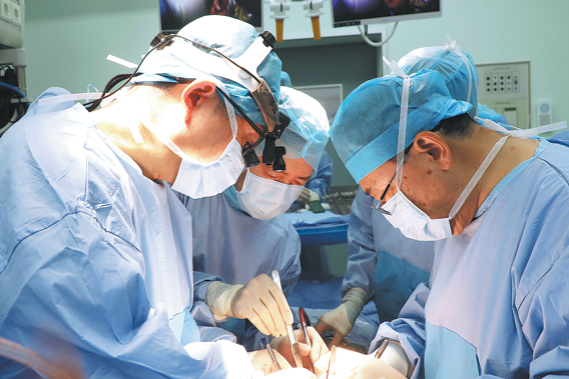
Bright prospects for AI in medical care







Doctors will play an important role in facilitating applications, but multidisciplinary cooperation is crucial
Application of artificial intelligence technology in the medical care sector has bright prospects, and it will play a great role in assisting doctors with diagnosis and treatment. But two preconditions must be met before mature diagnosis-aiding systems can be created in China.
First, the reliability of medical data should be improved. To realize AI-assisted diagnosis, standard diagnosis and treatment procedures for each disease should be established through multidisciplinary cooperation to produce data that meet standards. The major reason that many AI-assisted diagnosis products fail to work effectively is lack of reliable data.
In many hospitals in China, data is not intact. Due to differences in medical apparatus and staff skills at different hospitals, a patient may get different test results at different hospitals for the same test. On the other hand, the disease process is dynamic. Results of the same test are also different at different points in time. In addition, in many big hospitals, doctors are very busy and it is difficult for them to carefully record all patients' data, which can greatly reduce the completeness and reliability of data.
Second, a unified medical care platform should be created. For the present, regarding AI application in medical care, we have little problem in technologies and we can design medical solution plans, but we lack a unified platform that connects different hospitals for information sharing.
Currently, each public hospital on the Chinese mainland has its own information system, and without a unified platform that covers all hospitals, data stored in different hospitals cannot be shared. In comparison, in Hong Kong, all public hospitals use the same information system and share patient records. So intervention by the government is needed to establish such a platform on the Chinese mainland.
I think AI can be applied in medical care in the following four areas:
First, it can most possibly be used in reading medical images (including those of X-ray and computed tomography) and pathologic slides. China has a big population and boasts rich resources in medical images and slides, so AI application has very good prospects in reading pictures, provided that qualified data collection is completed.
Second, AI can be used for healthcare data analysis. It can assist with health management for the public through wearable devices and the internet. By analyzing a vast amount of data regarding a certain disease, AI can help authorities to predict development and prevalence of the disease.
Third, AI can help surgery robots to find the most optimized plans for surgery.
Fourth, AI can help with research and development of new drugs. By studying and analyzing existing drugs, AI can help researchers improve their compositions and develop new ones.
Although, theoretically, AI can promote the research and development of new drugs, it is a question as to how far it might help in the process. Research and development of new drugs also requires clinical trials.
AI technologies are developing very rapidly and no one is sure about AI's development in the next 10 years. But for the present, the major role AI has played is in assisting diagnosis and reducing the burden for doctors.
For example, companies in China have developed mature computerized voice recognition tools, and they can be used by doctors to record and create electronic records for patients, which can greatly reduce their computer work.
Although AI promises bright prospects in the medical care sector, I do not think it can replace doctors or squeeze all doctors from hospitals and clinics, as medicine is essentially a science relating to humans and involves communication between people. I don't think a patient would like to face just a machine when seeking diagnosis and treatment.
Having said that, although experienced doctors will still be needed to give final decisions in diagnosis, some doctors of the average level who fail to work hard may lose their jobs and be replaced by machines.
Last, I want to stress that doctors will play a very important role in facilitating AI application in medical care, and multidisciplinary cooperation in the sector is crucial. For the present, key tasks are to establish high-quality databases and create tangible products that benefit patients.
Moreover, technological breakthroughs in AI application in the medical sector require support from the government, so elite scholars and researchers of various disciplines are well organized for research and development.
The author is president of China Pharmaceutical University. The views do not necessarily reflect those of China Daily.
(China Daily European Weekly 11/10/2017 page9)




Today's Top News
- Wang to meet foreign ministers of Cambodia, Thailand in Yunnan
- China's top legislature concludes standing committee session
- Thailand and Cambodia agree to temporary ceasefire
- NPC's 4th annual session slated for early March
- Civilizational links for a fairer world
- Manufacturing in China spurs global growth