A bellyful of warmth







Editor's Note: China is divided into as many culinary regions as there are different ethnic groups. Its geographical diversity and kaleidoscopic cultural profiles contribute to the unending banquet of flavors.
When the temperatures drop and the central heating has only just kicked in, it's time for a warming pot of well-brewed soup.
Soup in Chinese cuisine is a major category on the menu and ranges from the lightest consomme to hearty rich broths that are thick with meat and vegetables.
| Trotters and peanut soup is rich and milky and scented with the unmistakable aroma of the nuts. Provided to China Daily |
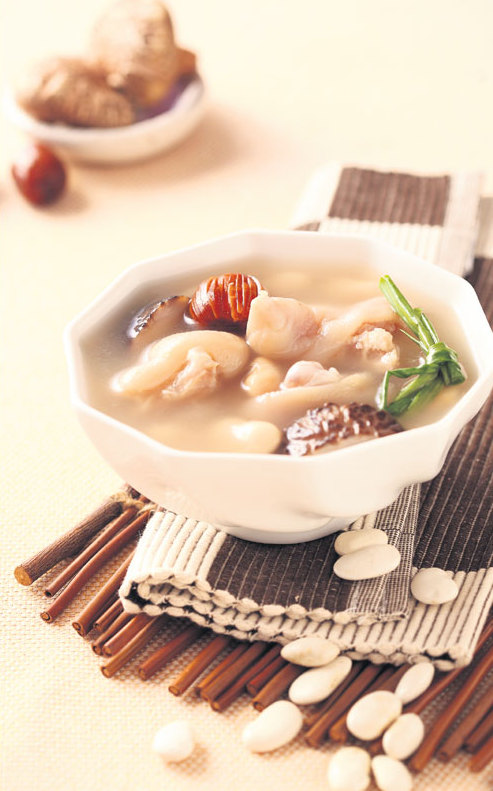
Of course, no one places more emphasis on soups than the Cantonese, so I will tap into that aspect of my culinary heritage for the classic recipes.
The wok is an important piece of equipment in every Chinese kitchen, but in the Cantonese home, another item holds equal importance: the soup pot.
Normally made of earthenware for its heat-conducting properties, this should be a tall pot with a raised lip that closely cradles the tight fitting lid.
It should comfortably hold at least four liters of liquid so the soup can slowly reduce. The raised lip helps to keep the lid from rattling and holds in the air pressure that builds up in the long, slow brewing.
Sometimes, more than one soup pot is found in the same kitchen, with a smaller one reserved for a different kind of brew - the medicinal soups so beloved by the Cantonese matriarch.
Not all soups are made in the claypot. Some of the lighter everyday soups are quickly made, often in the wok.
These are the light soups, made with a few slices of meat for flavor and plenty of vegetables. Mustard greens and lean pork, for example, or even an egg drop soup with coriander added at the last minute.
But the art of making soup reaches its pinnacle with those that are simmered long and slow.
I remember trotters and peanut soup. The broth was rich and milky and scented with the unmistakable aroma of the nuts. The nuts are thrown into the soup with the skins on, and these tinge the soup slightly pink. The trotters, reduced to a gelatinous tenderness, would be plated and served as part of the meal, together with a little saucer of soy sauce. I remember draining the bowl and happily picking at the soft, soft nuts.
Funnily enough, the alchemy of peanuts and trotters means that you hardly taste the porkiness of the pig's feet, only a nutty fragrance that is accentuated by the addition of a handful of dried Chinese jujubes.
And here you have the classic anatomy of a Cantonese soup.
First, you have the meat - which can be pork, beef, mutton or fish. Then you have the complementary ingredients, which can be root vegetables such as radishes, carrots or lotus root, or beans or dried leafy vegetables. And finally, there will always be dried jujubes, dates, ginger, dried citrus peel or any of a vast variety of Chinese herbs.
Every ingredient has a purpose.
The meat will either strengthen or cool the body. The root or leafy vegetables will play supporting roles for flavor or for health. Herbs or aromatics will neutralize certain undesirable effects - like ginger taking away the pungency of fish or pork, and dried jujubes adding sweetness where it is needed.
The long, slow simmering melds the flavors of the various ingredients and allows them to come together in the soup bowl.
Unlike Western soups, the treasured end product is the liquid, the soup, and not the ingredients that first went into the pot. These soup dregs, or tangzha as we call them, are often discarded. In fact, after three hours of simmering, almost all of the flavor has already been extracted.
And there are soups for every purpose.
The Cantonese grandmother's idea of chicken soup is to double boil a minced chicken breast. The result is a clear consomme that will tempt even the most recalcitrant invalid.
There are soups that will make you bright-eyed and clear-brained for those examination days, soups to revive flagging appetites, broths to boost energy after a hard day's workout, and a whole cookbook of soups for the new mother recovering from childbirth.
Soups are flash-boiled, simmered, steamed and double-boiled. There are also soups that resemble the stews of other provinces, but the Cantonese differentiate them by calling these geng, or thick broths.
The most famous, of course, is the infamous shark's fin soup but, with the ban on shark fins in most Chinese cities, this looks like a thing of the past. Instead, a vegetable called shark's fin melon is now very popular. This is very much like spaghetti squash and takes well to the cooking with shredded chicken, crabs and mushrooms to produce a tasty substitute.
In Shunde county, the Cantonese chefs like producing a thick broth that features the local fish, which is first fried and then deboned before being added to the broth with aromatic mushrooms.
The importance of soup to the Cantonese can be seen in the description of their daily meals. For an average family, sancai yitang, three dishes and a soup, sums it up.
paulined@chinadaily.com.cn
Mustard green and sliced pork soup
A bunch of mustard green, choy sum or caixin
100g lean pork, thinly sliced
1 teaspoon sesame oil, salt and a little cornstarch
1 slice ginger
Mix the sliced pork with sesame oil, salt and cornstarch. Massage the seasoning into the meat. This velveting process will make the lean meat tastier.
Wash the vegetable well, separating the leaves. Cut them up, separating the green tips from the stems.
Heat up a little oil in a wok and fry the ginger. Add the meat and toss till cooked. Add two to three cups of water and bring to a boil. Add the mustard green stems, and when they change color, add the leaves. When the soup comes to a boil, remove from heat, season and serve.
Peanut soup with trotters and tail
1 lower trotter, cleaned and chopped
1 pig's tail, cleaned and chopped 300g raw peanuts
4-5 dried Chinese jujubes
1 5-cm piece ginger, flattened with the back of a cleaver
Wash trotter and tail. Check to see that all gristle is removed and blanch in boiling water. Drain, wash in running water and drain again.
Wash peanuts. Keep the skin on.
Heat up three liters of water in a large stockpot, and when the water is boiling, add trotter and tail pieces and peanuts, ginger and dried Chinese jujubes.
Bring back to a boil, then reduce to a simmer. Keep the lid covered and slowly cook for at least an hour. Do not salt until you are ready to serve.
Fish out the tender trotters and tail and serve them with platters of soy sauce. Serve the peanuts with the soup.
If you don't like trotters or tail, substitute with a pork hock.
Cantonese granny's chicken essence
1 chicken breast, skin removed Pinch of salt
Wash the breast clean, dry and then finely mince. Sprinkle the salt over the minced chicken.
Invert a rice bowl and place it in a large soup bowl. Plaster the chicken over the top of the inverted bowl.
Steam the whole assembly in a steamer over constant high heat for 20 minutes. Allow to cool for five minutes. Remove the meat from the top of the rice bowl. Carefully lift it. You will find the chicken essence under the rice bowl.
Serve immediately. This is a recipe that never ceases to amaze me with its masterly application of physics.
(China Daily Africa Weekly 11/17/2017 page19)






Today's Top News
- Supercarrier to be put through paces
- Game changers for China's sports industry
- Nation drives global energy transition
- Tariff-troubled US fears not-so-happy holidays
- 'Looking China' brings American youth closer to Chinese culture
- National Games start new chapter