Scandals related to Abe show a term can lose its real meaning







December is generally the month when people across the world review the passing year. In Japan, people choose buzzwords that best convey their feelings for the year.
On Dec 1, sontaku, a word that is not part of Japanese people's working vocabulary, was picked as one of the words that went viral this year. The term, as the Financial Times said, refers to the preemptive, placatory following of an order that has not been given.
Sontaku was the most-searched word online for four straight months, according to a buzzwords' committee. The word has entered the Japanese vernacular because of two political scandals in which Prime Minister Shinzo Abe and his wife Akie Abe are said to be involved.
One began with revelations in March that Osaka-based educational institution Moritomo Gakuen had purchased a piece of public land at an unbelievably generous discount. The officials in charge of the transaction reportedly practiced sontaku to accommodate what they believed were the wishes of the Prime Minister's Office and Akie Abe, who was named honorary principal of a Shinzo Abe memorial elementary school to be built on the site purchased by Moritomo Gakuen.
At a hearing in parliament, Yasunori Kagoike, then president of Moritomo Gakuen, said Akie Abe gave him 1 million yen ($8,862) in the name of the prime minister.
The second scandal broke out months later. Abe and his aides were alleged to have helped Kotaro Kake, president of Kake Gakuen Education Institution, get permission for running a veterinary school despite public consensus it was not needed. Abe and Kake are long-time friends.
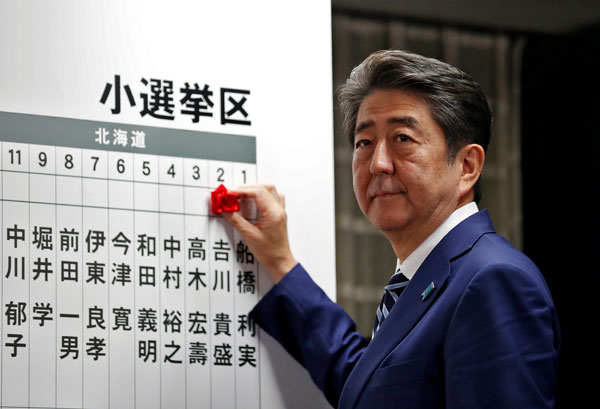
As the two scandals brewed, the word sontaku hit the headlines. The allegations, among a string of gaffes some officials made, led to a rapid drop in Abe's approval ratings. He played a political gamble by calling a snap election in October to consolidate his power. But despite the ruling Liberal Democratic Party winning a landslide victory, the two scandals continue to haunt him.
At the budget committee meeting in Japan's lower house in late November, opposition lawmakers continued to grill Abe and his officials for their suspected connections with the two educational institutions. Some opposition parties have demanded that the key people involved in Moritomo Gakuen's controversial land deal, including Akie Abe, testify in parliament. And the Asahi Shimbun has kept criticizing Abe, and accusing all the people suspected of being directly involved in the scandals of keeping their mouths zipped and therefore making it difficult to dig out the truth.
With Japanese politics being practically under Abe's total control, the newspaper said members of the ruling coalition of LDP and Komeito and government officials are increasingly keen to accommodate the wishes of Abe and the Prime Minister's Office. "The longer Abe allows the twin scandals to drag on, the greater the public's mistrust in him and his administration will grow," the Asahi Shimbun said.
A survey conducted by Kyodo News on Dec 2-3 showed the Abe Cabinet's approval rating declined 2.3 percentage points from last month to 47.2 percent. More than 40 percent of the respondents disapproved of its performance, and 75 percent said Abe's explanations fell short of clearing the air over the two scandals.
An Asahi Shimbun commentary said the word sontaku was used in The Book of Songs, a classic collection of ancient Chinese poems. One poem goes like this: "If someone has an evil heart, I will examine it carefully." From this, it appears sontaku originally meant the ability to see through someone's evil designs, according to Tadahisa Ishikawa, author of New Interpretation of Compendium of Chinese Classics. The poem goes on to liken this ability to that of a trained dog that can sniff out a crafty rabbit.
In Japan, sontaku obviously has a different meaning today, highlighting the ability to fawn on one's superiors by conjecturing their wishes, and not to ensnare those with evil designs.
The author is China Daily Tokyo bureau chief. caihong@chinadaily.com.cn