Awareness of ivory ban to get boost







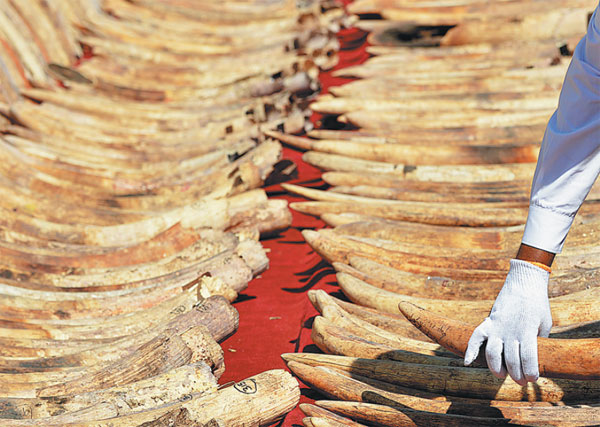
Consumers widely support the national ivory ban that will take effect at the end of this year in China, but public awareness is still low, according to a report released on Tuesday by two NGOs.
Nearly 90 percent of those surveyed by the NGOs said they would support the ban.
More than half of past ivory buyers have stopped buying, according to the report, which was produced by TRAFFIC and the World Wildlife Fund.
The State Forestry Administration, which manages the ivory trade, announced in January that all commercial ivory processing and trading will be banned at year's end.
The ban has been widely hailed by the international community as a policy that, if rigorously enforced, could help stop the poaching and reverse the decline of the African wild elephant population.
"China has shown great leadership on this urgent issue within a region plagued by illegal wildlife trade activity, which is exacerbated by legal markets. It is a huge step forward and a clear commitment to securing a future for Africa's elephants," said Margaret Kinnaird, WWF's wildlife practice leader.
"The next few months will be absolutely critical for the ban to be effectively enforced and communicated. We remain confident that as the doors to the largest legal ivory trade close, we start 2018 a step closer to securing a world where demand for ivory is significantly reduced," she said.
China had closed 12 processors and 55 retailers as of March this year. There are 105 ivory producers and stores in the list, mostly in Beijing, Shanghai, and Guangdong and Jiangsu provinces.
But among the 2,000 total survey respondents in 15 cities, only 19 percent can recall the regulation on ivory trade on their own, while just 46 percent can recall the ban when prompted.
Moreover, the survey also found that 1 in 5 consumers of ivory are persistent buyers, implying that they still intend to buy after the ban is implemented. But 62 percent of the persistent consumers are willing to reconsider future purchases, suggesting the potential to make them change their mind through effective messaging.
Experts suggest that improving understanding and knowledge of the ivory trade ban is essential and will provide a foundation for follow-up consumer messaging aimed at changing attitudes and behavior.
"Raising awareness about the law and the consequences of violating it could foster an environment that allows China to have a greater influence on consumer behavior," said Zhou Fei, head of the TRAFFIC China Programme and the WWF China Wildlife Trade Programme.
In 1981, China signed the Convention on the International Trade in Endangered Species of Wild Fauna and Flora. In 1989, the sale of ivory was prohibited worldwide after the African elephant population fell to 600,000 from 1.2 million in a decade.
The government banned all imports and exports of ivory tusks and related products in 1991. Penalties, ranging from heavy fines to imprisonment, and even capital punishment, are imposed for violators.
The report said that ivory purchases have dropped in the past three years in cities where regulations may be stricter and where there is more public awareness about the upcoming ivory trade ban-as in Beijing and Chengdu.
As NGOs have called for the closure of all legal domestic markets for ivory-believed to contribute to poaching and illegal trade-the ivory carving skill that was included in the First National List of Intangible Cultural Heritage Conservation in 2006 may face extinction.
To protect ivory carving as an intangible cultural heritage, the forestry administration is encouraging carvers to use their skills on other materials, and has invited some to keep their craft alive via written, audio and video records.


- China adopts revised Civil Aviation Law
- China launches satellite to aid in early extreme weather detection
- Report on mining accident that killed 6 suggests accountability for 42 individuals
- Law aimed at bolstering standard Chinese language education passed
- Connecting cities, changing lives
- World's longest expressway tunnel opens to traffic