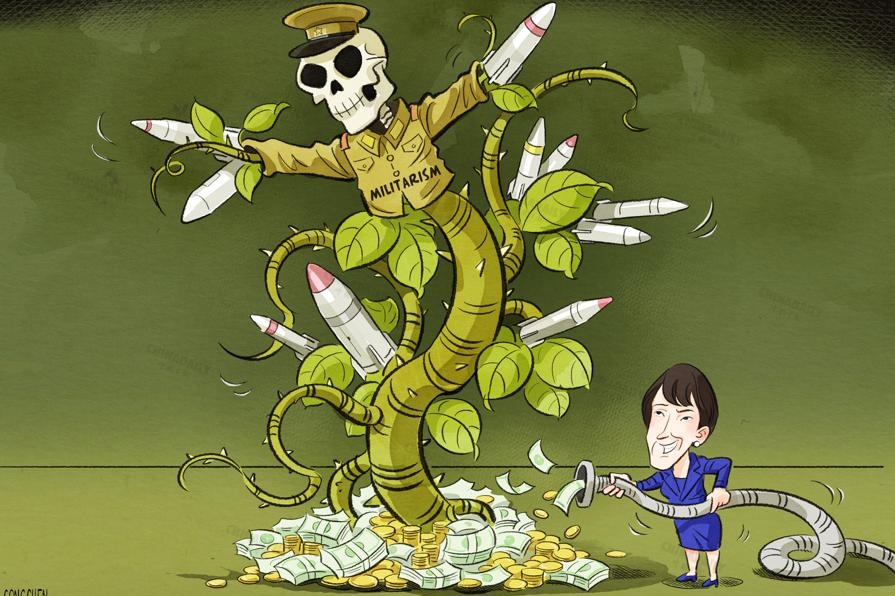
Chinese investment in US: A stabilizer for bilateral ties







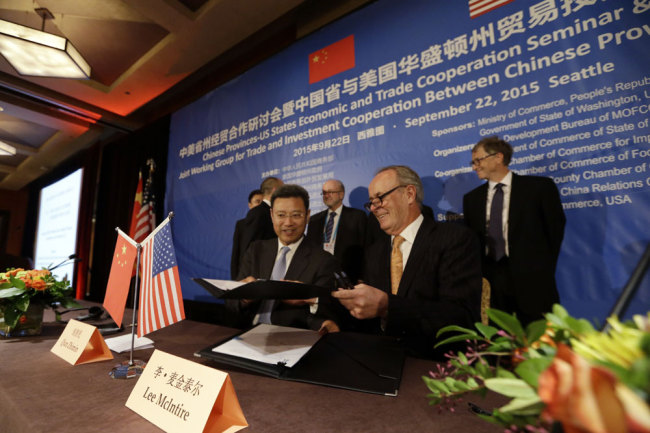
Chinese investment in the United States is a new dimension of the multi-faceted US-China relationship. In 2005, China National Offshore Oil Corporation (CNOOC) attempted to purchase Unocal, a money-losing California oil company. The $18.5 billion deal was blocked by U.S. Congress on national security grounds. This setback did not deter China. Instead, its penetration into the United States and other Western markets has accelerated since then. According to American Enterprise Institute, total Chinese investments and contracts in the United States have topped $172 billion since 2005
Chinese investment in the United States has not always been smooth. The U.S. government fears that some Chinese companies may engage in industrial espionage for military purposes. For example, Huawei has been singled out for having alleged ties to the Chinese military, since its president, Ren Zhengfei, was a former PLA officer. Huawei has strongly denied any links to the Chinese government. It has minority stakes in some small projects in the United States, but due to the persistent perception that it has ties to the Chinese military, Huawei has not been able to snatch large deals in the United States.
China is a favorite punching bag of American politicians, who accuse China of “stealing” American jobs. However, facts speak louder than words. According to the McKinsey Global Institute, only around 700,000 of the six million manufacturing jobs lost in the United States between 2000 and 2010 went to China. The National Committee on U.S.-China Relations and the Rhodium Group report that in 2010 fewer than 15,000 Americans were on Chinese company payrolls; by early 2017, 140,000 Americans were directly employed by Chinese companies in the U.S., and Chinese affiliated companies covered 98 percent of U.S. congressional districts. As Americans debate the risks of growing Chinese investment in the United States, it is important that they not lose sight of the benefits these investments can generate for local economies.
In its 2017 annual report, the U.S.-China Economic and Security Review Commission, an advisory body to U.S. Congress, recommended prohibiting the acquisition of U.S. assets by “Chinese state-owned or state-controlled entities”, and ensuring a strict review process for all significant Chinese investments in the U.S. Meanwhile, China itself is regulating overseas investment after the dramatic jump of total global investment to $225.4 billion in 2016, including $55.65 billion to the United States. Worrying that too much money may be leaving China unregulated, Commerce Minister Zhong Shan castigated what he called “blind and irrational investment” at a briefing in March 2017 while insisting that the country has not changed its policy of encouraging Chinese companies to become more global.
In addition to security concerns, some Americans suspect that the Chinese government is trying to game the system by snapping up foreign firms in key areas of the economy while blocking others from doing the same in China. To address such concerns, the Chinese government has repeatedly reassured foreign governments and investors that China’s door remains open. In November 2017, China’s State Council announced a new financial market liberalization policy, easing limits on foreign ownership of financial services groups. According to the new policy, foreign firms will be allowed to hold a majority stake in joint ventures with Chinese securities companies and life insurers. In addition, caps on foreign banks’ stakes in Chinese banks and asset managers are to be removed. The new policy was immediately welcomed by American businesses such as Morgan Stanley, Goldman Sachs, and Citigroup. In December 2017 Vice Premier Wang Yang said at a business forum that China would significantly expand market access, speed up drafting a timetable and roadmap for opening key sectors to foreign investment, and create an environment for fair competition.
The Committee on Foreign Investment in the United States (CFIUS) is perhaps the most famous governmental organization that reviews foreign investment in the United States. CFIUS does not always recommend prevention of Chinese investment. In August 2016, the state-owned China National Chemical Corporation received clearance from CFIUS for its $43 billion acquisition of Syngenta, a giant in farm chemicals and seeds, removing one of the biggest challenges to the deal. The transaction is still subject to antitrust review in several countries. When completed, the Syngenta purchase would be China’s biggest foreign deal so far.
According to China’s Ministry of Commerce, trade between the two countries surged from $2.5 billion in 1979 to $519.6 billion in 2016. John Frisbie, President of the U.S.-China Business Council, calls trade and investment “a source of stability” for bilateral relations. As its economy continues to grow, China is poised to invest more in the United States, contributing to America’s economic recovery. While China needs to follow international norms such as assuming corporate social responsibility (CSR), the United States must balance its national security interests with its economic ones. The two countries should work together to ensure that bilateral trade and investment will continue to benefit their citizens.
The author is professor of Political Science and International Relations at Bucknell University, USA