


Art with a message








An exhibition of works by Xu Beihong (1895-1953) celebrates his life and how he encouraged people to strive for independence and righteousness. Lin Qi reports.
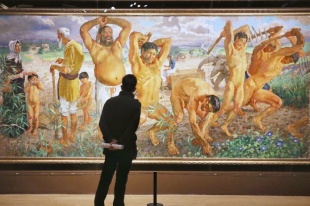
Master artist Xu Beihong (1895-1953) did two paintings in 1940 illustrating the Chinese fable of Yugong Yishan about a man attempting to move mountains. They are recognized as the best-known pieces in his oeuvre.
The story of Yugong Yishan, first mentioned in the fourth-century BC Taoist text Liezi, has been told for generations in Chinese households.
It hails the tenacity of an old man who endeavors to remove mountains that block the path in front of his house. Despite being considered a fool, he firmly believes that his offspring will continue the efforts after he dies.
Xu produced two paintings-an oil work and a classic Chinese ink work-using Indian men as models, during a year's stint in India.
And he didn't place the grey-haired man Yugong in the center, but depicted him turning to one side and talking to a woman. Rather, he highlighted several almost naked, muscular men digging on the mountains in the middle of the painting.
The two works, both titled Yugong Yishan, are now on show at Nation and Era, an exhibition at the National Art Museum of China through March 4 that celebrates Xu's life and how he encouraged people to strive for independence and righteousness.
The men doing the digging in the paintings do not look Chinese: They have darker skin tones, thick, hairy eyebrows and short, curly hair, while men in ancient China normally had long hair.
When Xu was in India, he was invited by Rabindranath Tagore to exhibit and lecture at the Visva-Bharati University in Santiniketan, which the Nobel laureate had established in 1922.
And students and staff members of the Visva-Bharati University offered to help when they heard that Xu needed models to paint.