Policy review suggests US likely to use nuclear weapons







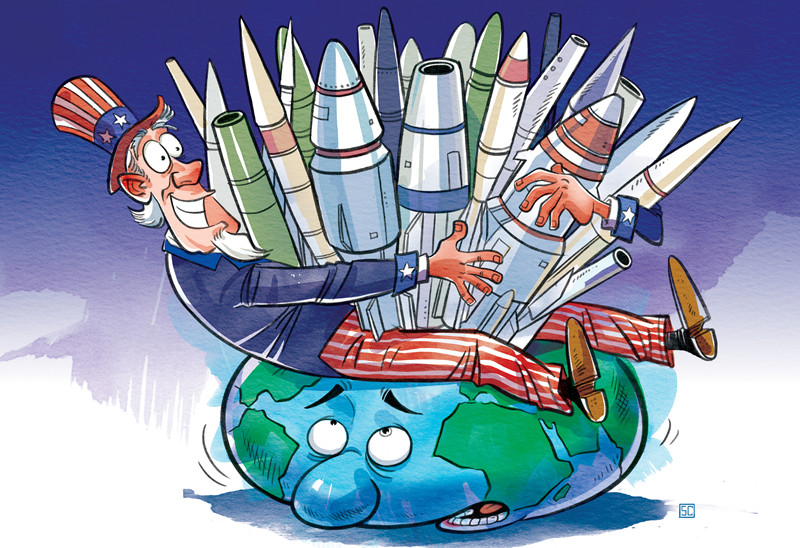
Compared with the United States' new nuclear doctrine that is noncommittal about scenarios when it might use nuclear weapons, China's policy is unambiguous.
The US Defense Department's Nuclear Posture Review, released on Feb 2, outlines the Pentagon's plans to expand its own nuclear capabilities, while claiming that China's "lack of transparency regarding the scope and scale of its nuclear modernization program raises questions regarding its future intent".
Yet to not do something can also be a "future intent", and in his comments regarding the US nuclear policy document on Sunday, Ren Guoqiang, spokesman of China's National Defense Ministry, said China "always abides by the principle of no first use of nuclear weapons under any circumstances" and will "unconditionally not use or threaten to use nuclear weapons against non-nuclear weapon states".
This diverges remarkably from the Pentagon's posture, which said, "The United States has never adopted a 'no-first-use' policy and, given the contemporary threat environment, such a policy is not justified today."
Lisbeth Gronlund, a fellow of the American Association for the Advancement of Science and the American Physical Society, said the Trump administration's Nuclear Posture Review lays out a policy that will make the use of nuclear weapons more likely and undercut US security.
The new policy described in the Nuclear Posture Review broadens the scenarios under which the United States would use nuclear weapons first, thus lowering the threshold for first use, she said on the day the nuclear policy document was released.
The Nuclear Posture Review explicitly lists a wide array of non-nuclear attacks that could constitute grounds for a US nuclear response, she said.
These include, but are not limited to, "attacks on the US allied or partner civilian populations or infrastructure, and attacks on US or allied nuclear forces, their command and control, or warning and attack assessment capabilities".
In a talk with the National Public Radio aired on Jan 28, Alexandra Bell of the Center for Arms Control and Non-Proliferation, also said the new policy document has widened the options for the use of nuclear weapons.
"Nuclear weapons may be used in response to a chemical attack, to a biological weapons attack, to an attack on civilians without a real description of where that threshold is and really widens the options for President Trump to use nuclear weapons," Bell, senior policy director of the center, said.
The Pentagon document said it remains the policy of the United States to retain some ambiguity regarding the precise circumstances that might lead to a US nuclear response.
This same rationale, however, could also be employed by other nuclear weapons states, including China, for ambiguity regarding the "scope and scale" of their nuclear weapons.
However, there is no ambiguity that there is a huge discrepancy between the size of China's nuclear arsenal and that of the US.
The Stockholm International Peace Research Institute estimates that China has 270 warheads compared to the 6,800 of the US.
At a news briefing at the Pentagon on Feb 2, Anita Friedt, deputy assistant secretary in the Bureau of Arms Control, Verification, and Compliance of the US State Department, said, the US had long sought to have dialogue with China to help manage the risk of miscalculations and misperceptions.
Perhaps Washington needs to put aside its Cold War mentality before proceeding to the dialogue, which hopefully will help it to better understand China's intentions, and contribute to easing the apprehensions of the world's most powerful nuclear country about Beijing's nuclear strength.
The author is deputy editor-in-chief of China Daily USA.
huanxinzhao@chinadailyusa.com