


National treasures?win over audiences








A look at the history of three important cultural relics that are a part of the Shanghai Museum's collection
The new television series titled National Treasure that features cultural relics from nine leading museums in China has been applauded by a large number of viewers.
Produced by China's Central Television, the first installment of the 10-episode series was aired on Dec 3. New episodes are shown every Sunday evening. The show has a score of 9.1 out of 10 on Douban.com, a leading site for film and book reviews.
Yu Lei, the producer of the show, said that National Treasure aims to "create connections between these objects in the museum and people and life" while Zhang Guoli, the show's host, said that the main objective of the program is to "bring young people to the museum".
"You can't buy any of the objects, nor will they ever have a price. But you will marvel at its story and be amazed by our culture and history," said Zhang.
Each episode features three objects from a museum. The three objects from the Shanghai Museum that were featured are the bronze Da Ke Ding, the Bronze Square Sheng and a silk tapestry with a design depicting ducks in a lotus pond.
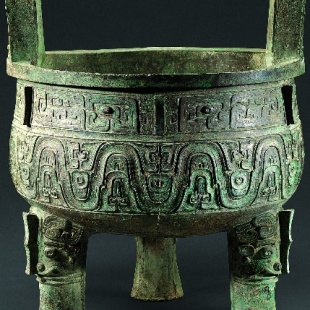
The Da Ke Ding, a 2,000-year-old bronze tripod, has been one of the most important artifacts at the Shanghai Museum since it was founded in 1952. Yang Zhigang, director of the museum, said "the object in the show is a rare national treasure because of its size, inscriptions and the way it was crafted".
The cauldron, which dates back to the Western Zhou Dynasty (c.11th century-771 BC), is 93.1 cm tall, has a diameter of 75.6 cm, and weighs more than 200 kg. It is inscribed with 290 characters that documents the merits and achievements of a royal chef named Ke. Aside from this relic, the chef also had seven smaller bronze cauldrons which indicated that he held a rank that was as lofty as a duke or prince.
The bronze cauldron was unearthed from Fufeng county of Shaanxi province in the late 1800s. Three large tripods were unearthed in China around the same period. Called Da Yu Ding, Da Ke Ding, and Mao Gong Ding, these tripods used to be known as the "Three Treasures within the Four Seas".
The tripods Da Yu Ding and Da Ke Ding once belonged to Pan Zuyin (1830-1890), a high-ranking official, scholar and an avid collector of antiques. Da Yu Ding was a gift from general Zuo Zongtang in gratitude of Pan's efforts in convincing the emperor of his loyalty, while Da Ke Ding was bought from its previous owner.
Pan kept his collection of bronze relics in a building called Pan Gu Lou in his hometown of Suzhou, Jiangsu province. As he did not have children, his antique collection was inherited by his younger brother Pan Zunian.
In 1937, the Pan family fled their hometown when Japanese planes dropped bombs over Suzhou. Before they left, Pan Dayu, the mistress of the household and Pan Zuyin's granddaughter-in-law, had the two bronze cauldrons buried with the help of a loyal servant because they were too heavy to carry.
The bronze relics were buried in the ground beneath the brick floor of the living room. Although the Japanese repeatedly raided the Pan house to search for his famous collection, the bronze relics were never found.
In 1951, Pan Dayu wrote a letter to the administration of the new Chinese government, offering to donate the family's collection, including the two cauldrons. "Da Yu Ding and Da Ke Ding are cultural relics of national importance," she wrote. "They should be kept appropriately and permanently. I sincerely wish to donate them to the State."
After donating the cauldrons to Shanghai, Pan Dayu received a citation from the Ministry of Culture which she hung on her bedroom wall for 50 years. She died in Suzhou in 2007.