


Classic drum thrives after taking a beating








A 600-year-old percussionist tradition is still beating thanks to innovation, the perseverance of three generations and an enthusiastic battalion of young drummers.
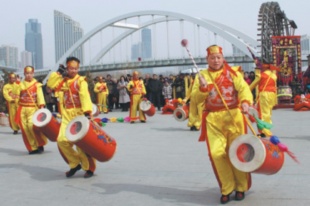
A row of brightly dressed percussionists danced and swung drums over their heads, and soon the 40 performers were thrashing the life out of the instruments. They were converged at Water Cart Park in Lanzhou, Gansu province, and the thunderous din stirred the watching crowd into raucous applause.
It was all part of the Taiping Drum Dance, now closely linked with Lanzhou, and a tradition that just 10 years ago seemed to be on the verge of entering eternal silence.
The origins of the folk performance can be traced back more than six centuries and centers on a tale that conjures images of the Trojan horse and the fall of the city of Troy in ancient Greece. In 1368, as part of an imperial campaign to unite the country, Ming Dynasty (1368-1644) general Xu Da hatched plans to conquer the strategically important city of Lanzhou, regarded as being impregnable and one of the last holdouts of the Yuan Dynasty (1271-1368).
The plan, to be executed during Spring Festival, called for a squadron of soldiers masquerading as drummers to take part in festivities to gain access to the city with their weapons hidden inside big drums.
Victory was soon theirs, and to celebrate this triumph and the peace that ensued, the tradition grew to become beating drums during the Spring Festival holiday. The ritual evolved into a dance, and the instrument came to be known as a taiping drum, with the word taiping meaning "peace".
Any talk of the glories of the drum is incomplete without mentioning Wei Yonghong, who is given much of the credit for keeping the tradition alive. In fact, Wei, 66, was recognized last year as one of the national-level inheritors of Chinese intangible cultural heritage.
During the "cultural revolution" (1966-76), the dance was all but silenced, according to Wei from Gaolan county.
"However, after things settled down in the '80s, public interest in this traditional dance was rekindled," he said. "The problem was that there were few usable drums left in our village."
Sound support
The local government paid a Shanghai manufacturer to make dozens of drums, but they were too weak to withstand powerful beatings. Wei, who was a carpenter by trade, inspected the old drums and the newer Shanghai-made versions, and came up with a way to not only improve the structure, but also ingeniously placed two springs inside the drums to achieve a uniform, sonorous beat.
Thus was born a new drum that was tough, durable and beautifully painted, while also sounding good. In 1990, more than 100 of Wei's drums were used in the opening ceremony of the Asian Games in Beijing, marking the instrument's debut on the world stage.
Lanzhou residents now had their drum back, and 16 years later it was designated as an item of national intangible cultural heritage.
However, by this time, the dance - usually performed by men because of the extreme physical demands - faced a further threat because men were swarming to big cities to find work. So the torch that would keep this art alive had to be passed to young students.
Stoking interest
Shidong Primary School in Gaolan was a pioneer. To ensure that young people would continue to carry the drums, Wei made a batch of smaller ones, each weighing about 3 kilograms - less than half the weight of the regular versions. Learning to play the drums became part of the school's curriculum, and Wei became an instructor.
The idea needed the backing of parents, as well as sufficient funding. These often were lacking, but Wei pushed on with efforts to revive the tradition.
"It's like killing three birds with one stone," said Zhang Lai, principal of the school, in talking of the benefits of reviving the dance. "Traditional culture is safeguarded, students improve their strength and physical stamina, and it nurtures students artistically, which is extremely important considering how exam-oriented our education system is."
The Ministry of Culture set up a program to include cultural heritage in formal education in 2015. As part of that program, the drumming course at the school has survived and thrived.
Experts are even compiling a drum teaching textbook to make the program more reliable and systematic, according to Wei Yujie, director of Gaolan's culture and sports bureau.
Since 2015, Wei's drum company - with the financial backing of the program - has sent out 10 professional drummers as coaches to different schools in Gaolan on a daily basis for lessons.
"We have an abundance of young successors now. We are extremely fortunate, as the cultural heritage has been preserved," said Wei Huaidong, Wei Yonghong's son and the company manager.
Eyeing commercial prospects, he said his dream is to build a drum theme park.
"It would bring together various forms of drum playing. If it comes off, it will be the first drum theme park in the world. The tradition of the Taiping Drum Dance is set to live on and will never die."