


The gold standard for the silver screens







Too fast, too furious
Another challenge the Chinese movie industry faces is finding a balance between its rapid growth and the rate at which talent is being produced. Driven by the growing consumption levels of the middle class, Chinese filmmakers have been churning out films to meet the burgeoning demand. Box office takings have grown from 920 million yuan ($111.25 million) in 2002 to a whopping 55.91 billion yuan last year.
But with so many shows being made and so few talent available, it was only a matter of time that the lack of quality became obvious.
"China produces about 700 movies every year but only 300 are good enough to be screened in the cinemas. Furthermore, only about 50 are profitable while just 20 can be considered to be of good quality by international standards. There is still much room for improvement," said Liu.
This lack of quality is an issue that has been raised by several parties over the past few years. In 2016, People's Daily criticized the domestic film industry, saying: "Some well-known directors have recently come out with terrible films…if it's too easy to make money, it's too easy for the finished product to be mediocre.
"The films that dominate now are the most star-studded ones, with nice-looking scenes and a big budget for a promotional campaign. If even lousy films sell well, what's going to motivate filmmakers to work hard and create something of quality?"
Highly acclaimed Chinese director Zhang Yimou also came under fire that year for The Great Wall, a Sino-US venture that featured a host of famous actors including Matt Damon, Willem Dafoe, Jing Tian and Andy Lau. Though the film was a financial success, grossing more than $300 million against a budget of $150 million, its reception among Chinese viewers was generally poor. On Douban, a leading Chinese movie review site, the movie has an average rating of 5.1 out of 10 based on more than 243,000 reviews.
The pursuit of quality
Calandre pointed out that though the definition of quality is ultimately subjective, Hollywood has done a good job at setting the benchmarks. The Spaniard said that China authorities can spur progress in the domestic movie industry by adopting a similar approach.
"One of the ways to define quality — and the Americans have done this very well — is to have experts make a judgement. Some people in the industry say that one of the best things the Americans have done is create an Academy Award for the best foreign film. By doing so, they become the ones who get to decide what's good or what's bad, not just in Hollywood, but in the world," he said.
"One thing the government can do is create an important award that defines what high quality is. In order to do that, they need to appoint credible global experts and give them the freedom to decide."
One aspect of filmmaking that can be judged objectively, Calandre added, is technical quality.
In this respect, Liu said that some of the latest domestic movies have demonstrated that Chinese production companies are capable of achieving high standards. One of these films is the 2017 action movie Wolf Warrior 2, the highest-grossing Chinese film in history. Liu praised the film for being "a landmark action movie that has achieved Hollywood-level technical standards".
While many Chinese viewers shared the same opinion as Liu, some also levelled criticism at the weak plot and the hard-selling of patriotic ideals.
But to Liu, it is just a matter of time before such problems become less prevalent.
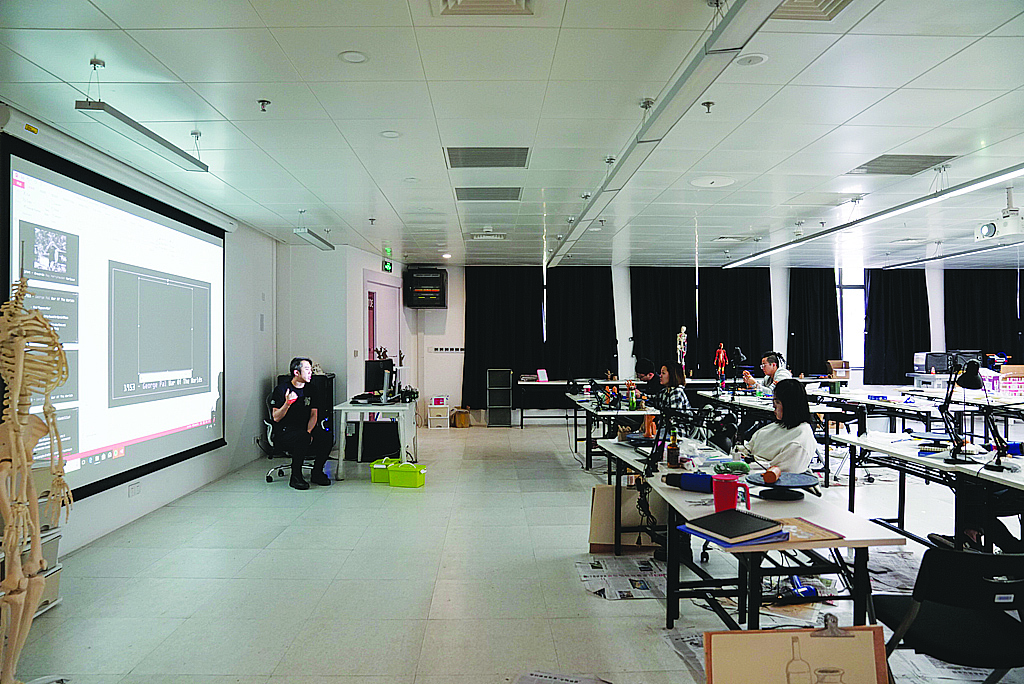
"The reform of film education in China is already in motion. We need to keep in mind that there are growth cycles and evoking positive change in the industry will take time," he said.
"I've been very impressed by some of the school projects produced by SHVFS students. It goes to show that there is a high level of creativity in local talent. I think audiences will be able to see considerable improvements in Chinese films in about five years."
He Qi in Shanghai contributed to this story.