
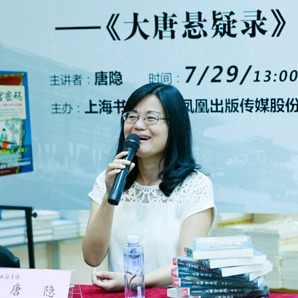



Writer mines the riches of an ancient dynasty








Ten years ago, when Tang Yin was a computer programmer in Shanghai, the TV series Amazing Detective Di Renjie was extremely popular in China.
Tang, a big fan of detective novels such as Judge Dee Mysteries by Robert van Gulik, was fascinated by the TV plays. After watching all of them, she went on an online forum and found that some people were posting fan fiction there.
She was unimpressed by the standard of writing, and after reading all of it, decided to write something herself, she says.
She then quickly completed her first novel. It was so popular online that she continued to write, completing another four novels under the title Amazing Detective Di Renjie. In 18 months she wrote about 1.2 million characters, even as she continued to hold down a regular job.
In writing about Di Renjie, she did a great deal of research about the Tang Dynasty (618-907) period. The more she researched, the more fascinated she became, she says.
It was one of the most prosperous times in China's long history, a highly open society connected by the busy Silk Road with the rest of the known world. The Tang Empire may have had the busiest Silk Road in China's history. It is said that one-tenth of the 1 million people in Chang'an (now Xi'an in Shaanxi province), the then capital, were foreigners, from countries such as Japan in the east and Persia in the west.
Two issues that particularly charmed Tang Yin were the great cultural prosperity and the freedom women had.
"It was a time when the greatest Chinese poets such as Li Bai, Bai Juyi, Du Fu and Li He lived. All of society respected literature and arts."
It was also the dynasty in which women could choose to occupy themselves with matters other than housework, such as becoming the empress or acting as government officials.
After having created Di Renjie and churning out the usual detective novel fare such as the issue of identifying bodies and coming up with plausible alibis, Tang hankered after something else.
"I wanted to create a female detective, and to make the cultural elements the basic framework of the story. To find the answers you have to look for clues in paintings, poems or music."
That was the genesis of Tang Mystery, featuring a beautiful female detective, Pei Xuanjing, who is physically frail but mentally acute.
Pei solved the mysteries in the four books of the series with clues hidden in literature and arts, such as Wang Xizhi's calligraphy masterpiece The Preface to the Orchid Pavilion Poems Collection, and Bai Juyi's poem Everlasting Regret.
In addition, Tang managed to paint such a mysterious picture that readers were left wondering whether the events written of really happened during the Tang Dynasty.
"All the big historical events in the books actually happened more than 1,000 years ago," Tang says. "But in the blanks between that had never been recorded I used my imagination. So I am really happy that many readers are confused about what is fact and what is fiction."
The charming cultural elements have helped make the series one of the best-selling books in China. More than 330,000 copies have been sold in the mainland, and in Taiwan it has gone through its 52nd printing, with more than 500,000 copies sold. The copyright has been sold to South Korea, Thailand and Vietnam.
Tang says that it is exhausting to write detective stories woven with abundant cultural elements.
"It's interesting, but exhausting for both writers and readers."
So after Tang Mystery, Tang says she wants to try to combine ghost stories with detective fiction.
"There were a lot of very interesting ghost stories in the Tang Dynasty. It's interesting to write detective novels like the Japanese Natsuhiko Kyogoku did in his book The Wicked and the Damned."




















