All work and no play







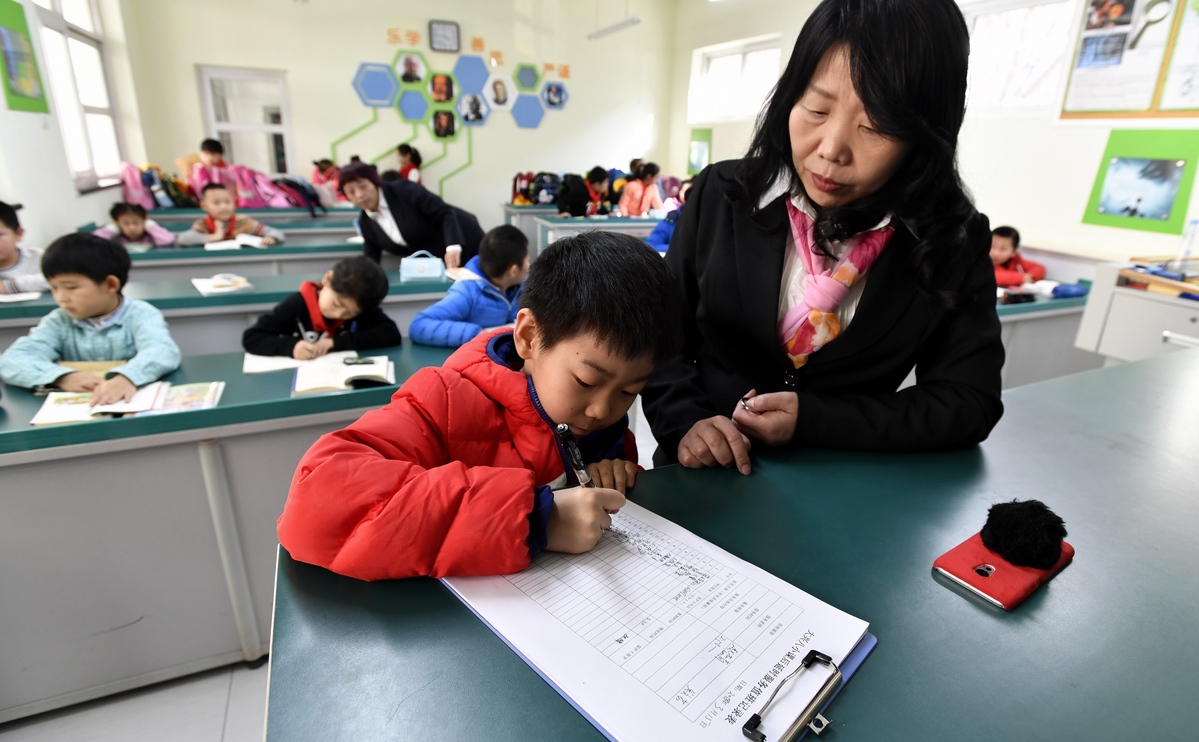
Chinese parents are looking to ramp up extracurricular classes as schools cut back on homework, as Zou Shuo reports.
China's parents are questioning whether the government's recent move to lessen the schoolwork burden on primary and secondary school students can achieve the intended result.
Since the order was issued in late February, parents in big cities have been discussing heatedly whether to let their children have a more relaxed and happy lifestyle, as the education authorities suggested, or to continue to send them to extra classes in their spare time to learn subjects such as mathematics, English and Chinese.
Since the end of February, the Chinese government's decades-old educational reforms have re-entered mainstream public debate. Known as "academic burden reduction", the policies aim to reduce the academic workloads of primary and middle school students.
The new rules prohibit schools from using enrollment tests to evaluate prospective students and taking a child's extracurricular qualifications into consideration during enrollment. They also forbid after-school training institutions from engaging in exam-oriented training or hiring teachers from public schools.
Parents worry that when public schools are reducing the number of homework assignments, making tests easier and reducing the importance of scores, they must step into the vacuum themselves to provide their children with more extracurricular learning to help them stand out from their peers and eventually gain admission to a good university.
Many have written open letters to the Ministry of Education on social media platforms arguing against reducing the schoolwork burden on their children.
Experts said the government's education reforms can better regulate the after-school tutoring market, but only a complete overhaul of China's exam-oriented education system can reduce the excessive burden on pupils.
Xie Wenfeng, the mother of a primary school pupil in Shanghai, said, "Although I really want my son to have more time to play, I have to remind myself to be rational.
"To qualify for admission into a key middle school, my son has to study hard now. Only by entering a key middle school can he study at a key high school and later at a good university. There's no other option."
With public schools reducing school hours and making tests easier, parents in Shanghai are choosing to send their children to much more expensive private schools, she said.
Xie said there is a popular saying in Shanghai that "if students do not go to private middle and high schools, they will end up in a private college".
Almost all good universities in China are public ones.
Her son attends five after-school tutoring classes, one each in painting, English and piano and two in mathematics, and the family spends around 100,000 yuan ($15,900) a year on such classes.
"When it comes to education, every family is a 'rich' family," she said.
Xie Meng, the mother of a fourth-grade pupil in Beijing, shares the same doubts about reducing academic workload.
When the school day ends so early, at 3:30 pm, working parents have no choice but to send their children to after-school tutoring classes, she said.
"It is better to attend tutoring classes after school than sit home and play video games," she said.
Her son is interested in mathematical Olympiads, yet the math classes in schools rarely cover advanced concepts because they are considered too difficult for most students.
Many mathematical Olympiad training classes had been shut down recently, she said, which made it more difficult for her son to develop his skills in that area.
Strong demand from parents has boosted the market for after-school tutoring in China.
In 2016, more than 137 million primary and secondary school students attended extracurricular classes, which had a combined market value of more than 800 billion yuan, according to the Chinese Society of Education, which is overseen by the Ministry of Education.
But many tutors merely focus on teaching pupils how to perform well in exams, rather than aiding the wider educational development of the child, according to a statement issued by the ministry and three other central government departments at the end of February.
"They have brought additional heavy homework for students and have increased financial burdens on families," the statement said.
Reducing the workload on children was also a catchword at this year's two sessions, with many deputies and members calling for less homework for young students.
Wang Guoqing, spokesman for the first session of the 13th National Committee of the Chinese People's Political Consultative Conference, told a news briefing that school students in China spent an average of 2.82 hours doing their homework each day, about three times the global average.
"The government will spare no effort to resolve the heavy workloads of primary and secondary school students," Premier Li Keqiang said on March 5, when he delivered the Government Work Report at the first session of the 13th National People's Congress.
In line with the education authorities' guidelines, two district education bureaus in Hangzhou, Zhejiang province, issued new guidelines for schools that prioritized children's sleeping hours over academic work.
According to the guidelines, primary school pupils in the two districts do not have to complete homework assignments if they have not finished by 9 pm, while the cutoff point is 10 pm for those in middle school.
One area the authorities have pledged to crack down on is tutoring institutions teaching children topics beyond the syllabus and holding competitions on academic subjects.
About 160 after-school training institutions signed an agreement at a China Association for Non-Governmental Education conference in Zhengzhou, Henan province, this month to avoid teaching beyond the syllabus, exam-oriented tutoring, mock exams and competitions on school subjects.
They also agreed to forbid any connections with teachers in public schools and the use of exaggerated advertisements to lure students to tutoring classes. Yu Minhong, president of New Oriental Education and Technology Group, a leading provider of after-school tutoring services, said after-school training institutions are an important supplement to the education system.
You Sen, deputy secretary-general of the Chinese Society of Education, said the guidelines are not aimed at closing all tutoring institutions. Instead, they are intended to increase the threshold for the sector and shut down substandard institutions.
"In the long term, after-school training institutions should only play a supplementary role in China's education system, focusing on offering individualized educational services and promoting students' all-around development," You said.
Xiong Bingqi, deputy director of the 21st Century Education Research Institute in Beijing, said that while tutoring institutions are spending lots of time and energy to provide personalized education to pupils, teachers in public schools are busy handling all kinds of paperwork from the education authorities for evaluations and exams.
That was why the quality of school education was gradually lagging behind that in tutoring institutions, he said, adding that the real solution to reducing pupils' academic workload is to increase the quality of school education.
When the quality of school education was as good as that offered in after-school classes, parents would only need to send their children to tutoring classes when they wanted to develop their artistic or sporting talent.
Chu Zhaohui, a senior researcher at the National Institute of Education, said that although the education authorities had been discussing ways to reduce the burden on children for more than two decades, pupils' workload had, ironically, increased over the years.
"The root cause for the increasing workload is the unbalanced distribution of education resources among different schools, forcing parents to do everything they can to send their children to better schools," Chu said.
Almost every district has "superschools" that have the best educational resources and are supported and promoted by local authorities looking to burnish their achievements, he said.
Xiong said parents are not opposed to reducing the academic workload on their children.
"However, they also know that as long as the university entrance exam is the only way for students to get admitted, they have to force their kids to put all efforts into studying," he said.
In the absence of a social safety net, education remains the key means by which most families hope to enrich a younger generation, he added.





- China narrows US' scientific research lead
- HKSAR govt urges residents to vote, eyes post-fire recovery
- Students forgo vacations to prep for overseas universities
- Xi, Macron vow to deepen relations
- Ten photos from across China: Nov 28 - Dec 4
- Intl students showcasing global business acumen in Shanghai