Finding opportunities to flourish







Nobel-winning economist Edmund Phelps says the key to innovation is people with vitality
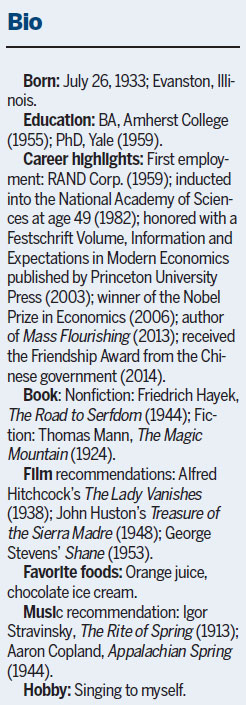
In his 2013 book Mass Flourishing, Nobel Prize-winning economist Edmund Phelps says the key to an economy that's modern enough to be innovative is a people who have the desire and opportunity to build lives based on personal accomplishment. He argues that Aristotle's concept of what constitutes a good life, usually translated as "happiness," should actually be translated as "flourishing".
At the heart of flourishing is "engagement, meeting challenges, self-expression, and personal growth", Phelps writes. "Receiving income may lead to flourishing but is not itself a form of flourishing. A person's flourishing comes from the experience of the new: new situations, new problems, new insights, and new ideas to develop and share."

Phelps, an economics professor and director of the Center on Capitalism and Society at Columbia University in New York, tells China Daily, "Having an interesting time at work, challenges, puzzles to solve, opportunities to succeed - succeeding at something is so important."
Phelps' ideas on how to encourage innovation and entrepreneurship have struck a chord in China. Mass Flourishing has sold 10 times as many copies in China as in Phelps' native United States.
He says he is grateful for the opportunity to have met several times with Premier Li Keqiang to discuss the book. "Li said he read the original in English and also the Chinese version when it came out later. I had the good fortune of sitting next to Premier Li at a dinner meeting of the State Administration of Foreign Experts Affairs in 2014, and we had a very nice conversation about a range of things. I was hugely impressed by him. I was glad that he got to know me a little more and see the intellectual background of my passion for innovation and my recommendation to China that it be much more broadly innovative down to the grassroots," Phelps says.
He says the innovative technologies that transformed the world in the 19th and early 20th centuries were made possible because many people had opportunities to flourish. The change was not driven just by changes in institutions, but by changes in average people's philosophy of what makes a good life.
"Really, I am talking about culture. I say in the preface that freedom is not sufficient. Sure, individuals have to have some degree of freedom; otherwise all their abilities and urges and ambitions will come to naught. The trouble in the United States is that, until the recent wave of regulation, there was still a lot of business freedom, but the interest in innovation seemed to wane - outside of Silicon Valley, perhaps," he says.
He worries that the West since around 1970 has lost its flourishing character. "I think that in the US we have a population now that is kind of lacking mojo, pizazz. I've been speaking lately about a people with a lot of vitality. You don't see a lot of that in Western Europe. You don't see nearly as much of it as was present in the United States in the 19th century and a good deal of the 20th century," Phelps says. He adds that the rate of innovation in the US has declined since 1970. There was a brief blip upward in Silicon Valley, but that has largely been replaced by large, monopolistic companies.
Asked what governments could do to promote flourishing, Phelps emphasizes that a flourishing economy depends on having a vital people. "That takes us back to education. What I'm calling for is instruction in the good life, beginning with kindergarten. Learn to be adventurous, to be an explorer, to embrace the unknown, to have a thrill from uncertainty. We have to get back to an educational curriculum that teaches the humanities and goes back to the sagas of ancient times, Greece, Rome, the Renaissance, the age of creating and discovering," he says.
"It seems to me that the Chinese have a lot of that vitality. But even though the Chinese have all that vitality, are they familiar with the literature of adventure, of exploration? They should take some inspiration from the past, wherever they can find it."
In a 2016 interview with CNBC at the Boao Forum for Asia, Phelps said China's reforms are headed in the right direction. "I don't want to put a stamp of approval on every single thing that they're trying to do, but I think generally they understand the big point, which is that there's tremendous overcapacity in the traditional industries," he says. "What investment there's going to be in the future is going to be in a different set of industries."
He tells China Daily, "One of the things I called attention to in my talk at the recent SAFEA meeting presided over by Premier Li, was the importance of allowing new entrants to come into an industry, even if that will cause excess capacity. It is important to let the weak ones that can't cut the mustard, the ones that are not profitable, to allow them to be pushed out. I think this is huge. We are having a similar problem in the West now."
He says he was favorably impressed by the speech at this year's World Economic Forum in Davos, Switzerland, by Liu He, a member of the Political Bureau of the Communist Party of China Central Committee and top economic adviser to President Xi Jinping.
Phelps, noting that productivity growth began rising in 2016, says: "The data are on the side of allowing competition to occur and making companies compete in order to stay in the game. The point is, and it is made clearly in this (WEF) presentation, that if you have more competition, that will lead to more exercise of entrepreneurship. As (renowned economist Friedrich) Hayek would say, companies should be free to use their insights into what new possibilities have arisen as the result of changes in the world. The presentation to the WEF mentions innovation as well as entrepreneurship."
In a 2009 paper, Phelps argued that a significant cause of the 2008 global financial collapse was that US banks focused on mortgage and consumer lending. "(The banks) long lacked expertise to embark on a big program of lending to the business sector.... They directed it into mortgages."
Asked whether China should copy the US financial system, Phelps responds, "You should pass the word that they should think twice about that."
Phelps has been a frequent visitor to China, making around four trips per year in recent years. From 2010 to 2016, he was dean of the New Huadu Business School at Minjiang University in Fuzhou, Fujian province. He received the Chinese government's Friendship Award from Premier Li in 2014.
"China intrigues me. Because it is yet another laboratory for economic development. I think it is so exciting and so interesting. And that's not something we have in front of us in the West," he says.
davidblair@chinadaily.com.cn