Subsidy cut to cool solar sector







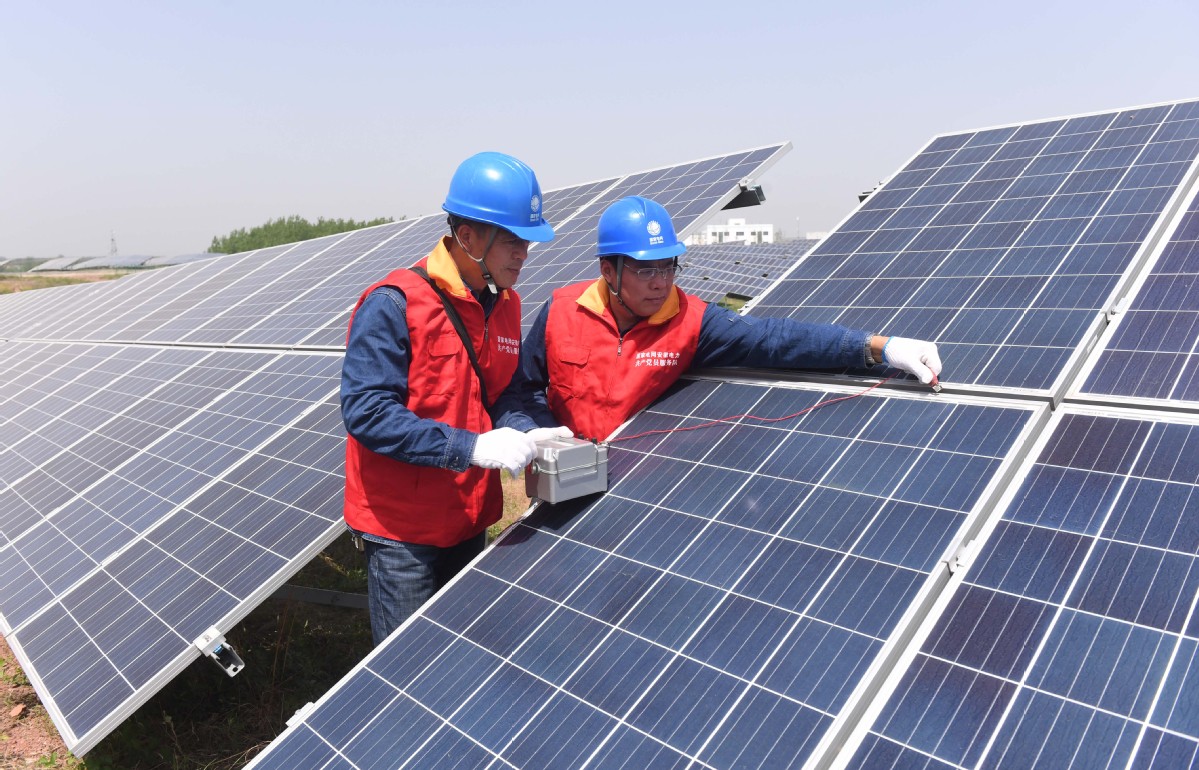
Policy will ensure cheaper electricity prices, industry's sustainable development, analysts believe
New rules to reduce national feed-in tariffs for the photovoltaic industry will stabilize China's rapidly growing and overheating solar power sector, and make electricity cheaper for consumers in the long term, according to analysts.
"In the short term, the upcoming one or two years, the impact could be negative for manufacturers with lower margins," said Joseph Jacobelli, a senior analyst of Asian utilities at Bloomberg. "But the bigger developers like China Longyuan Power, Huaneng Renewables and others who still have returns from existing assets are likely to fare better in the long term, given their nationwide footprint and capacity to win bids for new capacity."
The big developers can also acquire wind and solar farms from their parents, he added.
On June 1, the National Development and Reform Commission, the Ministry of Finance and the National Energy Administration announced a cut in the national feed-in tariff by 0.05 yuan (0.8 US cents) per kilowatt-hour, as well a reduction of the same amount in subsidies for power generated by distributed photovoltaic projects.
On-grid power tariffs now range from 0.5 yuan to 0.7 yuan per kWh. There will be no change to the subsidies for county-level poverty alleviation photovoltaic projects.
Insiders said the policy is the most austere in recent years.
The sudden shift of policy, which has sent solar stocks into free fall, has drawn protest from Chinese solar firms, saying the new rules came far too soon and might damage a sector that has racked up huge debts.
Executives from 11 Chinese solar firms protested in a letter sent to Xinhua News Agency. They said the sector still needs another three to five years of government backing to be able to compete with traditional power generators, and suggest a delay on the surprise subsidy cuts and a relaxation of the cap on new projects.
China's National Energy Administration, in response, met solar industry representatives on June 6. It said the new policy is designed to encourage the more sustainable and efficient development of the sector. The administration promised it will speed up the launch of a quota system obliging regions to buy more renewable power.
According to the China Photovoltaic Industry Association, while the sector's growth momentum might not be sustained, photovoltaic power will remain a key force in the nation's energy revolution and will still receive State support.
By the end of 2020, renewable energy will supply 1.9 trillion kWh of electricity, 27 percent of total power generation nationwide, according to the government's 2016-20 plan for renewable energy.
Lin Boqiang, director of the China Center for Energy Economics Research at Xiamen University, said the policy will ensure cheaper electricity prices for consumers. The cost of photovoltaic equipment has declined in recent years, which makes it reasonable for the subsidy to be lowered, and the feed-in tariff is not sustainable in the long term, he said.
"As the government vows to lower the electricity price in 2018 by 10 percent, the photovoltaic subsidies must be scaled back," Lin added.
He said the surplus capacity in the domestic photovoltaic market will encourage upstream firms in the sector to seek more overseas opportunities, especially in markets in Africa and countries and regions participating in the Belt and Road Initiative.
Five days after the government announced plans to cut the subsidies, JinkoSolar Holding Co Ltd, the world's biggest solar panel producer by shipments, signed a three-year agreement to supply 1.43 gigawatts of high-efficiency modules to sPower, a United States-based independent renewable energy producer. JinkoSolar had supplied over 800 megawatts, approximately 2.5 million solar panels, for sPower's photovoltaic projects earlier.
To optimize the pace of solar plant construction, China will add just 30 GW of capacity this year, compared with the record 53 GW last year, according to the National Development and Reform Commission. New solar plants that require subsidies will not be approved, while smaller-scale "distributed generation" on rooftops will also be capped at 10 GW, half of last year's rate, it said.