Panda protection creates billions of dollars








The giant panda is both the most iconic animal native to China and a powerful symbol for the conservation of wildlife around the world – but the protection of the species continues to generate controversy.
Some zoologists and journalists argue that the millions spent each year to conserve the vulnerable bear is a waste, partly because the creature’s highly selective feeding and breeding habits make it so challenging to protect.
British naturalist Chris Packham infamously once said the panda had “gone down an evolutionary cul-de-sac” and that conservationists should “pull the plug and let them go”.
But new research by a team of scientists from China, Britain, the United States, and Australia posits that panda protection efforts produce a significant return on investment.
The study, which was published in the journal Current Biology, estimates that the value generated by panda reserves in China adds up to between $2.6 billion and $6.9 billion a year, or roughly 10 to 27 times the cost of maintaining the reserves.
“Many detractors have argued that spending valuable resources on panda conservation is wasteful,” said lead author of the study Wei Fuwen of the Chinese Academy of Sciences. “Our analysis contradicts this view and demonstrates clearly the great value of the panda, both for its cultural and intrinsic value, and for the ecosystem services provided by panda reserves.”
The study was conducted by researchers from the Chinese Academy of Sciences in China, the Australian National University and James Cook University in Australia, the University of Pittsburgh and San Diego Zoo in the US, and Cardiff University in the United Kingdom.
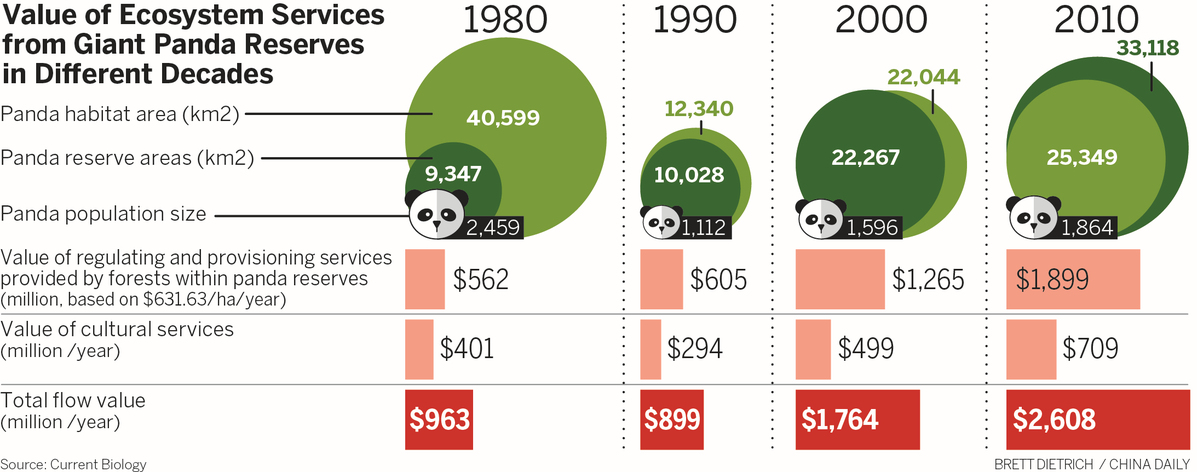
The researchers looked at a range of variables before coming up with their estimates, including carbon storage and the production of resources.
Giant panda reserves offer a variety of ecosystem services that are valued by local people, according to Wei. The reserves are used to grow crops, graze animals, procure water supplies, and harvest firewood.
The reserves play a role in the management of water runoff, retention of sediments and nutrients, and in carbon sequestration. The research also factored in the cultural value of the panda.
“Now, we know that the system of reserves and protections are working to reverse the panda’s decline and that these efforts have benefits for society and nature at large,” Wei said.
Charlotte MacDonald, director of conservation and living collections at the Royal Zoological Society of Scotland, did not take part in the study but noted that the panda is an “umbrella species” and panda reserves provide protection for other animal and plant life.
“Giant pandas are in many ways also a flagship for conservation,” MacDonald said. “Safeguarding their habitats also helps to protect many other animals they live alongside.”
China has stepped up efforts in panda conservation since a survey 28 years ago showed a steep fall in the panda population and a dramatic loss of habitat.
A national panda survey in 1990 showed the panda population had more than halved during a 10-year period, dropping to 1,112 individuals. Panda habitat had also sharply decreased, by two-thirds to 12,340 square kilometers.
Since then, the government has protected 33,118 square kilometers of panda reserve and panda numbers have rebounded, to 1,864 individuals.
In 2016, the International Union for Conservation of Nature downgraded the panda from “endangered” to “vulnerable”on the global list of species at risk of extinction.






- Five members of northern Myanmar telecom fraud syndicate sentenced to death
- Shenzhou XX crew to return to Earth on Nov 5
- Former deputy chief of China's State Tobacco Monopoly Administration indicted for graft
- Xi meets Russian PM in Beijing
- Xi extends condolences to Jamaica governor-general over heavy hurricane losses
- Chinese medical team performs remote 5G robotic eye surgery over 4,000 km away