Border clinic at forefront of HIV/AIDS fight







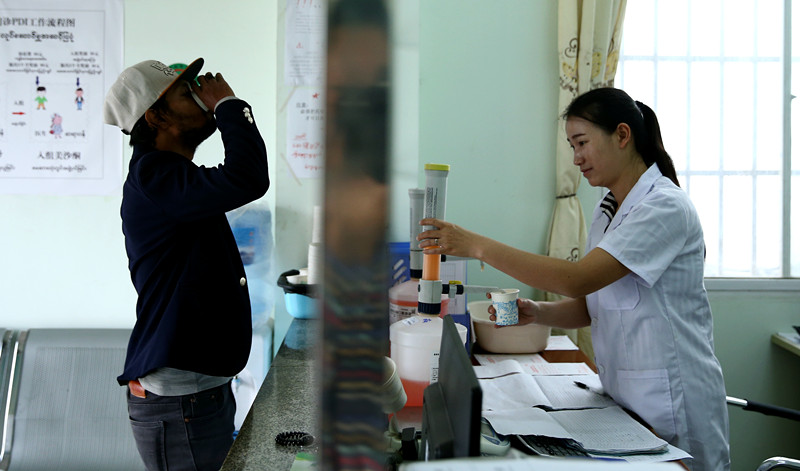
Apart from free drugs, the patients are given follow-up checks, including CD4 tests for immunity levels and viral load, which measure the effectiveness of the treatment, all funded by the Chinese government.
Yi Keke, from a village in Namhsan, Shan State, said, "The free treatment helps me settle down here and move on with life."
The 36-year-old looks like a Chinese except for the white Thanakha powder on her cheeks - a plant-based cosmetic popular with women in Myanmar to make the skin smooth and cool.
She lives with her Chinese husband and 6-year-old son in Ruili. The couple began treatment at the clinic when they were diagnosed with HIV/AIDS three years ago.
Every three months, Yi, who now works at a local restaurant, comes to the clinic for a new supply of drugs and a medical check-up. "I am doing well with the drugs, except for occasional insomnia," she said. The couple now makes about 2,000 yuan ($300) a month, with 400 yuan spent on rent.
Ten years ago, she left her hometown for Ruili to seek better employment. Back home, she was employed as a farm worker and made less than 10 yuan a day.
There were many more job opportunities back then with fewer immigrants from Myanmar, she said.
In Ruili, she has only a handful of friends, and Zhang Lin is one of them.
"Lin is nice to me and helped me through the tough early days when I first began the treatment," she said.
Every time she receives a new supply of drugs, Yi says she places them in a black plastic bag so that others cannot see them. She also said she hid her HIV status from others, even friends from her hometown.
Zhang said that in recent years more young women from Myanmar, especially from poor regions with frequent violence, have married Chinese and moved to Ruili.
Since the late 1990s, Ruili, a major crossing point between China and Myanmar that has prospered with cross-border trade, has attracted a rising number of nationals from Myanmar for business and job opportunities.
The county-level city in Dehong prefecture, Yunnan, has 200,000 residents, with 50,000 from Myanmar, according to Li Zhoulin, a researcher at the Center for Disease Control and Prevention in Ruili.
Due to the lack of a sound intervention system, HIV/AIDS is spreading in Myanmar, and only a small proportion of those infected are aware of their status, according to the World Health Organization.
The country has a population of more than 54 million and 230,000 have HIV/AIDS.
In recent years, Li said that an average of more than 300 HIV/AIDS cases have been detected annually in Ruili, and nearly 80 percent involve Myanmar nationals who live there or who frequently cross the border for work and trade.
To curb the disease, action must be taken regardless of the patients' nationalities, Li said.
In 2012, the local health authority began offering free HIV/AIDS intervention, treatment and follow-up services, particularly for those from Myanmar vulnerable to the disease such as intravenous drug users, long-haul cross-border truck drivers and illegal sex workers.
Initially, the free treatment was only for the spouses of local Chinese, such as Yi Kenken, but was later extended to Myanmar nationals in Ruili who could present residence and employment permits.
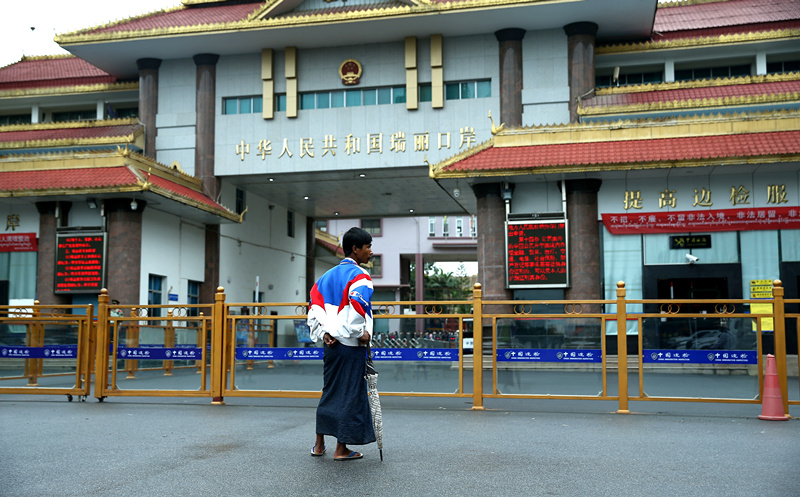
Close to the opium producing areas of the Golden Triangle countries of Myanmar, Thailand and Laos, and major drug trafficking routes, Ruili's initial HIV cases in the late 1980s were among intravenous drug users.
As China stepped up the fight against drugs, scaling up methadone maintenance treatment and needle exchanges among intravenous drug users, HIV/AIDS cases related to drug injections dropped substantially in Ruili.
For HIV prevention, intravenous drug users from Myanmar in Ruili were also covered as Chinese citizens under a program largely subsidized by the government.
At the methadone outlet at the Better Clinic, Suo Mei, 26, has arrived every morning for the past three years to take 70 milliliters of the pink liquid under the supervision of doctors.
At a cost of 3 yuan a day, this has helped prevent Suo, who is from Myanmar, from injecting himself with drugs, and from potential HIV infection. After one visit, Suo, wearing jeans and a white baseball cap, rode his motorcycle to his workplace, a jade trade center several blocks from the clinic.
He now lives with his wife in Ruili. "Life is OK and under control," he said.
However, several kilometers away at the border waiting area, a long-haul truck driver from Myanmar in his early 20s was overwhelmed after testing positive for HIV, and realizing he now faces huge uncertainty.
He turned pale, sweat glistening on his forehead.
"Please don't let my mom know. She's outside waiting for me," he told a nurse at the Better Clinic who helps with information and counseling for those who test positive.
Long-haul truck drivers from Myanmar entering China undergo HIV tests under an anti-AIDS partnership between the two countries.
Those diagnosed with HIV/AIDS are referred for treatment said the nurse, adding that most became infected after paying for sex.
Apart from the screening, the clinic provides them with safe sex education and HIV prevention information, she said.
Li Zhoulin, a researcher at the Ruili Center for Disease Control and Prevention, said, "In many cases, the interventions and treatment for those at high risk, or the patients, work as a preventive measure for other people, too."
The measures taken in Ruili have been extended to other border towns, counties and prefectures in the province, including Longchuan, Mangshi and Xishuangbanna, said Jia Manhong, assistant director of the Yunnan Center for Disease Control and Prevention.


- China halts port fees on US vessels for one year
- China moves to cut teachers' administrative workload
- China launches group of internet satellites into orbit
- Former senior official expelled from CPC for serious violations
- Senior political adviser Yang Xiaowei expelled from Party, public office
- Former senior political adviser expelled, dismissed for legal violations