Eurasia Canal can link Black, Caspian seas







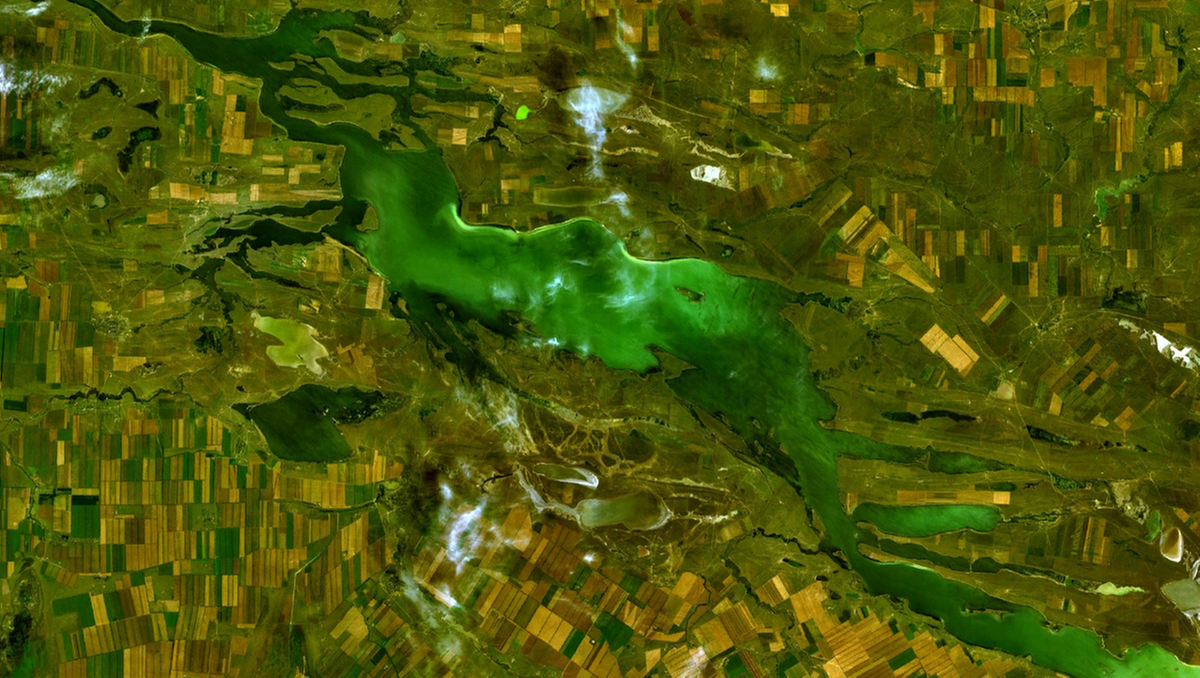
The fifth summit of the Caspian states will be held Aug 12, 2018, in Aktau, a Kazakh city on the shores of the Caspian Sea. As expected, leaders of the Caspian littoral states – Russia, Kazakhstan, Iran, Azerbaijan and Turkmenistan – will sign the convention on the legal status of the Caspian Sea. The Caspian states have discussed the status of this reservoir for more than 25 years. The definition of the legal status of the Caspian Sea will open new opportunities for cooperation, especially in the implementation of transport and communication projects, including the Eurasia Canal.
President of Kazakhstan Nursultan Nazarbayev announced the possibility of building a shipping channel between the Black and Caspian seas at the summit of the countries of the Eurasian Economic Union (EAEU) in Sochi on May 14, 2018. The idea is not new and, as Nazarbayev himself put it: "It was voiced even under the tsar". So, what is the expression of the solidarity of the president of Kazakhstan and the Russian tsars of past centuries? The answer, in general, lies on the surface: No one has canceled geopolitical and economic claims of different states, especially in modern, sometimes very complex, political realities. But in order to understand the issue in detail, I propose a review of its history.
Nazarbayev declared for the first time, scale and in the conditions of integration of the EAEU countries, about the construction of the channel 11 years ago, in 2007. And it is very symbolic that it was precisely the same year that the need to expand waterways in Russian territory was declared by the president of this country, Vladimir Putin, suggesting, as an option, modernization in the way of the Volgodonsk Canal. But the waterway offered by Nazarbayev, for example, is 1,000 kilometers shorter than what the Russians offered, and the Eurasia Canal is able to skip much more cargo than the Russian one -- up to 45 million tons per year. But the benefit is not only in the duration of the journey, although in business even this fact would play a significant role. Economic issues are not always a priority when big politics come into play. But the Russia of 2018 is not the same country as it was 11 years ago. So world experts agree that now seems to be the time for Nazarbayev’s sound idea.
The president of Kazakhstan is a great pragmatist and this statement cannot be refuted, for it is not necessary to go far for examples. Nazarbayev spoke for the first time about creating a single economic space in 1994. Twenty-four years later, the trade agreement with the EAEU was signed by Iran, the partnership agreement was signed by Kyrgyzstan, and Moldova, Uzbekistan and Tajikistan are among candidates for entry into the economic union. In January to February, the volume of trade within the EAEU rose to $8.6 billion, which is 14.4 percent more than in the same period in 2017.
However, Nazarbayev's new-old initiative to build the Eurasia Canal can be considered as another push for development of the EAEU. Nazarbayev said: “The infrastructure of the EAEU should become a good bridge between Asia and Europe, the East and West, the Pacific and Atlantic oceans.” Of course, for Kazakhstan this project is simply necessary. Given the export conditions for hydrocarbons and the fact that now almost 70 percent of Kazakh raw materials are transported through Russia, a new transport route will reduce the time and costs for transportation. To compare, Astana is currently transporting oil to Black Sea ports through the Caspian Pipeline Consortium (CPC), but first it is necessary to bring it to the CPC by tankers.
Kazakh media have already calculated that if the new canal does appear, it will be able to receive ships with a carrying capacity of up to 8,000 to 10,000 tons. But the benefits are not only for Kazakhstan, but for all Caspian states. The construction of the canal will give impetus to the development of related industries in construction and shipbuilding, allowing hundreds of people to get a job. This is a standard and quite predictable economic effect, but not the only positive impact of the project. The new Eurasian sea route will also become an outlet to the sea for all countries of Central Asia through Russia, which will receive payment for the use of its segment on the way. So for this country, the proposed project is of political rather than an economic nature, and this is recognized by Russian experts. A new waterway will be able to strengthen the image of the EAEU, including Moscow.
Sergei Markov, the well-known Russian political scientist, writes that the driving force for starting construction of the canal is the desire to revive the Eurasian Economic Union. On April 10, 2018, at the Boao Asian Forum in Hainan, President Xi Jinping and Prime Minister of Pakistan Shahid Hakan Abbasi agreed to continue construction of the China-Pakistan Economic Corridor. This is an infrastructure project worth $46 billion, with funds invested by China. Within the framework of the project, it plans to connect the Pakistani southwestern port city of Gwadar with the Chinese Xinjiang Uygur autonomous region through a wide network of roads and railways. That is, if Kazakhstan does not offer a more advantageous alternative, Chinese goods can go another way, bypassing the countries of the EAEU, and this is the missed millionth profit.
It is no coincidence that at the summit held in Sochi, Nazarbayev invited his colleagues to think about the construction of a Eurasian high-speed highway, which would connect Europe and Asia via Russia and Kazakhstan. So the transport artery proposed by Astana is also a new opportunity and a way of export for Chinese producers. For comparison, the current average time to supply Chinese goods to Europe is two months. With the advent of a new route, this period will be reduced to 10 days. According to experts, the new canal will be pay off after 10 years, a very acceptable period for such a large-scale construction.
When analysts, economists and political scientists studied Nazarbayev's idea of building a Eurasia Canal 11 years ago, they stated it could change the geopolitical situation of the Caspian countries, turning them into countries with access to the sea. This prospect seems to justify the scope of work and the financial costs of the facilities. And if problems can arise, then only from the environmental point of view, but, and without a doubt, it will be carefully studied, since leaders of the Caspian states are more interested than other countries in preserving the ecological balance and natural microclimate within their borders.
The author is an observer of Central Asian affairs based in Beijing.
The views do not necessarily reflect those of China Daily and chinadaily.com.cn.