US and allies can't exclude China from world trade







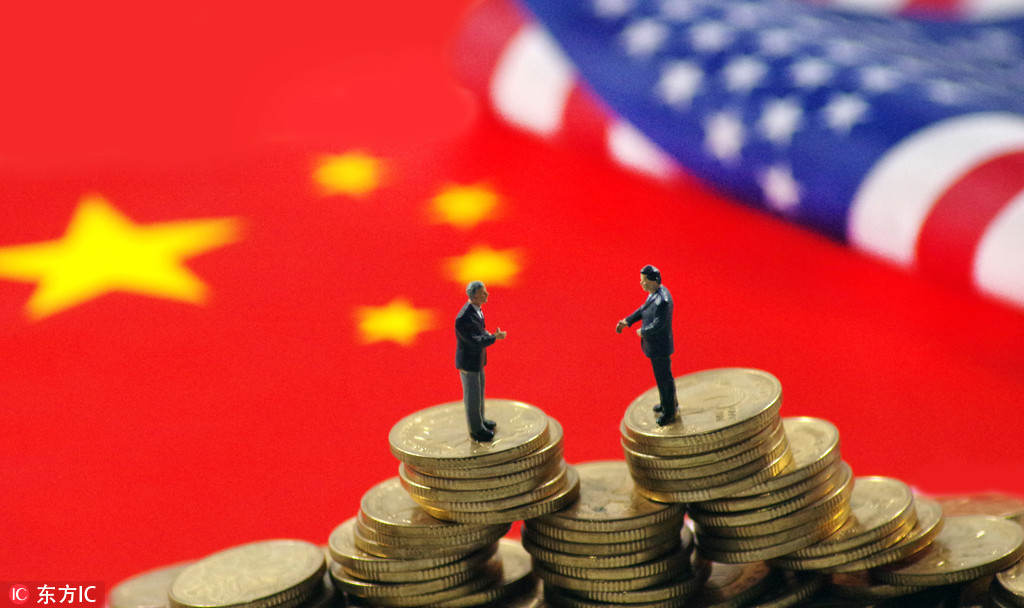
The tariff war the United States initiated with China has been continuously escalated by the Trump administration.
On Aug 2, the US government threatened to raise the previously proposed tariffs on $200 billion worth of imports from China from 10 percent to 25 percent. It had already slapped 25 percent tariffs on Chinese goods worth $34 billion, and 25 percent tariffs on $16 billion worth of Chinese imports are expected to take effect soon.
While ratcheting up the pressure on China, US President Donald Trump has also talked with President of the European Commission Jean-Claude Juncker and they reached a consensus on suspending the tariff exchanges between the US and the European Union and agreed to lower trade barriers between the two sides through negotiations. And earlier, the EU and Japan signed their Economic Partnership Agreement, according to which the two sides will exempt nearly 99 percent tariffs on imports from each other.
These moves have created the illusion that China has been excluded from a reshuffling of global trade relations by an alliance of developed countries.
But the fact is, even if the three parties reached a zero-tariff accord, which would be hard to come by, it would not constitute a substantial threat to China.
To begin with, the US-EU consensus on striving for zero tariffs, zero barriers and zero subsidies is more symbolic than practical. Their joint statement indicates the EU has only promised to lower barriers to US soybean imports, not agricultural goods as a whole, as some US officials pronounced in a manifestation of their own wishful thinking. It is almost impossible for the EU, which imported $1.6 billion worth of US soybeans last year, to fill the vacancy left by China, which bought $14 billion worth of US soybeans in 2017.
EU officials have clearly said the EU's imports of US soybeans will finally be decided by the market, which means the promise of increasing imports of soybeans from the US is more of diplomatic protocol rather than a realistic means of meeting the US' need to fill the gap left by China.
And when it comes to the EU's imports of liquid natural gas from the US, the wording of the joint statement does not exclude Germany, France and the other European countries from importing LNG from the much closer Russia.
French President Emmanuel Macron has clearly opposed negotiations on a new or upgraded large-scale trade agreement with the US, which will unavoidably affect agricultural trade, which is strictly protected in many European countries.
Second, the overlapping industrial structure and export superiorities of the US, the EU and Japan mean the zero tariffs will be of limited value to boost the marginal increase of the trade among them.
Machinery equipment, automobiles and the other transportation equipment accounted for about 40 percent of the exports of the US and the EU, and nearly 60 percent of Japan's exports between 2012 and 2016. The three parties, all holding the upper link in the industrial and value chains, do not need each other's main export products and goods as much as developing countries do. Moreover, their tariff rates in these fields were already low. So it is unrealistic to expect a marked increase in trade through exempting tariffs.
Last but not least, they are similar in their reliance on imports from China and the Chinese market. And they cannot find a trade partner to replace China's role. Last year, 17.4 percent of US imports were from China; 24.5 percent of Japan's imports were from China, and 19 percent of its exports went to China; 20.2 percent of the EU's imports were from China, and 10.5 percent of its exports went to China.
If they really aim to join hands to isolate China from the international trade system, they must find another market to consume their hundreds of billions dollars' exports and new sources for an even larger scale of imports. None of Brazil, India, Indonesia, and Vietnam can match China in terms of labor productivity, market demand and savings rate at the same time. Last year, India's trade volume was only 18.2 percent that of China, Vietnam's was 10.4 percent, Brazil's 9 percent and Indonesia's 8 percent.
With a population of about 1.4 billion and an annual per capita GDP of less than $9,000, China is the largest growth market and the upgrading of its production and consumption harbors great growth potential and opportunities for the world, particularly the developed economies. Only armchair strategists will urge China be isolated from the global trade system.
The author is a researcher of world economy and politics at the Chinese Academy of Social Sciences. The article was first published by Guangming Daily on Aug 4.