Traditional Chinese medicine as a bridge to BRI







Five years have passed since the Belt and Road Initiative (BRI) was first proposed by Chinese President Xi Jinping. The idea of opening up and joining multiple countries in a giant trading network with the goal of boosting a new world economic growth by building infrastructure, stimulating investment and consumption and creating new jobs, benefiting its partners in win-win cooperation seemed too ambitious to achieve, almost utopic.
About 90 countries and organizations have joined the program, which together account for more than one-third of global GDP and about 65 percent of the world's population. In the past five years, China signed over 100 deals worth more than $5 trillion in a wide range of areas under the initiative and trade volume with countries participating in the BRI.
China’s investment in the least developed countries, such as Bangladesh, Myanmar, Nepal and Ethiopia has provided opportunities to improve their infrastructure and connectivity, enhancing their economy through a more active role in global trade. Willing to work with all governments, BRI also includes participants involved in active conflicts, such as Syria, Somalia and Yemen, countries that would have difficulty in securing financial resources without strict requirements. In addition to infrastructure, these countries have also been benefiting from BRI with education, science, technology and innovation transfer, which might help them to develop and prosper on their own.
Thanks to the Belt and Road Initiative, traditional Chinese medicine (TCM) has gained increasing international acceptance and recognition. On May 28, the State Administration of Traditional Chinese Medicine of China disclosed on its website 57 TCM international cooperation projects for the year 2018, which are for the implementation of the TCM Belt and Road Development Plan (2016-2020). These projects include TCM centers in the United Arab Emirates, Germany, Poland and France.
In Hospitalet, a municipality near Barcelona, Spain, the European TCM Development and Promotion Center, a signature project under the BRI, will include a TCM clinic health management center, an education and training center and a service trade center. It also includes a master's degree program undertaken by the Beijing University of TCM, University of Barcelona and Universitat of Pompeu Fabra, as well as a TCM diagnosis and treatment center at Clinical Hospital of Barcelona.
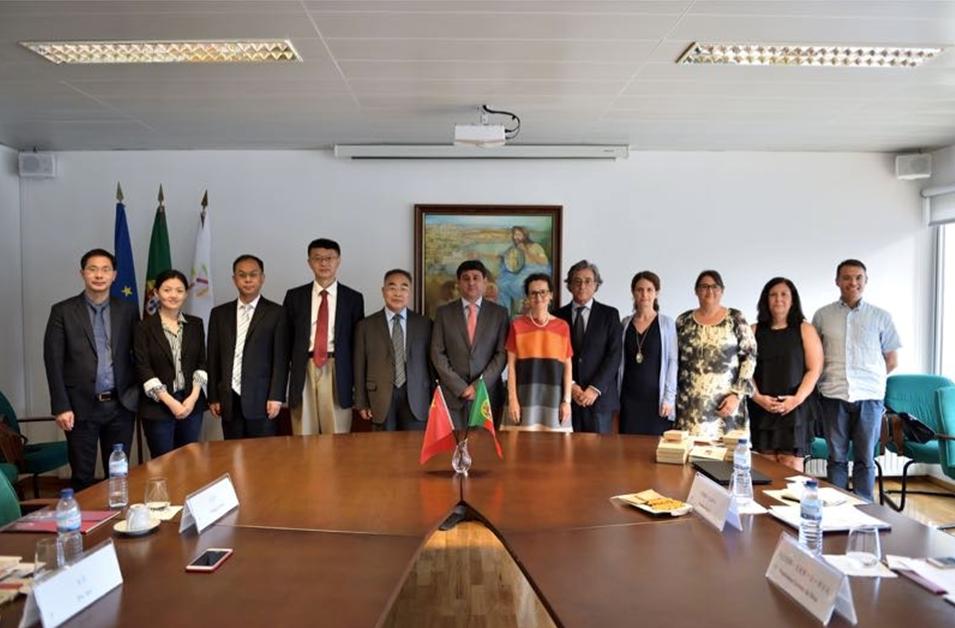
But more than just a project, Portugal went even further and, in 2013, approved laws that allowed the country to be the first in Europe to open a four-year bachelor's degree program in acupuncture in the year 2017, at a public higher education institution, the Polytechnic Institute of Setubal (IPS). IPS recently signed a double degree agreement with Tianjin University of TCM that will allow its students to study an extra year in Tianjin and obtain the Chinese bachelor's degree. Academician Zhang Boli, dean of Tianjin University of TCM and president of the Chinese Academy of Chinese Medical Sciences, led a delegation of distinguished professors and researchers who visited several academic institutions in Portugal, including IPS and the biggest university in the country, Universidade de Lisboa. The group was also received at Setubal City Hall by the mayor, Maria das Dores Meira.
Earlier this year, the Portuguese government approved another law that will allow TCM bachelor's degree courses in the future, opening the path for other European countries to do the same, which will create conditions to better understand the culture and establish a bridge with China.
The numbers confirm that the BRI is growing quite rapidly both in Asian and African countries, especially with the help of the Asian Infrastructure Investment Bank. And despite that its equivalent in Europe seems to be going slower, the growth of Chinese medicine culture on the Iberian Peninsula might help the process of the China-Europe cultural approach, providing an environment that might allow the creation of a global momentum for Euroasian economic exchange and integration.
Diogo Calado is a researcher and lecturer in Chinese medicine and a PhD candidate in Chinese internal medicine at Tianjin University of Traditional Chinese Medicine.
The opinions expressed here are those of the writer and do not represent the views of China Daily and China Daily website.