Fruit king profits from agritech







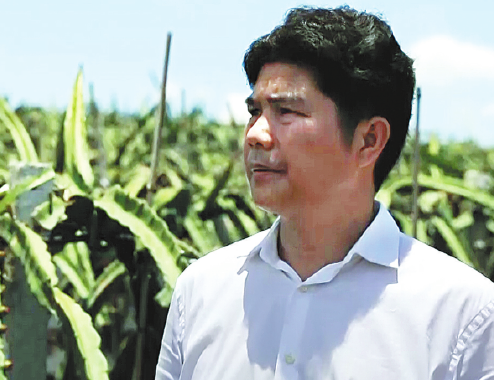
Lu Yizhen, founder of Guangxi Jinsui Agriculture, shows that persistence, faith are the key to success
Lu Yizhen grins shyly when fellow villagers call him the "Banana King", although he has had the nickname for many years in his hometown in South China's Guangxi Zhuang autonomous region.
Gesturing toward almost endless fields of banana trees in Natong township, Long'an county, Lu said he often has visitors who come to learn about his success in growing the tropical fruit.
"Look! Here is my orchard, every plant you see is mine, and those far from here, which you can't see, are also mine," Lu said, pointing toward the fields spanning 866 hectares.
Born in a small village, the 49-year-old Lu is the founder of Guangxi Jinsui Agriculture Co Ltd, a leader in corporatized and mechanized agriculture. He barely finished junior middle school. "I collected rags and sold popsicles to earn small change. Life was harsh when I was young.
"It was the 1980s, the early years of the reform and opening-up. The local government encouraged farmers to grow sugarcane. I saved 50 yuan ($7.3), a large sum then, and borrowed some more money from my relatives to lease land and grow the plants. The first year, I lost 10,000 yuan. At that time, it was equivalent to some $1,200," he said.
Most people in his hometown were poor. "I had not made much money before I made such a big loss. My parents were so angry, they called me a disgrace," he said.
Lu did not give up. He started to study the necessary farming technology and made himself familiar with fertilizers and pesticides.
In his words, trusting his gut and not fearing losses were the keys to his success in the early days. By 1994, after six years in the business, Lu had earned 100,000 yuan and spent a good part of it on a jeep, which was still a rarity in Chinese towns at the time.
Lu's story represents a generation of bold, daring, and insightful farmers, contractors, and entrepreneurs who benefitted from the reform and opening-up policies.
China is marking the 40th anniversary of the implementation of reform and opening-up policies this year.
Lu knows boldness can only get him so far. "One needs technology, the right talent, and some vision to achieve something bigger," he said.
He founded a company in 1996 and was determined to pursue modern agriculture powered by technology and at a certain scale, rather than fragmented fields.
As China's land policy grew quite inclusive in the 1990s, Lu took lead to launch a model that encompassed the company, the base, the cooperative society and the farmers in his hometown. That model helped break the limitations imposed by the household contract system. He was then regarded as a pioneer of rural agricultural corporations.
Over the years, Lu continuously expanded his fields through rural land transfer and shifted his focus from sugarcane to bananas. In 2005, he registered a banana trademark for promotion.
"My fame as the Banana King did not come easy. I don't rely on heaven or earth, but only on technology to succeed," he said.
In 2004, Lu lost millions of yuan after a typhoon leveled his banana trees. After that, he adjusted the planting times to avoid the impact of typhoons.
"The period from August to mid-November is fruit season in northern China, and I need to beat my competition by having my bananas on the market one month earlier and ensuring supplies lasted even one month after the season ended. That's why, seedling, humidity, and fertilizer management must be precise," he said.
To fight Panama disease, a common headache for banana growers, Lu established a research center and cooperated with national research organizations. Bio-manure was used to improve soil conditions and fight the disease.
Lu now has 333 hectares of dragon fruit and 2,400 hectares of bananas. Workers use screens to control moisture and fertilizer for the fruit. It is precise down to how many grams of water and fertilizer are used each plant, said Li Baoshen, technical supervisor of Guangxi Jinsui Agriculture Co Ltd.
In 2014, Lu founded a subsidiary in Oudomxai province, Laos. The company hires more than 800 local staff and cooperates with 600 local contractors. The average income for farmers was $2,350 last year, said Liang Shengzhong, vice-president of the branch.
"The farmers are rather happy, and many people have used the earnings to build new houses," Liang said.
The company will build its own refrigeration, plastic bag production and recycling facilities, and will have a logistics team, Lu said.
"I've spent most of my life doing just one thing, and I'm determined to do it well," he said.
Xinhua contributed to this story.