Chinese automakers charge to develop smart, connected cars







What was once just a tool of transport is set to become an intelligent mobility service platform
Chinese carmakers are stepping up efforts to develop smart and connected cars, with the conviction that vehicles of the future should be more than just the tools of transport that they were in the past.
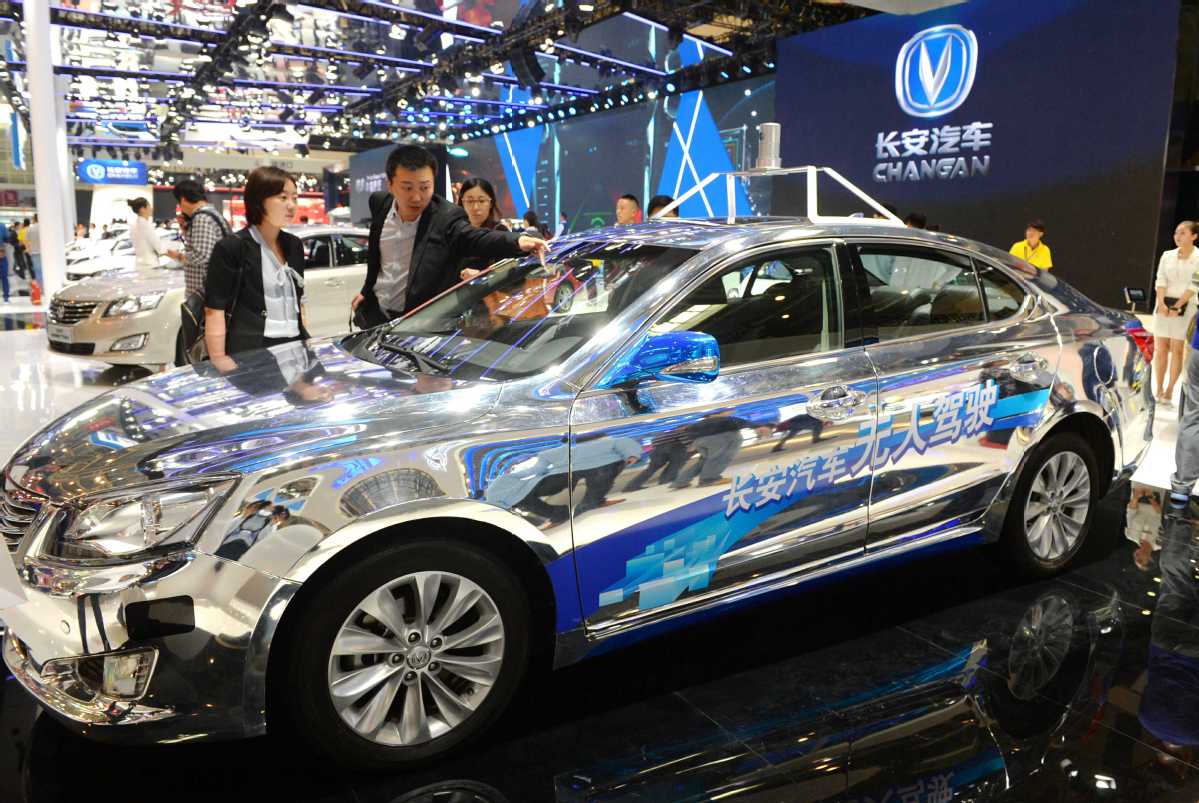
Chongqing Changan Automobile Co announced last week that all its vehicles produced starting from 2020 will have access to the internet-the most ambitious plan made by any Chinese carmaker in terms of connectivity.
Among other things, the vehicles will have their software updated online and problems diagnosed remotely, and by 2025, all of Changan's vehicles will feature voice control, according to the Chongqing-headquartered carmaker.
The strategy was unveiled months after Changan partnered with Chinese tech giants, including Tencent Holdings Co and Huawei Technologies Co, to develop its vehicle operating systems.
"Clearly, vehicles are evolving from transport tools to smart mobile platforms that facilitate people's life and work," said Changan President Zhu Huarong.
Changan was also one of the first Chinese carmakers to test autonomous driving, with its fleet of Level 3, or hands-off, cars, finishing a 2,000-kilometer test in China back in 2016. It has also obtained a license to test its vehicles in the United States.
According to Changan, by 2025, it will offer Level 4, or eyes-off-road, autonomous cars that are capable of real dialogues with drivers.
Xiao Yong, deputy general manager of GAC New Energy Automobile Co, a subsidiary of Guangzhou-based GAC Group, shares the same belief that future vehicles must be smart.
"Just connected cars have no future at all. The future belongs to artificial intelligence-based cars," said Xiao when speaking of one of the major selling points of the company's latest GE3 530 model.
The electric vehicle, scheduled to hit the market later this week, features an operating system co-developed by GAC and Tencent, which is able to have almost natural conversations with drivers and passengers.
If the operating system is told it is hot inside the car, the system will automatically lower the temperature two degrees at a time. Give the name of a singer or a song, it will search the music in Tencent's database and play it, and tell it you want to go home and it will-navigate the best route back to your address.
The carmaker said it will mass produce models with L3 autonomous functions in 2019, and it is already testing L4 cars.
SAIC Motor Corp, China's largest carmaker by unit sales, established an AI lab in late June, further consolidating its efforts in the technology.
The lab has a team of some 70 people who are working on smart mobility, smart manufacturing and autonomous driving, according to Chinese internet company Sohu.
AI is seen as one of the three pillars of SAIC's ABC strategy, with the other two letters standing for big data and cloud computing.
"It is an inevitable trend that vehicles will become smart, and we are considering to apply such new technologies into areas that can be commercialized," said SAIC Chairman Chen Hong at a shareholders' meeting in late June.
The Marvel X under SAIC's Roewe brand, which is able to locate free parking spaces and park itself automatically, is expected to hit the market in September at the forthcoming Chengdu Motor Show.
Roewe was the first Chinese brand to offer an internet car when it launched the RX5 SUV back in 2016, which featured an operating system developed by Banma Technologies, a joint venture between SAIC and internet and technology giant Alibaba.
Besides navigation and in-car entertainment, the system offers value-added services such as car maintenance and allows users to book and pay for parking spaces, filling up at gas stations and shopping from inside the car.
The Banma system, now in its 3.0 version, has caught the eye of the US carmaker Ford, with its latest Kuga SUV produced in China to be the first model to use the system.
Banma expects its operating system to be used in about 6 million vehicles produced in China within five years, said its CEO Hao Fei in an interview with the South China Morning Post.
Currently, cars featuring the system stand at around half a million, according to Sohu.