Unmanned robots delivering a smart future







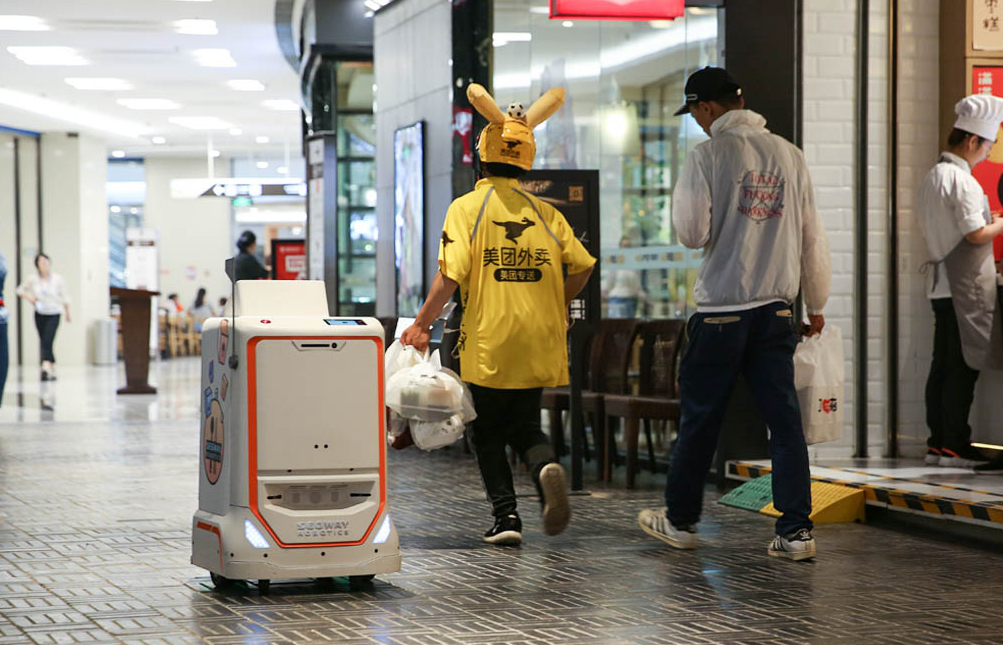
Beijing-based Yunji Technology has also rolled out a similar robot named Run. Introduced to the market in January 2016, the robot has mainly been used in hotels. To date, the robot is employed in 400 hotels worldwide, including Singapore, Australia and South Korea.
The robot mainly runs errands, bringing all kinds of things to guests' rooms. Just like a human employee, the robot also gets paid each month-about 5,000 yuan-according to Zhi Tao, chief executive officer of Yunji Technology. From time to time, it even gets tips, she said.
"Robots for commercial services will improve industry efficiency and provide more pleasant working and living environments for people. Although such robots are in their infancy at present, their roles will certainly grow in the future," she added.
According to the Ministry of Civil Affairs, the number of people over 60 years old will reach 243 million by 2020, accounting for more than 17.2 percent of the population. It is expected that this figure will surpass 300 million in 2025.
The rapidly aging population will lead to a decrease of labor supply in the catering and hospitality industry, which will result in rising labor costs.
More and more enterprises are aware of the significance of adopting unmanned delivery robots, which is becoming the new driving force for the transformation and upgrading of traditional industries.
Experts say that with the advent of the AI era, unmanned delivery robots could undertake tedious work, such as handling orders and deliveries, freeing people to be engaged in more valuable work.
Statistics from market consultancy Analysys show the market scale of China's service robots will reach 12.29 billion yuan in 2018, an increase of 27.2 percent year-on-year.
Keenon Robotics Co Ltd, another Shanghai-based intellectual service robot manufacturer has launched autonomous service robots that can be used for shopping, providing information, food and beverage delivery and other services.
Equipped with a fully autonomous positioning and navigation system, the company's Peanut delivery robot has the ability to navigate precisely, allowing it to move freely in a complex indoor environment.
Such delivery robots have been introduced in some restaurants and hotels, with the aim of upgrading workflow, reducing operation costs and helping enterprises achieve intelligent management.
Li Tong, CEO of Keenon Robotics said: "Robots need to coexist with people when working in restaurants, so we should give top priority to security. Moreover, the robots should be efficient and stable, without hardware and software breakdowns."
Li said the robot's smart voice recognition system could receive users' orders accurately and give responses quickly, and its infrared perception system could detect the status of goods in its pallet.
"The delivery robot returns automatically, as quickly as a person, to clear away empty dishes, while multiple robots can cooperate with each other effectively in the same working environment," Li added.
In addition, autonomous delivery robots have been introduced in outdoor environments. China's e-commerce giant JD launched robot deliveries in Beijing's Haidian district in June. With a maximum speed of 15 kilometers per hour, the robots, which are equipped with radar and sensors to help them recognize traffic lights and their surroundings, can carry up to 30 parcels at a time.
Customers receive a message from JD when the robot is about to arrive, and are able to collect their parcels using facial recognition, by inputting a code or using a mobile phone app.
"Unmanned deliveries represent a potential development direction of future logistics, which is one of the reasons why e-commerce and logistics enterprises are actively experimenting at present," said Wang Xiaoxing, an analyst with Analysys.
This delivery method will help solve the labor shortage issue in the express industry, reduce delivery costs and improve efficiency, but the industry is still in its infancy and should be further tapped, Wang said, adding that more time is needed to realize large-scale commercialization of unmanned delivery robots.