Kavanaugh and the myth of US justice







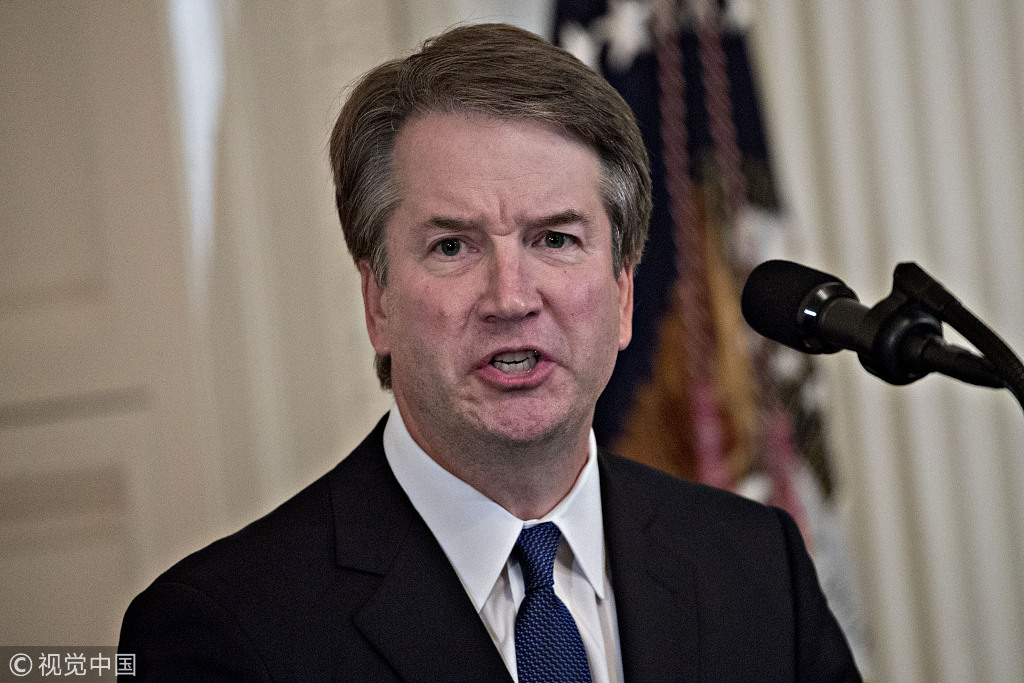
As Christine Blasey Ford testified before the United States Senate in late September about her treatment at the hands of Supreme Court nominee Brett Kavanaugh, calmly telling a tale of violence and attempted rape, I couldn’t help but wonder when the US legal system failed her. Was it when she knew there would be no point in going to the police? Was it years after the fact, when she saw the name of her attacker on the preferred shortlist of nominees from President Donald Trump?
Or did it fail her long before? Was the failure built into the system from its founding, making this miscarriage of justice a feature rather than a bug?
These questions went unanswered as Kavanaugh won his confirmation vote earlier this month, in direct defiance of his unprecedented unpopularity and a furor unseen since the attempted nomination of Robert Bork in 1987. It didn’t matter that Ford’s account and Kavanaugh’s rage-filled response raised serious questions about the nominee’s character and competency. All that mattered was the win, and Senate Republicans got it by any means necessary.
The senators who voted to confirm Kavanaugh for a lifetime’s tenure represent less than half of the US population. So a minority Senate has confirmed a nominee of a president who didn’t win the popular vote, and since Kavanaugh joins a conservative majority with earlier Trump nominee Neil Gorsuch, two of the five people with a decisive vote in matters of law in the US have no legitimacy. This of course follows the refusal of a hearing for Merrick Garland, former president Barack Obama’s 2016 nominee. Hardly a shining moment for democracy, but then after the 2000 election — a contest essentially decided by the nine-member Supreme Court —people should be used to that.
Kavanaugh’s confirmation should give many in the US pause for reasons outside its anti-democratic nature —women especially. The new court is sure to curtail women’s health rights by overturning landmark abortion decision Roe v. Wade, or by defanging it through a long process of judicial attrition similar to what state courts have already done. Whether killed in one fell swoop or by a thousand cuts, family planning is now in mortal peril.
Not to mention the accusations against Kavanaugh were numerous and credible. After last month’s spectacle, where Ford displayed remarkable poise and Kavanaugh went red in the face, the prospect of an abuser sitting on the country’s highest judicial bench remains undoubtedly traumatic for victims everywhere. Others who’d known Kavanaugh told their own stories of harassment, and women all over the country relived moments in their lives when they felt powerless or assaulted. And whatever your opinion of the charges — personally, I believe everything Ford and the others have said — the temperament Kavanaugh showed was in no way befitting a lifetime member of the highest court in the most powerful country on the planet.
Kavanaugh’s case is eye-opening — not just because of its particulars, the national outrage and the eventual confirmation — but also what it has revealed about the way the law works in the United States. For a lot of people, the events of the past month have unearthed some unpleasant truths.
Or, to be more accurate, lies. For decades the US has sold itself as the country with the fairest and most equitable legal system in the world — a system which protects the rights of every citizen, no matter the severity of the offense. If you are arrested, received wisdom goes, you have the same right to a defense as everyone else and receive absolutely equal treatment.
But the reality is there are two legal systems in the United States: one for the privileged, and one for everybody else. In theory, each citizen is guaranteed equal representation — but the best lawyers are expensive, and the US’ public defender system is woefully overworked and underfunded. Top law school graduates almost uniformly choose “white shoe” firms representing multinational corporations over public service.
Investigative practice is also famously flawed. Examples abound of wrongfully convicted inmates serving multi-year sentences, or even being executed before new evidence exonerates them. Police profiling, arrest rates and sentencing rules disproportionately favor whites, who not coincidentally represent an overwhelming majority of the most affluent Americans. Poverty, the most accurate predictor of “criminality”, also affects minority groups at far greater rates. All this adds up to a justice system in name only.
This month’s confirmation was only the latest reminder. It showed us, yet again, some people are above the law so long as they have the wealth and connections to rub elbows with the ruling class. Kavanaugh himself was part of a large and influential patronage network from an early age, starting with the elite Washington prep school where he spent his high school years. It’s a deep irony when the people who enjoy functional immunity from the law are chosen to interpret it, in spite of enormous public outcry. Even putting Kavanaugh aside, we have countless instances of rich men or their sons receiving little to no consequences for violent crime. We have a history of unarmed black men being killed by police officers and those officers receiving, at worst, a slap on the wrist via paid administrative leave.
Laws are an extension of the society in which they are created. The United States was founded by a group of wealthy white landowners, many of whom owned slave plantations. The country’s legal infrastructure was built in their image, and it shouldn’t surprise anyone such a system would reproduce those brutal race and class relations, even hundreds of years later. Yet the myth around rule of law in the US persists, and its present-day leaders see fit to lecture other countries about it on a regular basis. Hypocrisy is, after all, a virtue among those never punished for it.
For minority groups in the US — black Americans especially — for women, for the poor, this is not new information. This has been the unspoken truth of their country’s justice system since its creation, and the agonizingly slow march of progress has offered precious little in the way of comfort. With this latest blow, the meager gains made over the past century are poised to evaporate entirely. The one microscopic positive in a sea of horrors is this moment might mark a transformation in enough people to effect real change.
I imagine quite a few unjustly imprisoned in the US would say it’s about time.
The author is a copy editor with chinadaily.com.cn.
The opinions expressed here are those of the writer and do not represent the views of China Daily and China Daily website.