


Huanglong Scenic and Historic Interest Area







Category of Site: Natural site
Brief introduction
Situated in Songpan county, northwest of Sichuan province in the southern part of Minshan Mountains and southeast of the Qinghai-Tibetan Plateau, the Huanglong valley is made up of snow-capped peaks and the eastern-most Chinese glaciers. In addition to its mountain landscape, diverse forest ecosystems can be found, as well as spectacular limestone formations, waterfalls and hot springs. The area also has a population of endangered animals, including the giant panda and the Sichuan golden snub-nosed monkey. Huanglong National Nature Reserve is 31.5 kilometers long, 28.4 km wide and covers a total area of 55,000 hectares. Its main targets for protection are natural scenery and rare wildlife.
Huanglong Scenic and Historic Interest Area was declared a World Natural Heritage Site by UNESCO in 1992.
Natural heritage
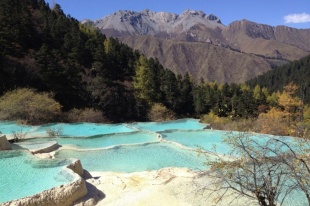
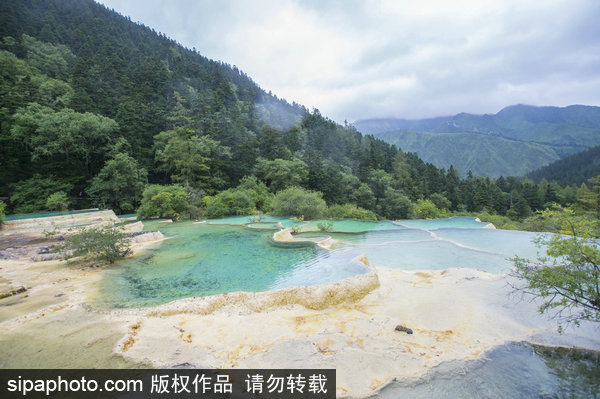
Huanglong is noted for its beautiful mountainous scenery with relatively undisturbed and highly diverse forest ecosystems, combined with the more spectacular localized karst formations, such as travertine pools, waterfalls and limestone shoals. Its travertine terraces and lakes are certainly unique in all of Asia and rate among the three most outstanding examples in the world.
The 7.5 km Huanglong Valley is located at the foot of snow-capped mountains near the source of the Fujiang River. At the end of the valley, near the foot of Green Jade Peak, water from melting snow mixes with limestone water from underground and flows down the mountain terraces, depositing calcium carbonate from limestone water on rocks, stones and fallen branches in its path. The calcium carbonate, in turn, reacts chemically with organic and inorganic substances, resulting in various kinds of calcareous deposits that shine golden in the sunlight, just like a huge yellow dragon flying down from the snow-capped mountain, hence the name Huanglong.
When the water flows into two separate streams, it forms colorful ponds and waterfalls. At the end of the gold-reflecting river is the Bathing Cave Waterfall. Plunging 7 m off a cliff, it creates a curtain of water. Nearby, the Brilliant Flying Waterfall, fed by the ponds in the upper reaches, cascades 10 m down, with a width of 60 m. The jigsaw-like cliffs at the top of the waterfall split the water into small streams, creating a most fantastic sight. Of all the colorful pools, eight are most famous: the Flower-washing Pool, Bonsai Pool, Mirror Pool, Rhododendron Pool, Jade Plants Pool, Riot of Color Pool in the south, the Stone Pagoda Village Sea Pool and the Turning Flower Pool in the north.
Diversity of plants and animals in Huanglong Scenic and Historic Interest Area is mainly due to its location within four floral regions, its wide altitudinal range, and the extensive undisturbed forests. All together there are 101 plant species of interest for their rarity, endemism, and ornamental and medicinal value, including some internationally threatened species. A large number of animals species in this area are threatened at the national and international level, such as the giant panda, golden snub-nosed monkey, brown bear, Asiatic black bear, Pallas' cat, Asiatic wild dog, Szechwan takin, Chinese monal and a number of waterfowl species.
Historic temples
According to The Songpan County Chronicles, Huanglong's three temples, one behind the other, were built during the Ming Dynasty (1368-1644), attracting a large number of worshippers. The front and middle temples are mostly dilapidated, but the rear temple, at the end of Huanglong Ravine, and the Hall of the Goddess of Mercy in the middle temple are well preserved. The back temple contains a statue of the Perfect Man of Huanglong. In the middle of the sixth lunar month each year, a temple fair at Huanglong attracts local people from the Tibetan, Qiang, Hui, and Han ethnic groups. Festival goers offer incense, pray, sing, dance, and enjoy the scenery.