Industrial base reborn with cars







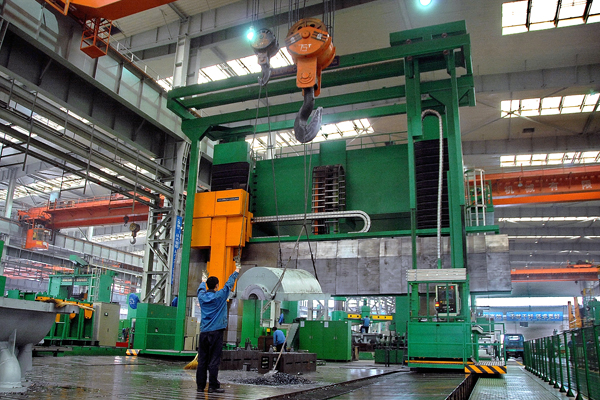
A district in Shenyang prospers by shifting its orientation from old ways
Once a major iron and coal industrial base in China, Tiexi district in Shenyang, Liaoning province, has experienced a rebirth as the primary auto production hub in China.
Since reform and opening-up policies were launched in the late 1970s, Shenyang, a city known for its primary industry leading groups during the planned-economy era, gradually faded into a city where few workers could rely on their jobs for a living.
The transformation of the Tiexi district also reflected a history of modern industry.
Located in the southwest part of Shenyang, the district had been classified as industrial in the 1930s. Machine tools, electric cables and heavy mining machinery transformed the district into a base of industrial production.
Early in the 1980s, the industrial base began playing an important role, with gross output accounting for 65.3 percent of the city's total.
"It was an honor to work in a factory in Tiexi district in the 1970s, as the living facilities were all well-equipped and housing was provided," said Yang Jianhua, 65, a retired welding technician who worked at Shenyang Blower Works Group.
He recalled that a company house was precious during the first year he worked at the factory. According to Tiexi district records, the number of medical staff members at factories making heavy machinery reached 471.
But leaner years came as the 1990s approached. Hundreds of entrepreneurs in the industrial district suspended production, and losses were high. At the same time, large numbers of workers at State-owned enterprises lost their jobs.
"My family couldn't afford regular meals. Several relatives searched for work opportunities on the street," Yang said.
Liang Qidong, deputy director of the Liaoning Academy of Social Sciences, said the factories in Tiexi district during the planned-economy era were not comparable to the way a modern company operates.
"Even getting a toilet for the factory had to be approved by the government," said Liang. "Also, the factories rarely considered the market environment."
The rapid development of enterprises also generated serious environmental pollution, and the Shenyang Smelting Plant became the city's largest source of air pollution. The sulfur dioxide emitted by the factory accounted for 42 percent of the total.
A large area of heavy-metal pollution had seriously infected suburban counties in western Shenyang, said Li Zhiying, director of Tiexi district's development and reform bureau.
"Moreover, most of the workers lived in the workers' village that was built in the early 1950s. It had been worn out by the late 1990s, and shantytowns appeared," he said.
Half the 300,000 industrial workers in Tiexi district were laid off. Disappointment, anxiety and helplessness spread.
In June 2002, the central government unveiled a policy to revitalize northeast China that involved relocating and transforming some functions of the old industrial area. The district enhanced its modern manufacturing and services industries to boost consumption, spurred by the central government's incentives and policies.
Since then, Tiexi district started building new factories in western Shenyang and moved some old plants to the economic and technological development zone to profit from the price gap. A new district was formed in 2002 to build an organizational framework.
Wang Zhenzhong, director of the reconstruction department in Tiexi district, said in an interview with China Economic Weekly in 2009 that since 2002 the district had relocated 239 companies, freeing up 5.95 million square meters.
The district's finance bureau made a 14 billion yuan ($2 billion) profit from the transferred land, he said.
The long-term problems-where the money should come from and where human resources should go-that once existed in the State-owned company have been solved, Wang said.
The main effort to promote reform is in reusing existing resources and making full use of production capabilities.
So the local government started to give priority to the service industry in Tiexi.
This has greatly improved the output value of the enterprises and has improved people's livelihoods, Liang said.
Shenyang Blower Works Group is one that profited. A new factory covering 900,000 square meters has been built with advanced technologies, according to Shu Xin, CEO of Turbo, a company under the Shenyang Blower Works Group.
At the same time, the company also introduced advanced techniques to manage the workflow and technological processes, he said.
The production value of the company increased eightfold, it said. The plant also introduced many foreign experts to improve production value, Shu said.
Tiexi district's per capita disposable income rose from 7,566 yuan in 2003 to 41,924 yuan in 2017, Shu said.
The district also upgraded its industries to promote the region's further development. Zhang Dazhi, director of the foreign trade bureau in Tiexi district, said the district had attracted overseas-funded enterprises with capital and equipment.
"In recent years, more and more private firms have started to set up joint ventures with leading companies overseas to develop domestic and overseas markets," he said.
The new construction of a BMW AG plant became a milestone in the district's development in 2012. It attracted large numbers of supporting manufacturers.
One year later, the plant-the only BMW research and development center outside Germany-had completed construction.
Auto companies in Shenyang also started to build their own research and development centers. Tian Jiaping, director of the research department at Brilliance Auto Company, said the company learned from leading foreign companies to incorporate its own innovative products to enhance manufacturing.
"Within two years, we determined to enhance our auto manufacturing to catch up to the world level," Tian said. "When our production reaches a certain level, we will export more products to the countries in southeast and Central Asian areas."