The story of peacock dancer







China Reform and Opening – Forty Years in Perspective
The story of peacock dancer
Editor's note: Laurence Brahm, first came to China as a fresh university exchange student from the US in 1981 and he has spent much of the past three and a half decades living and working in the country. He has been a lawyer, a writer, and now he is Founding Director of Himalayan Consensus and a Senior International Fellow at the Center for China and Globalization.
He has captured his own story and the nation's journey in China Reform and Opening – Forty Years in Perspective. China Daily is running a series of articles every Thursday starting from May 24 that reveal the changes that have taken place in the country in the past four decades. Starting this month, China Daily will run two articles from this series each week – on Tuesday and Thursday. Keep track of the story by following us.
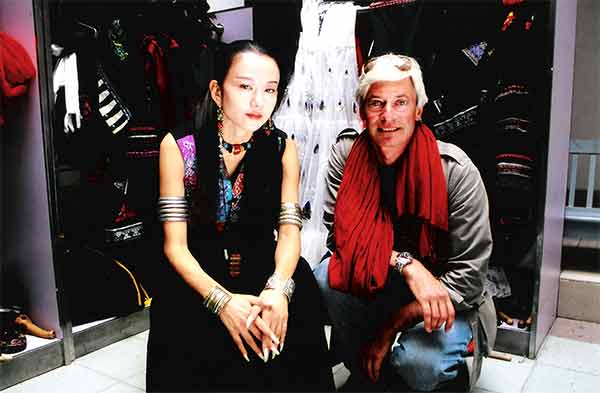
I first saw Yang Liping in Yunnan in the very early 1990s. I believe it was 1991. Her "Peacock Dance", mimicking a peacock, was both shocking and beautiful. I was stunned and mesmerized watching her live performance in Xishuangbanna, sitting together with a delegation of central bank of officials from Beijing.
I had traveled to Yunnan as a legal advisor to a team of officials from the People's Bank of China to research and draft a law for negotiable instruments in China. Monetary policy had become my specialization after advising the central banks of Laos and Vietnam. The delegation had chosen to meet in Kunming and then Xishuangbanna, the home of ethnic Dai tribes, who are a lot like the Lao. After discussing regulatory restrictions for the manipulation of money, I slipped out the back door of our hotel, rented a jeep, and drove off into the hills looking for the Dai. I found them living in cramped villages built on stilts along misty rivers beside lonely white pagodas.
I saw Yang Liping again in 1992, this time on television. I was sitting in a dirty, run-down Sichuan restaurant in Lhasa, eating spicy toufu. The tiny television in a corner of the restaurant showed her performing the Peacock Dance for an audience that included some of China's heavy- weight leaders. Somehow the last thing on my mind was the remote possibility that there would one day be a connection between myself, Tibetan Buddhism and Yang Liping. Somehow that was the last thing that could possibly have entered my mind that night while eating spicy toufu in a Sichuan restaurant in Lhasa. I thought about it no more. I left Lhasa. It would be exactly ten years before I returned.
A decade later, I came across Yang Liping again in Kunming, where she had established a dance studio for sustaining the culture of ethnic minorities in Yunnan. Every road that opened to a village brought with it development and change, and Yang Liping was determined to save what she could while it was still there. To enable preservation of her people's culture on a sustainable basis, she brought young village children to her studio in Kunming, recorded their songs and filmed their dance. To keep their culture alive, she brought their different traditional dances and music into an ongoing performing arts program.
As I sat beside her, Yang Liping pointed to the girls dancing in synchronic rhythm. There was something totally organic about their movements. Their clothes and exquisite headdresses were woven in villages, maybe a generation or two before, passed from grandmother to mother to daughter. Their movements were natural, over owing with a spirit that could not be choreographed.
Moving her long thin fingers in a slow movement like a Bodhisattva's mudra, Yang Liping pointed a finger — extended into the infinity of a single fingernail prolonged into a moment that seemed to hang in the air as if floating — toward the children as they danced. She whispered, "The children of Yunnan are pure; they are like little Buddhas."
I was momentarily struck by profundity, held in the simplicity of her words. In fact, I was totally taken back. Still craving for re-confirmation, I asked Yang Liping to repeat what she said.
She did not, just shrugged, and added, "The people of Yunnan are like that." As far as she was concerned, what was said should be understood. Otherwise, it was not meant to be understood. Then her fingers unfolded again like a fan and her eyes beamed with a depth of penetrating black as she talked about Yunnan and the ethnic minorities — her own people. "Xishuangbanna, in our tropical south, is home to the Dai people. It is their place locked in rice-terraced valleys along the Mekong River. They are like the Thai and move in long sarongs of silk. Further along the Red River, which flows to Vietnam, is the place of the Wah. Some of their lifestyle and religious practices even resemble those in Africa. They pray to the sun. They live close to the sun. This way is right. Then there are the Yi people who are different. They live in mountains, slash and burn, and move when there is nothing left to keep them. They pray to fire and tigers and have no possessions because they do not stay long enough in one place to make possessions worth keeping."
"What about yourself?" I asked. "What ethnic group do you come from?"
"I am a Bai. Our home is Dali. It was once a kingdom. The old city is still well protected. Many artists are going there to find Shangri-La. It is the first stop on the Tea Caravan Trail. If you want to find Shangri- La, then maybe this is where you should begin your journey."
Then with a faint voice bordering on a slight gasp, Yang Liping talked about her home. "The lake, Erhai, is shaped like a Buddha's ear and reflects the Cang Mountain. But there is more than the scenery for you to discover in Dali. There, you will find the people and their culture intact. So it is a special place. I remember when I was young, we went into the water of the lake. Fish would swim between our legs — humanity and nature was in harmony. The climate there is spring all year. Not too cold or hot. I am building my home there and when I retire from dance, I want to return to the home I was born in. I have been around the world but feel that Dali is closest to me. It is the best for me to return there. Behind me is the Cang Mountain and before me the Erhai Lake. The environment is still protected. Dali was once a powerful kingdom. Its culture is like a magnet."
"But some people say Lijiang is Shangri-La," I asked incredulously. "Others say it is somewhere north of there; they say Zhongdian. So you seem to say it is Dali. Where is the road to Shangri-La? Does it begin in Dali?"
She just laughed, then smiled and closed the fan of her outstretched fingers. "People say Yunnan is Shangri-La because its environment is pure and the ethnic diversity is sustained. So Lijiang is also Shangri-La and so is Zhongdian, for that matter. Every place in Yunnan thinks it is Shangri-La. To find it, follow the Tea Caravan Trail. It will lead you from Dali to Lijiang and past the Tiger Leaping Gorge to Zhongdian. Along the way, there are many sacred mountains. They are sacred to each of the peoples who live there." "Sacred mountains?" I asked, disbelieving. "What makes a mountain sacred?"
"After leaving Dali, you will go to Lijiang. There, the Jade Dragon Mountain is sacred to the Naxi people. Climb the mountain, but it is cold and difficult to stay there. Lijiang's water comes from the melted snow of the Jade Dragon Mountain. The people pray to the mountain. So you could say they drink sacred water, it is the source of life and death. People go to the mountain in search of 'death love'."
"'Death love'? What's that?"
"Young Naxi boys and girls believe in joint suicide to go to an ideal third world. They believe another world is even better."
I was even more confused. Sensing this, Yang Liping continued, her thoughts uninterrupted. "Then go north of Lijiang to the Lugu Lake. The Mosu people there believe it is Shangri-La. The women choose their lovers but never marry. The Mosu are a bit like Tibetan and Naxi mixed. Their life is very free and it is a matriarchal society. Because women can give birth, thus property should transfer to them. They think they are the useful part of the society; and love is natural there because women set the rules. Their belief is different — they feel that love is the highest state of conscious awareness, so they strive toward it instead of regulating it with laws and rules of marriage."
"So where is Shangri-La then? Lijiang or Lugu?"
"Zhongdian claims to be Shangri-La," Yang Liping smiled at my confusion. "Because the higher altitude makes it a Tibetan region. The natural environment is more protected. The environment is retained best. Due to high altitude, life there is not easy. People are few, so its natural environment is protected. Going further north is the sacred Tibetan mountain, Kawagebo. People going there in late autumn feel there are flowers growing in the snow, and yaks and sheep run free. There is no barrier between people and nature."
"Why?"
"Because they live a life that is close to the mountains. When you live close to the mountains, you can better listen to what they say. They are the words of spirits," she explained.
"So there is a way to communicate with a sacred mountain?" I asked incredulously.
"If you want to hear the words of spirits," Yang Liping said, no longer smiling but with one long outstretched fingernail pointing in an uncertain direction, "Then I suggest you find the mountain."
Please click here to read previous articles.