Gene editing experiment generates controversy







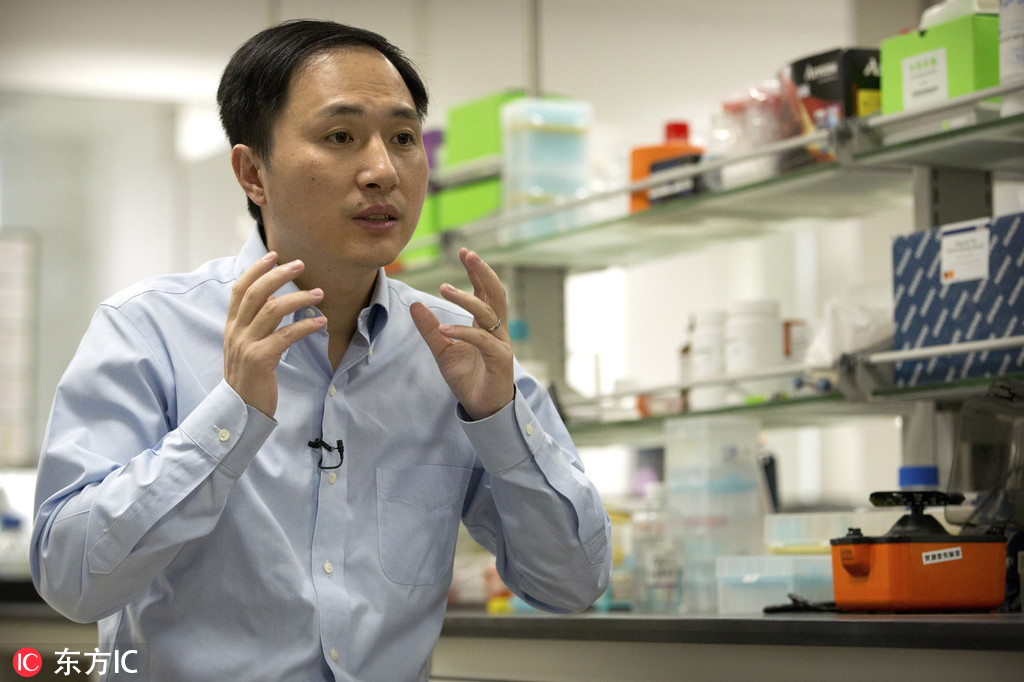
A Chinese scientist's attempt to produce the world's first gene-edited babies who are immune to HIV has sparked heated controversy among those in academia and the public.
In an online video posted on Monday, He Jiankui, a biological researcher, announced that a pair of twin baby girls, Lulu and Nana, were born healthy a few weeks ago through in-vitro fertilization with genetic editing technology that can prevent them from being infected with HIV.
"The mother started her pregnancy by regular IVF with one difference: right after sending her husband's sperm into her eggs, we also sent in a little bit of protein and instruction for a gene surgery," He, from the Southern University of Science and Technology in Shenzhen, Guangdong province, said in the video. "Lulu and Nana were just a single cell when the surgery removed the doorway through which HIV enters to infect people."
He, who was believed to be in Hong Kong on Monday to attend the Second International Summit on Human Genome Editing, a three-day conference due to open on Tuesday, could not be reached for comment. But his announcement sparked heated controversy among regulators and academics concerning medical ethics and effectiveness.
The Shenzhen Health and Family Planning Commission said on Monday evening that it had not received any ethical assessment application for the study, which is a prerequisite for such experiments.
A report by The Associated Press on Monday said He sought and received approval for his project from the ethics committee of the Shenzhen Harmonicare Women's and Children's Hospital, and an approval document from the hospital circulated online on Monday.
However, the Shenzhen commission said the hospital's ethics committee was invalid, as the hospital did not register as required with the commission about the establishment of such a committee.
The commission started an ethics investigation into the issue and will release the result to the public, it said. The hospital would not comment on Monday.
The Southern University of Science and Technology said in a statement on Monday that the university was not aware of the research, as He did not report it to the school.
The university said the academic council of its Biology Department, where He works as an associate professor, believes that the research has seriously violated academic ethics and rules, and the university would immediately set up an independent investigation team on the matter.
A regulation released in 2016 by the previous National Health and Family Planning Commission — the current National Health Commission — requires health institutions to establish ethical committees for ethical inspection over biological or medical research that involves humans before they get approval, while the national health authority is responsible for researching into major ethics issues concerning such research and providing guidance to local health authorities.
The National Health Commission did not reply to questions sent by China Daily on Monday.
Bai Hua, head of Baihualin, a nongovernmental organization that promotes the interests of people with HIV/AIDS, told China Daily on Monday that the parents of the two babies are people with HIV.
He Jiankui talked to Bai in April last year, hoping to find people with HIV for the research, Bai said, adding he spread the news to such people he knew, and about 200 showed interests.
"Of the group infected with HIV, many are with special conditions, such as they are unable to naturally conceive, but the reality is that they cannot get babies through IVF in hospitals," he said. "Many of them think the research gives them a chance to have babies without the risk of getting HIV as they do."





- 6.6-magnitude quake hits waters off Taiwan: CENC
- China seeks public feedback on draft rules for anthropomorphic AI services
- China's top legislature concludes standing committee session
- China adopts revised Civil Aviation Law
- China launches satellite to aid in early extreme weather detection
- Report on mining accident that killed 6 suggests accountability for 42 individuals