Technology key to toilet revolution in countryside







China's "toilet revolution" is shifting its focus to reducing the disparity in sanitation conditions between urban and rural areas, aiming to reduce infectious diseases and boost the development of rural tourism, a top tourism official said.
"We started the revolution with tourist toilets. It's time to channel efforts to promote clean toilets to public places and rural families to ensure residents a clean and healthier living environment," Li Jinzao, vice-minister of culture and tourism, said in an interview with China Daily.
Li said he is concerned that people in the countryside commonly use pits as toilets, without flushing water or modern hygiene equipment, which can cause odor and diseases as the human waste isn't properly treated.
A report by the National Health Commission in January showed that only 17 percent of toilets in rural areas met modern hygiene standards as of the end of 2017, causing great environmental and health problems.
Over 80 percent of infectious diseases are caused by polluted water and pathogens in human waste that is improperly treated, according to a report on the "toilet revolution" by the former China Tourism Administration in 2017. The administration was merged into the culture and tourism ministry in March.
The report said that the "toilet revolution" is meant to correct backward sanitation conditions in the countryside, which will also greatly change rural residents' lifestyles.
"It's a problem of economy and people's consciousness," Li said. "It has long been a tradition for rural residents to use a pit, which cannot be changed in a short time. They are unaware of the larger costs of disease treatment if infected by pathogens in untreated human waste."
Improving sanitation conditions in the countryside will also help drive development of rural tourism as toilets play a key role in infrastructure serving tourists, he said.
Culture and tourism ministry officials have said about 22,600 toilet facilities with modern hygiene standards will be built in rural areas in poor financial conditions but rich in tourism resources by the end of 2020. Also, modern technologies like cloud computing will be applied to toilet management.
Li said technology is important in advancing the revolution. "But it's quite challenging as varied environments require different technologies to build toilets that are both hygienic and ecologically friendly, for example, in conditions with cold temperatures or water shortages, and in areas with extreme poverty.
"It's not a job solely for the government but requires joint efforts by government and enterprises," he said.
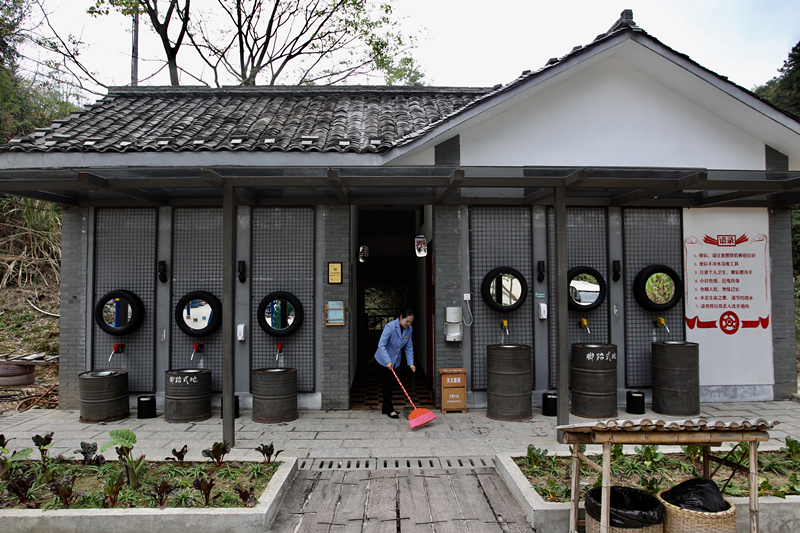
Shen Yangze, general manager with China Everbright Ecological Technologies Co, said they have built 300-plus modern toilets with cutting-edge technologies for residents' use at no cost in Guzhang county, in Hunan province's Xiangxi Tujia and Miao autonomous prefecture. The company has been helping with the county's poverty alleviation work since 2016.
"We want to give something more practical to poor residents, which can both improve their living environment and help protect nature," he said.
The 300-plus toilets, which meet modern hygiene standards, use water-free technologies that employ microbes to dispose of human waste, and water extracted from waste can be used to irrigate farmland. The ecological toilets will be put into use next month, he said.
Hunan province also has provided financial support to help improve sanitation conditions in its rural areas. Lanshan county in Yongzhou, for example, has allocated 20 million yuan ($2.9 million) to rebuild toilets in the countryside. Residents willing to replace their pit toilets with modern, hygienic ones with flushing water will receive a government subsidy of 500 yuan, according to provincial government report.
"People used to shrug when human feces was mentioned, as it was not worth discussing compared with economic and industrial development," Li said. "However, nothing related to living standards should be overlooked, including toilets, which can turn into a fatal problem if not properly handled.
"We did achieve progress in improving people's consciousness, especially in the countryside, because toilets are rather important infrastructure to serve travelers if they want to turn poor villages into travel destinations."