Joint efforts essential for self-driving industry as explosive growth is expected







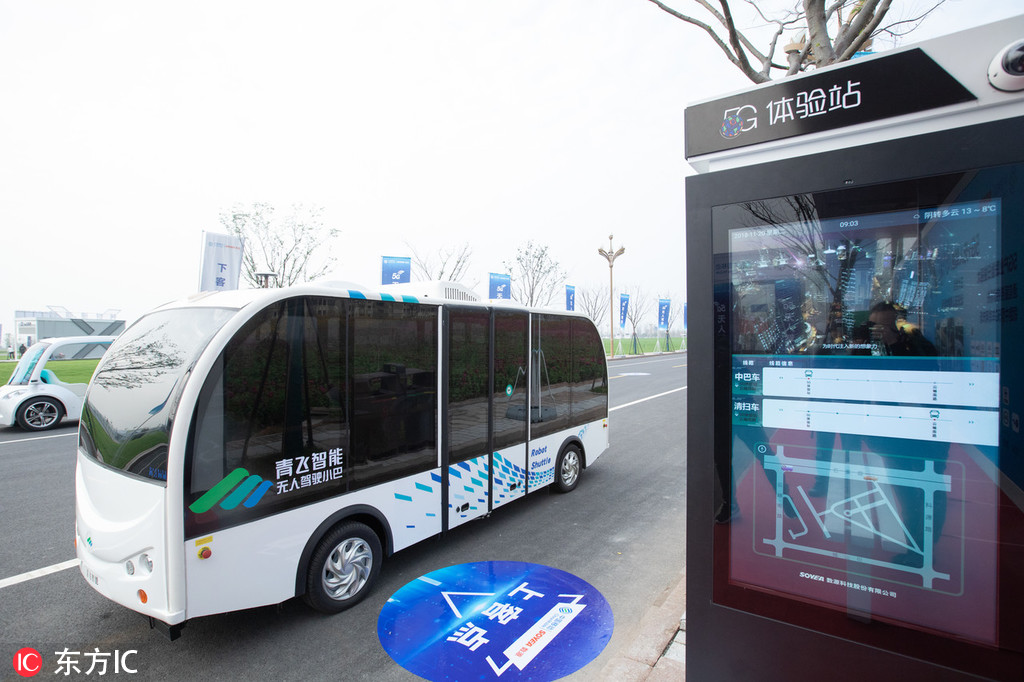
Collaboration between firms globally is vital for the success of the autonomous-driving industry, and governments should take an active role, say several key Chinese players in the sector.
Both traditional vehicle makers, such as Toyota, BMW, Audi and Volvo, and tech giants including Apple, Intel, Uber, and Baidu, have collectively pumped billions of dollars into driverless vehicles in an attempt to advance the technology, test safety, and bring commercial products to the market.
It’s too early to determine who the winners will be, said Tony Han, CEO of WeRide, a Chinese startup that specializes in AI technology and robotics. Since it was established in 2017, the firm has expanded to include offices in Guangzhou, Beijing, Anqing, and Sunnyvale, California.
“Currently, we are all partners that work hard to push forward the entire autonomous-driving industry,” he said, adding the US possesses the most advanced expertise and technology know-how in this field. “We believe a mutually beneficial relationship will be the driving force and eventually help reshape the way people travel.”
Echoing Han is James Peng, founder and CEO of Pony.ai, another Chinese autonomous-driving startup that has raised $214 million since late 2016. He said a massive global market for fully autonomous driving is “not mature yet”, adding that “an expectation for an overnight shift from traditional driving to fully autonomous driving is not realistic”.
Based in Fremont, California, Pony also operates in Beijing and Guangzhou, and announced its partnership with Guangzhou Automobile Group in February by launching its fully self-driving fleet on a 2.8-kilometer route.
The global self-driving vehicle market will undergo explosive growth in the next 10 years and reach an estimated value of $556.7 billion by 2026, according to Allied Market Research.
In China alone, a $14 billion market value is projected for intelligent connected vehicles by 2020, according to China’s Industry and Information Technology Minister Miao Wei, speaking at the World Intelligent Connected Vehicles Conference in October in Beijing.
Baidu, which began autonomous -driving research in 2013, has developed over 100 self-driving minibuses powered by its Apollo platform and will soon deploy them in Beijing, Shenzhen and foreign cities, said its CEO Robin Li in September.
WeRide operates a fleet of 30 vehicles, which have logged 60,000 kilometers of testing with zero accidents. WeRide is aiming for large-scale, commercial deployment of autonomous vehicles in China’s major cities by 2025, said Han.
“Our vehicles will operate without human intervention by using a combination of LiDAR (light detection and ranging), cameras and radar sensors, along with artificial intelligence to perceive the road conditions and choose the quickest and safest route to the final destination,” Han said.
No matter how ambitious the entrepreneurs are, nor how rapidly the technology emerges, safety remains the top priority and benchmark of autonomous driving.
Over 90 percent of car accidents are caused by human error, such as fatigue, road rage and drunken driving, said Peng, adding that autonomous driving will be much safer and more reliable.
“Safety is our, or the industry’s top priority,” he emphasized.
In March, one of Uber’s autonomous cars killed a pedestrian during a test drive in Arizona, leading to the temporary suspension of similar tests by several US counterparts.
The integration of urban governance with algorithms and artificial intelligence, or the practice of smart cities, ultimately will benefit citizens and help solve some of the most severe urbanization challenges, including traffic congestion, climate change and energy overconsumption, said Tang Jie, former vice-mayor of Shenzhen, in a global climate action summit held in San Francisco in September.
“However, further development of autonomous driving relies on the government, which offers regulatory support and invests in infrastructural upgrade,” Li said.
Danial Sperling, a professor of civil and environmental engineering at the University of California, Davis, said the government should play a more active role in regulating and shaping the autonomous driving industry.
“We will definitely have electric vehicles; we will definitely have automation, but we need to learn that the government should bring them all together with pooling and sharing, to avoid vehicle dependency,” Sperling said.