Roadstar.ai plans self-driving fleet, services expansion overseas







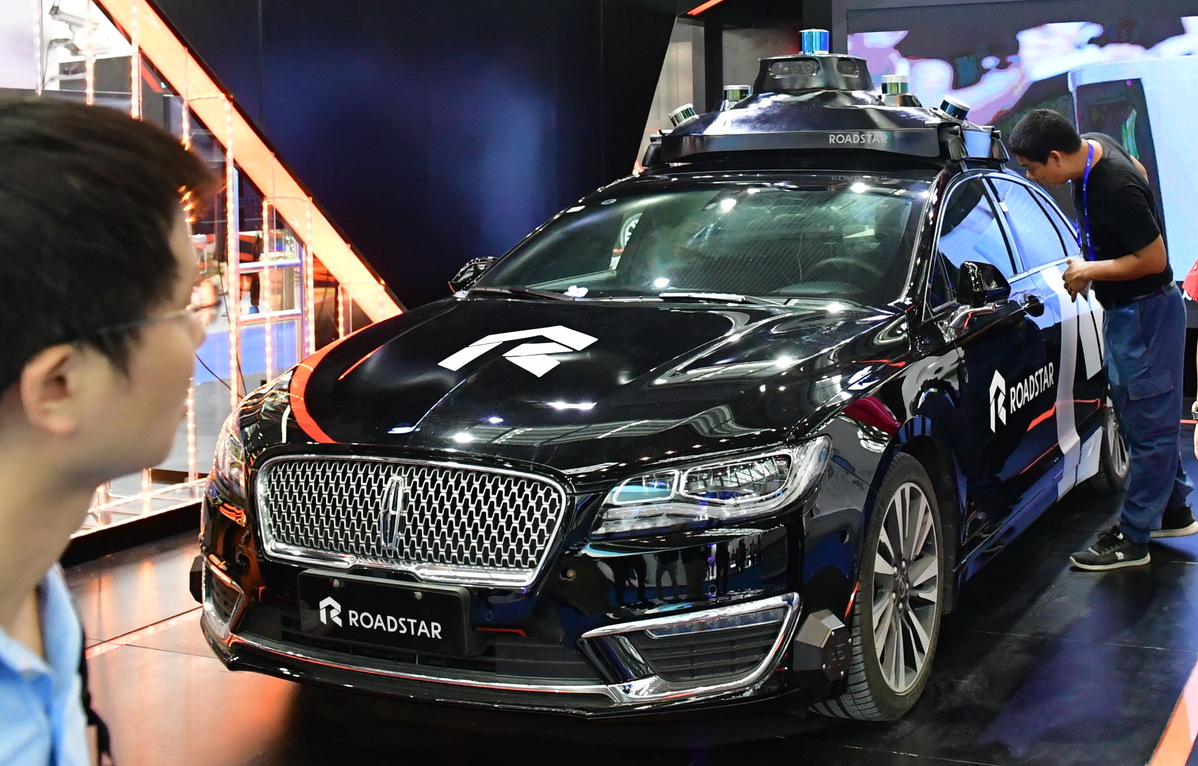
Chinese self-driving startup Roadstar.ai said it plans to produce at least 100 self-driving vehicles this year, offer ride-hailing services and expand its presence in overseas markets, such as Japan, Europe and North America.
"We will launch 1,500 pre-assembled self-driving electric vehicles by the end of 2020, and propel the commercialization of autonomous driving technology by providing chauffeur services to improve city public transportation," said Tong Xianqiao, founder and CEO of Roadstar.ai.
Tong said he is bullish on the prospects of the self-driving sector and the company's accelerated steps to expand into overseas markets.
Roadstar.ai released its first self-driving tech kit, Aries, in May. In November, it announced its second-generation Level 4 autonomous driving effort. The new generation includes an algorithm upgrade with further performance optimization of the vehicle's perception, decision planning, and control.
The company's autonomous driving research and development focuses include sensors, perception, maps, localization, planning, control, hardware, systems engineering and cloud services.
The Level 4 vehicle is capable of completing an entire journey without driver intervention, but the vehicle does have some constraints, such as being confined to a certain geographical area.
That said, Roadstar.ai has performed extensive road tests on public roads, covering 200 square kilometers in multiple countries and regions, such as China, the United States, and Japan.
Its autonomous vehicles were seen roaming the main roads of Wuzhen, in East China's Zhejiang province, during the Fifth World internet Conference in November.
By the end of 2018, the company had 20 self-driving vehicles and had also obtained licenses to test its driverless cars in California and Chongqing.
Roadstar.ai announced in May last year that it had secured $128 million in its Series A funding round, marking the single biggest investment made in an autonomous driving startup in China.
The figure surpassed that of rival self-driving startup Pony.ai, which secured $112 million in its Series A funding round.
Self-driving has become a trend in the automotive industry, but its safety is the top priority, says Xu Yanhua, deputy secretary-general of the China Association of Automobile Manufacturers, who noted that US tech heavyweight Google, meanwhile, is at the testing stage of its own self-driving vehicles.
In March, one of Uber's autonomous cars killed a pedestrian during a test drive in Arizona, leading to the temporary suspension of similar tests by several of its US counterparts.
"We should be cautious about self-driving technology. Companies should invest and establish more testing sites that imitate different traffic scenarios, rather than testing their vehicles on the urban roads prematurely," said Lin Jian, a senior engineer in the automobile engineering department at Tsinghua University.
Founded in May 2017 by three engineers who had previously led autonomous driving technologies research at Google Inc, Tesla Inc, Apple Inc, Nvidia Corp and Baidu USA, Roadstar.ai has established R&D centers in Silicon Valley, Shenzhen in Guangdong province, and Beijing.
It said it is committed to revolutionizing future mobility by creating safer, smarter and more reliable autonomous driving solutions.
The Shenzhen-based startup boasts two revolutionary technologies, including DeepFusion and HeteroSync. The former aims to produce a safe, efficient and reliable self-driving solution, while the latter offers real-time updates, accurate time measurements, robust databased features and spatial synchronization.