


Visitors flock to Palace Museum







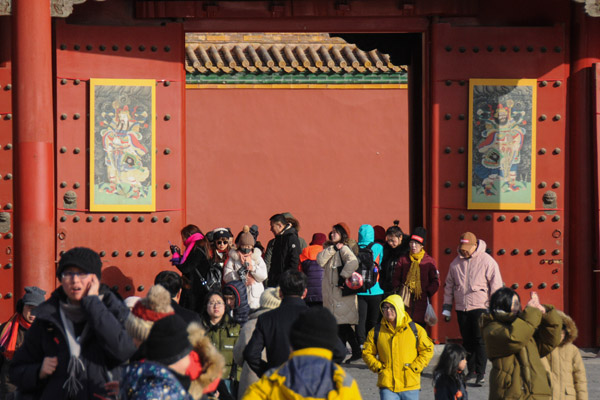
For those hoping to stop by key tourist attractions in the capital during Spring Festival holidays, admittance is not a given due to limited space within popular facilities.
As the holiday began, some were surprised to find that tickets to Beijing's Palace Museum had been sold out until Sunday, and they simply had to find other ways to enjoy their time off.
A quota restricting visitor numbers has been in place by the museum since June 2015 to help with crowd control.
Up to 80,000 people are allowed to enter the complex each day. Since October 2017, all tickets must be purchased online, and buying electronically has become second nature to more and more people.
ID cards are needed to buy digital tickets online, but a small number of paper-based tickets are still reserved as gifts for some, which are still valid for entry.
As regular tickets recently ran out of stock, stand-in commemorative tickets were going for over 200 yuan ($30) during the holiday on Xianyu.com, a major secondhand trading website.
By comparison, tickets typically cost only 40 yuan in winter (from November to March).
Nevertheless, visitors have many reasons to be keen on touring the palace during the holidays.
The Palace Museum was China's imperial palace from 1420 to 1911 and also is known as the Forbidden City.
As a UNESCO World Heritage site and the world's largest surviving wooden architectural compound, it houses more than 1.86 million cultural heritage items, most of which are art pieces and daily-use articles.
This year's theme, "Celebrating Spring Festival in the Forbidden City", is one of the largest scale exhibitions in the site's history.
The display in the Meridian Gate Gallery will run through April 7. The exhibition combines more than 100 curators' efforts to showcase 885 Qing Dynasty (1644-1911) cultural relics centered around the theme of Lunar New Year.
The kaleidoscopic display, ranging from royal rituals to entertainment and banquets, complements the holiday traditions of family reunions, and offers wishes for good health and fortune.
Auspicious red couplets are ubiquitous in the Forbidden City, and contain both prayers for prosperity and admonitions to ward off evil spirits.
Eaves are decorated with lanterns in royal style in an attempt to recreate an imperial ambience for the first time since the institution became a public museum in 1925.
Sky lamps and longevity lamps were erected in front of the Palace of Heavenly Purity in the Forbidden City.
The lamps, all exquisitely decorated, required thousands of workers to create and install, and were used during Lunar New Year's celebrations of old as auspicious decor.
However, the tradition was halted in 1840 when the national coffers came under pressure.
Ren Wanping, deputy director of the Palace Museum and chief curator of the Lunar New Year events, said the reappearance of the decorative lamps shows the country's revitalization.
More than 150 well-known domestic brands were invited to a square in the Forbidden City to participate in a holiday fair that lasted from Jan 28 to Sunday.
"Perhaps, the emperors would never have expected their home would become a market full of vendors and shoppers," said Gao Zhiwei, a tourist visiting the museum on Saturday. "However, does it really matter? It's great to enjoy the festive mood and auspicious atmosphere in the Forbidden City."
Shan Jixiang, director of the Palace Museum, said it depends on visitor feedback whether or not such Lunar New Year's celebrations at the venue would become routine in the future.
The crowds this year may have provided him with the answer.
Also, the country's tourist destinations received 415 million visits during the Spring Festival holiday, and 40 percent of the tourists visited museums, the Ministry of Culture and Tourism said on Sunday.