Sino-Indian cooperation would drive EV sector







China and India, two of the world's fastest-growing economies, need to look past their differences on various issues and find areas where they can actively cooperate and benefit from each other's development.
Identifying and building on areas of shared interests will benefit the two countries economically and help build stable and enduring bilateral ties.
In the past three decades, both countries have tried to find areas where they can facilitate deeper ties despite a number of contentious border issues. India, in particular, is eager to learn from China's experience in spurring fast-paced economic growth. So rather than immediately trying to find solutions for issues with deep-rooted differences, both countries can more easily find common ground in the economic and commercial fields.
In this context, it is heartening to note that early this year the two countries took some tentative steps to cooperate in a field that offers huge economic potential-the joint development of electric vehicles.
At the recent fifth China EV100 Forum industry event in Beijing, Anil Srivastava, principal adviser to the think tank National Institution for Transforming India, urged Chinese industries to invest in the development and expansion of the Indian EV market. His comments are significant, since the think tank is a key policy group of the Indian government and aims to achieve the United Nations' sustainable development goals.
At the Beijing forum, Srivastava headed an auto industry delegation from India that included leading Indian automakers and industry associations. The industry players were on the lookout for technology linkups in related fields such as DC motors, motor control systems and EV battery cells.
Speaking at the forum, Srivastava told Chen Qingtai, the president of the China EV100 grouping of more than 200 leading Chinese electric mobility industries, that China's EV sector should take part in India's ambitious plans to attain full electric mobility. For India to realize its objective, Srivastava said, he sees a "very substantive role for the Chinese EV players".
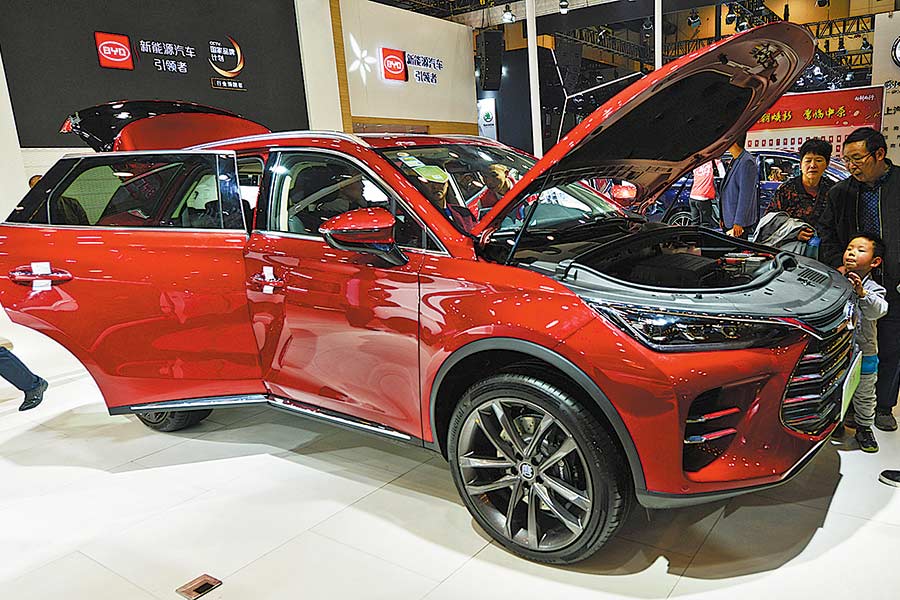
China is both the world's biggest auto manufacturer and the sector's largest market. However, China's auto sales in 2018 recorded their first annual decline in 20 years. The China Passenger Car Association said car sales fell by 6 percent to 22.7 million units in 2018, largely due to a combination of factors including the slowdown of the Chinese economy, drastic measures to restrict new car sales to cut pollution, and the trade conflict with the United States.
But the sales of new energy vehicles, an industry segment that includes electric and hybrid models, bucked the slowdown and grew over the past year.
Without doubt, there is huge cooperation potential for the EV industries of both countries. The segment also dovetails with China's and India's ambitions to build clean energy vehicles.
The Indian team's participation at the Beijing forum is part of the ongoing economic exchanges between China and India. The EV industries of both countries must take this process forward and talk to each other, and set up a formal mechanism to promote frequent interaction among their EV industries.
India is committed to achieving its global environmental commitments. It will encourage the development and adoption of clean energy and new energy transportation at the earliest time. India's EVs are projected to be 30 percent of total vehicle sales by 2030, with 25.36 million EVs and 59.17 million internal combustion engines.
India's overtures have also been well received by the Chinese EV industry. Chen has urged Chinese companies to invest in the nascent Indian EV market, which is important for his group.
Such a move could enable Chinese companies to make India the EV manufacturing hub for South Asia and beyond. It could also help Chinese companies shore up their fortunes amid declining sales in their domestic market and the changing global trade environment.
In the long run, cooperation in the production of EVs can help the two neighbors find more economic incentives that can eventually rekindle the warmth of their ties in the 1950s, when India was one of the first countries to recognize the People's Republic of China.
The author is a Hong Kong-based journalist. The views do not necessarily reflect those of China Daily.