Robots serving up savory food at artificial intelligence eateries







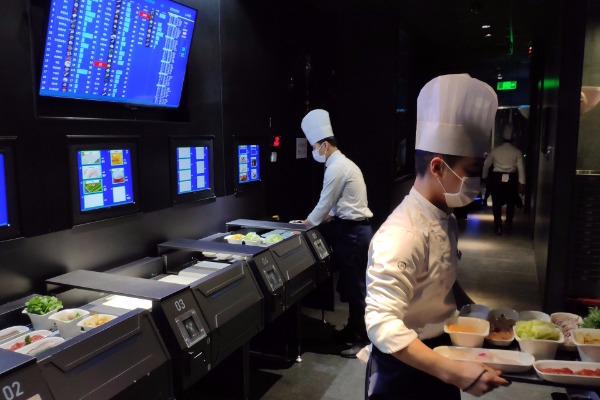
Would you enjoy a truly unique hotpot experience? If so, you could be warmly served by robots.
A famous hotpot chain has gained even more popularity since it opened its intelligent restaurant in downtown Beijing in October 2018. Patrons eager to visit the establishment often have to wait an average of two hours to get a seat.
There are 18 automatic "machine arms" that constantly work in an intelligent dish sorting room that is between 0 and 4 degrees Centigrade. They are capable of processing up to 8,000 dishes each day. Windows allow guests across the 93-table dining hall to see the operation from start to finish.
The flavor of the hotpot is one of the most important factors. Customers can choose from six levels of spiciness, and flavor consultants help advise when patrons face the dilemma of choosing between moderately spicy and eye-watering, extremely spicy hotpot. Once the decision is made, the broth is seasoned by the automatic flavoring machine.
Within 10 minutes after customers place their orders on iPads, six dish dispatching robots carry the meat and vegetables to the dining tables by tag location technology.
Each dish-dispatching robot can operate for an entire day after being charged for one night.
"The operation of our restaurant is helped by two intelligent systems," said Zhang Jinshan, technical trainer of the restaurant. "One accurately copes with customers' canceled, added and urgent orders, analyzes the data of the restaurant, monitors the operation condition of the equipment, provides maintenance of the software and checks the food inventory and expiry date."
The other is an energy management system, which calculates and analyzes the energy consumption including water, electricity and fuel gas of the restaurant, Zhang added.
The intelligent hotpot restaurant is not alone. China's e-commerce giant JD opened its smart Xcafe restaurant in Tianjin in November 2018.
The 400-square-meter dining hall can hold 100 people. Ordering, assembling, cooking, dispatching, dining and checking out are all facilitated by robots and an artificial intelligence system. In the kitchen, one person operates five robots.
As of now, there are a total of 40 courses available at the restaurant.
JD is transforming and upgrading traditional industries using AI, robots and big data, said its Vice President Xiao Jun. The intelligent restaurant is their attempt to combine catering with intelligent technology. He expects that "unmanned technology" will have broader applications.
China's catering industry posted a record high of 4.27 trillion yuan ($628 billion) in revenue in 2018, coupled with encouraging trends.
The figure marked a rise of 9.5 percent from the previous year, accounting for 11.2 percent of the country's total retail sales of consumer goods, according to the National Bureau of Statistics.
The huge catering market means diversified flavoring demands exist across the country.
Thus, intelligent catering has to improve the capability of automatic machines and prepare a wide range of dishes, said Tang Siyu, director of the Xcafe restaurant project.
Intelligent restaurants are expected to solve the problem of rising human costs in the catering industry, and JD hopes to make the robot technology applicable in practice, Tang said.
Tang admitted that intelligent restaurants are still in their early stages. He predicted that the intelligent catering industry will attract more merchants in the following three to five years.
But not everyone is so keen on the idea: "Chinese cuisine is extensive and profound," said Zhang Yi, chief executive officer of iiMedia Research.
"Take noodles as an example; we have various kinds of noodles from north to south and from west to east," he said. "I believe handmade sliced noodles taste much better than those made from machine hands."
Feng Jun, a member of the fast food professional committee of the China Cuisine Association, acknowledged that jobs in the catering industry could be divided into three categories: physical labor, skilled labor and emotional expression.
"The fast-food industry can make full automation happen, while high-end restaurants require more considerate service by people," Feng said.
Xinhua