One of Yunnan's best police dogs cloned







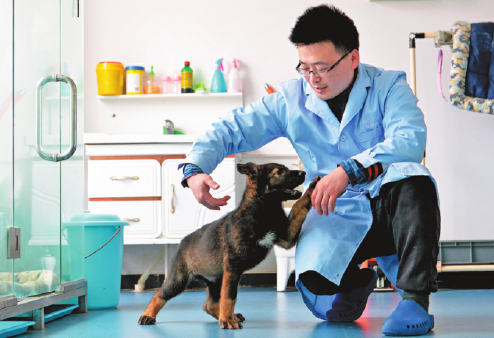
China has cloned a canine known as the "Sherlock Holmes of police dogs" to help detectives in Yunnan province. Scientists hope such technology will help meet the country's huge need for quality police dogs, which are expensive and time-consuming to train.
The canine named Kunxun, which has a distinguished lineage, is the first cloned police dog in China. She is a female of the Kunming wolfdog breed - a cousin to the German shepherd. Wolfdogs often are used for border security, police work and firefighting in China, according to the Kunming Police Dog Base of the Ministry of Public Security.
Kunxun, now around 3 months old, recently arrived at the center to begin basic training, Science and Technology Daily reports. At around 6 months old, Kunxun will begin three to five months of training, including following and tracking, drug investigation, crowd control and searching for evidence.
After graduation, Kunxun will participate in police fieldwork as a novice under the guidance of a dog trainer. If all goes well, Kunxun will enter service at around 10 months old. According to officials at the Beijing Police Dog Base, around 35 percent of all police dog candidates wash out before entering service.
Kunxun might have an edge thanks to being a clone of a veteran police dog named Huahuangma, who is serving in the city of Pu'er, Yunnan province. At age 7, Huahuangma has helped crack dozens of murder cases, hence the reference to Sherlock Holmes.
Huahuangma is an extremely gifted and precious asset, given her talent and the fact that the training to develop such a police dog's abilities can take up to five years and 500,000 yuan ($74,490) with no guarantee of success, said Wei Hongjiang, a professor at Yunnan Agricultural University, who helped with the cloning.
"These steep costs, coupled with the high elimination rate, means there is a shortage of quality police dogs that can satisfy China's security needs," he said. "By cloning veteran dogs, we can greatly improve the success rate and the number of quality Kunming police dogs available, bolstering national security as a result."
The cost of cloning was not available.
China is planning to build a repository of cells of other top police dog breeds for future use, Wei said. Chinese scientists will also create a networking platform where arrangements can be made to crossbreed top police dogs around the country, which also might lead to stronger offspring, he added.
In 2005, South Korean scientists created the world's first cloned dog - an Afghan hound named Snuppy, according to Seoul National University. Two years later, another team of South Korean scientists created the world's first cloned working dogs - Labrador retrievers called Toppies - for the Korean Customs Service to screen drugs.
In recent years, South Korea's Sooam Biotech Research Foundation, a company best known for cloning pet dogs for the hefty sum of $100,000 each, has also cloned special military dogs for the United States and Russia for sniffing out explosives or guarding prisons.
However, animal cloning has been a controversial topic ever since Dolly the sheep, the world's first cloned animal, was created in 1996. The debate was reignited last year when famed United States actress Barbra Streisand cloned her fluffy Coton de Tulear dogs, Miss Violet and Miss Scarlett, from genetic material taken from her deceased dog Samantha.
Streisand's decision to clone her pet sparked public discussions ranging from animal rights to the concepts of mortality. Wei said while public discourse on cloning technology is necessary, he believes cloning working dogs is less morally ambiguous given how specific its applications and implications are.
"Cloning technology is now being used to preserve and save endangered species," he said. "It also has wide applications in agricultural and medical research. It is just a useful tool."
Li Yingqing contributed to this story.