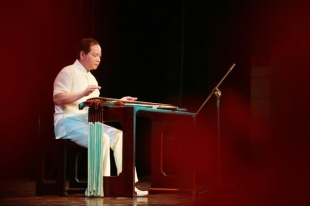



A passion for stringed things that began with radio waves








Someone some time early last century seems to have decided that an instrument that for more than 2,000 years had been known as the qin needed some brand differentiation. Qin essentially refers to a stringed instrument, and for a long time that name was good enough for Chinese.
However, eventually to distinguish it from Western instruments such as the piano (in Chinese the gangqin), the harp (shuqin) and the violin (xiaotiqin), the qin became the guqin, that gu meaning old or traditional.
Now, you may think that the most important of the word quqin is qin, for ultimately it is the qin, along with the player, that has all the work to do in making music, but Ma Weiheng sees things a little differently.
For Ma it is that wonderful character gu that gives the qin all of its character. For him it embodies the centuries of all that is wonderful about the guqin and its music.
Ma has a reputation second to none in making guqin, and last year he was designated a national-level inheritor of China's representative intangible cultural heritage projects, a tribute to a man whose love of the instrument goes back 35 years.
Ma's introduction to the guqin came the way many of us first stumble on a piece of music or an artist we end up liking-the radio. He was 20 at the time and he says he was entranced by the euphonious notes flowing out of that little box. He learned that what he had heard was guqin music, and thereafter he began a quest not only to learn more about the instrument but to learn how to play it.
That of course required a tutor, and finding someone was a monumentally difficult task because at that time there were fewer than 100 qugin players in China.
However, Ma was literally well placed to succeed in such a task for his hometown, Yangzhou, is a center of guqin culture, and several years later he made contact with Hu Lan, a player of the Guangling school, who took him on as a student.
In Chinese tradition guqin playing is valued as one of the four arts-the others being Chinese board games (qi), calligraphy (shu) and painting (hua)-and players are required to have qualities that extend well beyond the instrument and its seven strings. So for the first three months of his studies, Ma did not even get to touch a guqin. Rather, he and Hu discussed poetry, prose, art, opera and scholars' writing paraphernalia.
"Later my teacher told me that she had been teaching me from the very beginning," Ma says. "Guqin is not simply a plucked instrument. Its culture contains more than musicality, but also history, literature and philosophy."
So apart from painstakingly memorizing and mastering techniques, it is equally essential to learn about the story behind a piece of music and grasp its gist, so as to present its authentic flavor to the audience, Ma says.
When learning to play Three Variations on the Plum Blossom (Meihua Sannong), Hu took him to the Mountain of Plum Blossoms in Yangzhou during winter, to see how the flowers withstand the freezing cold and deliver their sweet fragrance.
For the ancient literati, guqin is often compared to a noble person. Not only does each qin have its name engraved on the body, but ancient people believed that a good qin had nine virtues.
The second of the nine virtues is in fact gu but in this case it signifies that the qin should sound pure and clang like a percussion instrument, a quality that demands a lot of the material the instrument is made of.
From the early 1990s Ma started learning to repair and preserve ancient qin, which laid a solid foundation for his later guqin making.
He was fortunate to be exposed to ancient qin from early on, he says, because his teacher Hu is from a family with long connections to the guqin, and the first guqin Ma practiced on was made during the Song Dynasty (960-1279).
"The sound of the ancient guqin is engraved in my heart," Ma says. "I've also been lucky enough to see the inside of an ancient guqin. The guqin maker must learn from the true masterpieces, the quality of which have passed the test of time."
When Hu finally acknowledged that Ma had truly mastered the guqin, she said he should have a qin of his own. Unable to afford a high-quality one to match the Song Dynasty guqin he practiced on, he decided to make one from scratch.
The first guqin he made sounded better than many of those sold on the market, he says, and a guqin player in Hong Kong soon bought it.
After accumulating years of expertise, Ma's guqin echoes the aesthetics of the Guangling school, and are widely recognized for their simple and classic appearance, as well as rich and mellow timbre.
Much like a sage whose wisdom accumulates through time, guqin matures as time goes by. After hundreds of years of aging, some guqin may be gifted with cracking patterns, which can produce a mellower sound and is a sign of a masterpiece.
Drawing on ancient wisdom and expertise, in 1994 Ma finally produced a qin with artificial cracking patterns, which consolidated his prestige in the field of guqin making.
He established the Nanfeng Qin Society in 2008, and gradually shifted his focus from making guqin to doing research on the instrument and disseminating information about it as his students pass on his expertise in guqin performing and making.
Zhang Wei, one of Ma's students, who has worked with him for 10 years, says: "Ma has dedicated his life to the guqin. Even in his everyday life, he thinks about how to apply the common elements to guqin art."