China's AI ecosystem is changing real economy, says Li Kaifu







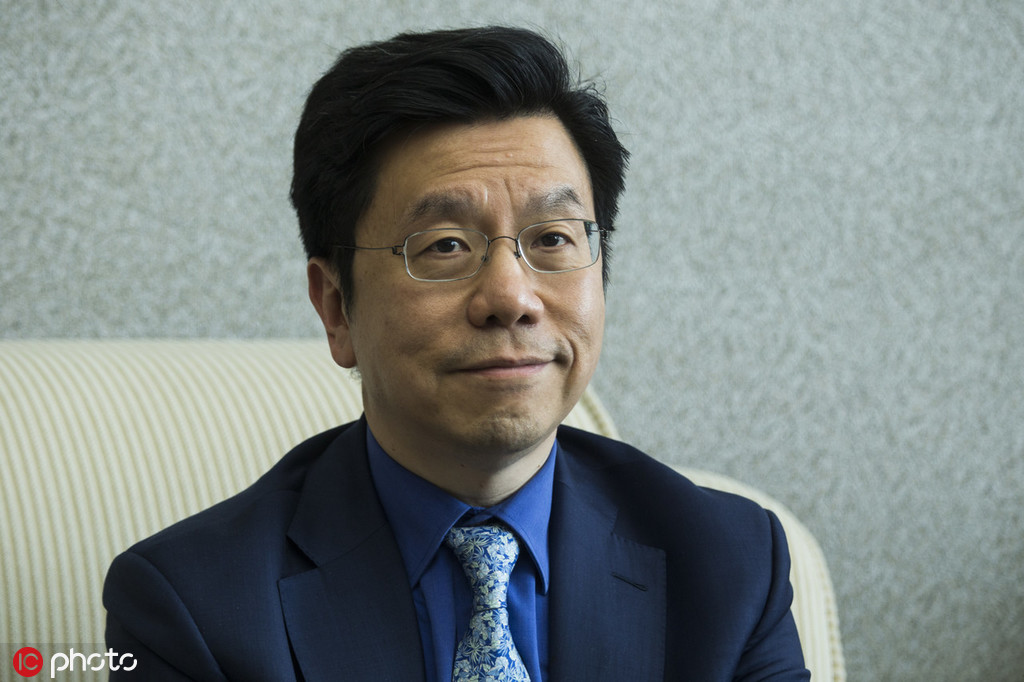
Artificial intelligence will bring about changes as fundamental as those enabled by electrification, argues Li Kaifu, Chinese artificial intelligence specialist and founder of the venture capital firm Sinovation Ventures. He says that China is leading in real-world applications of AI to businesses, factories and cities, and is catching up with the United States in basic research.
Li's technological optimism contrasts with a widespread pessimism about technology prevalent among thinkers from Silicon Valley.
For example, famed venture capitalist Peter Theil uses the slogan "We wanted flying cars, instead we got 140 characters" as the subtitle of his investment fund. In many interviews, he has explained that we've seen "innovation in the world of bits, but not in the world of atoms".
In contrast, Li said in an interview with China Daily that we are already seeing people's lives improved by, for example, shopping websites that help you find what you are looking for. "For people who are feeling that this is not science fiction, this is just Amazon showing me an ad or a bank giving me a loan. Just wait. In the next five or 10 years, we'll see robotics and in the next 10-20 years autonomous vehicles - and they will be magical," he said.
"The atom part will take longer, but that will happen too. The hardest part today appears to be the atom side - robotics, autonomous vehicles, flying cars and things like that. Because the big breakthroughs have been just pure software."
Ironically, Theil, the co-founder of PayPal and a lead investor in Facebook and big data mining company Palantir, has said that we live in a financial age, rather than a scientific and technological age. "It's not clear it's enough to bring our civilization to the next level."
Most tellingly, Theil points out that the oligopolistic US tech giants - Facebook, Apple, Google, Microsoft - are each sitting on billions of dollars of cash, but they can't think of any technological opportunities where they can invest that money.
On the other hand, China's ferociously competitive tech sector is pushing real-world uses of AI.
Li said: "When you measure implementation and value creation, China is ahead. Roughly speaking, China's AI engineers are more massive, more hardworking and tenacious, and are moving forward and creating momentum."
He added that the Chinese tech sector is more competitive and its business model innovation is "definitely way ahead" of Silicon Valley. "We can count unicorns, we can count market cap, we can count revenue. Also, we can count who has more accurate speech recognition or face recognition or machine translation at the industrial level."
However, recent academic reports conclude that China still does lag behind the US in terms of fundamental scientific research in the field.
Li cited a March report, which he calls "most authoritative", by the Allen Institute for Artificial Intelligence in Seattle. The report shows that total Chinese academic publications on AI have surpassed the US, but high-quality publications have not yet caught up.
The Allen Institute "basically measures what percentage of the top 50 percent of AI papers originate from China compared to the US. The study paper counts citations in other research papers, which is commonly accepted as a metric of quality. In terms of the top 50 percent of papers, China has now caught up with the US. But, in terms of the top 10 percent, China is further behind, but will catch up within the next three to four years. If you measure the top 1 percent, China will need about five years to catch up." Li adds that he believes that China is about 10 years behind if you look at the key papers that are in the one-tenth of 1 percent most cited. No other country or region is close to China or the US in terms of AI applications or research.
A July 2018 report by Tsinghua University's China Institute for Science and Technology Policy concluded that China's economy has fundamentally moved from the process of catching up to an innovation-based economy: "Unlike in the past industrial revolutions where China was left behind and struggled to catch up, China has got a head start for the fourth industrial revolution. In AI, in fact, China has secured a leading position in the top echelon in both technology development and market applications and is in a race of 'two giants' with the US."