Boeing agrees faulty sensor led to Ethiopian jet's crisis







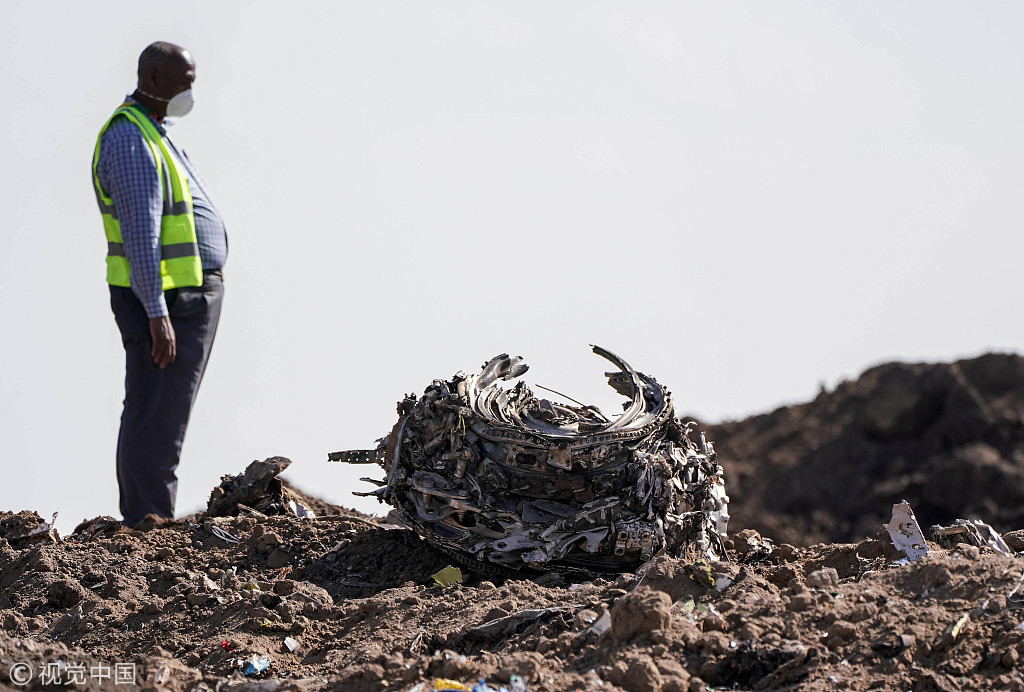
A preliminary report issued on Thursday by Ethiopian officials found that a malfunctioning sensor sent incorrect information to a Boeing 737 Max 8 jetliner, triggering an anti-stall system that began a chain of events that ended with the plane nose-diving into the ground, killing 157 people on March 10, the Associated Press reported.
Boeing has acknowledged that the sensor malfunctioned in the Ethiopian Airlines 737 Max jetliner, triggering the anti-stall system when it was not needed, the AP reported.
"It's our responsibility to eliminate this risk. We own it, and we know how to do it," Boeing CEO Dennis Muilenburg said in a video, according to the report.
Also on Thursday, an Ethiopian official confirmed news reports that the flight crew of the doomed flight had followed Boeing's recommended procedures, at least in part, by disabling the automated anti-stall system of the 737 Max 8 but were unable to regain control of the plane before it crashed.
At a news conference in Addis Ababa, the nation's transportation minister confirmed earlier indications that the plane's anti-stall system was repeatedly triggered in the minutes between the takeoff and crash, but he did not draw definitive conclusions about the crash's cause.
"The pilots turned the MCAS on and off, but I can't say how many times, because we will find that out when we have the final report," Dagmawit Moges, Ethiopia's transportation minister, told The New York Times. Moges was referring to the anti-stall Maneuvering Characteristics Augmentation System.
The Wall Street Journal reported earlier this week that after the pilots turned off the MCAS, they were unable to regain control of the plane. They then re-engaged the anti-stall system, the Journal said. It was not clear why the pilots did not continue following Boeing's emergency checklist. Aviation experts who asked not to be named told China Daily that using nonstandard procedures may have made things worse.
The preliminary finding by Ethiopian authorities likely will increase pressure on Boeing to develop and install new software for the MCAS. It also is expected to result in a rigorous review of the software fix by the US Federal Aviation Administration, which has been criticized by aviation analysts and members of Congress for depending too heavily on aircraft industry officials to certify their new planes as safe.
The FAA said late on Wednesday that it will launch a joint task force with NASA and international aviation regulators to review Boeing's new software for the anti-stall system. The task force will be headed by Chris Hart, former chairman of the US National Transportation Safety Board. The FAA has not released the names of those to serve on the Joint Authorities Technical Review team, their affiliations or nationalities.
"This is an unprecedented move," said Robert Mann, president of R.W. Mann & Co, an aviation consulting firm. "I think it will be a good thing for Max aircraft, but I'm not sure it will be a good thing overall if it creates an international bureaucratic process for future certification that will take longer than any individual oversight agency would now require."
James Hall, managing partner of Hall & Associates, an aviation consulting firm in Washington and former chairman of the NTSB, said it's unclear how the FAA's new panel will mesh with investigations of Boeing launched by the US inspector general, US Justice Department and Congress.
"Will the technical review team look at the certification process, or is it an attempt to get the plane back in the air?" Hall said. "We'll see."
Boeing said it would work closely with the new task force.
"We welcome the Joint Authorities Technical Review and look forward to working with the panel," Paul Bergman, a spokesman for Boeing in Seattle, said in a statement. "Safety is our top priority."
If the nose of the Boeing Max 8 model rises, threatening a midair stall, the MCAS system automatically points the plane's nose down to gain speed needed to stay aloft. Boeing added larger, more fuel-efficient engines to upgrade the existing 737 airframe to compete with European rival Airbus. The new engines are positioned closer to the fuselage, changing the aircraft's aerodynamics and pushing the nose up in certain conditions.
Boeing created MCAS to make the new Max planes handle more like previous versions of the 737, a popular model used by airlines around the world. Some in the aircraft industry, including pilots, have said Boeing did not provide adequate notice of the new plane's flight characteristics or how to shut off the new anti-stall device if necessary. A group of pilots independently compiled and circulated a 13-page manual about the new system. Others have said Boeing provided adequate notice of the changes and how to disable MCAS.
The version of MCAS installed on the Ethiopian Airlines plane had relied on information from one sensor that sent back bad information.
Flight systems, however, typically are built with a backup system so there can be no single point of failure. Since the crashes of Max jets in Indonesia in October and Ethiopia last month, Boeing has modified design of the anti-stall device to include two sensors on all aircraft.
The FAA allows airlines to make minor modifications in previously certified aircraft to meet their operational needs, a rule Boeing followed in building the 737 Max for foreign carriers. Ethiopian Airlines and Indonesia's Lion Air — involved in fatal crashes five months apart — reportedly declined to buy two add-on safety devices that might have helped the pilots keep the doomed planes in the sky.
Neither airline purchased the "angle of attack" system display for readings of two sensors rather than one and a "disagree light" to be activated if the sensors produce conflicting readings. The Lion Air crash in October killed 189 passengers and crew.
Airlines around the world, including China and the US, have flown the 737 Max, introduced in 2018, without incident.