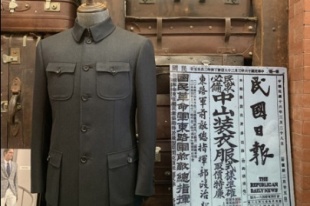



Tradition of making suits stumbles on inheritance hurdle








"Tailors are found everywhere, especially in Ningbo."
This is how Qing Dynasty (1644-1911) scholar Qian Yong (1759-1844) started his literary sketch about a local tailor from the ancient city in East China's Zhejiang province.
Ningbo's dressmaking tradition evolved over a long period after that.
Tailors from the city have played an important role in the transformation of dressing styles in modern China. They created China's first Western-style suit, invented the Chinese tunic suit, opened the earliest Chinese-owned suit shop and a school to train tailors, as well as published the first textbook on making suits.
Now, the successors of those Ningbo tailors are struggling to inherit and develop its suit-making culture.
According to Qian's story, back then, most tailors in Beijing came from Ningbo. They dominated the capital's tailoring sector in the late Qing Dynasty as some inscriptions from 1905 suggest.
In 1896, Ningbo tailor Jiang Liangtong started one of the first suit shops in Shanghai. Until the beginning of the 20th century, Ningbo tailors had opened more than 400 suit shops along 10 major roads in Shanghai.
Ningbo tailors, especially those originally from areas on the banks of the Fenghua River and holding businesses in Shanghai, were often called hongbang (red band) tailors. This is because many of them were serving foreigners whom the Chinese had long referred to as "redhaired people". The tailors accounted for 60 percent of the practitioners in Shanghai by the 1940s. Tailors like Jiang learned to make suits in Japan, according to Li Benting, a researcher at the Ningbo Garment Museum.
In 1905, nationalist leader Sun Yat-sen commissioned Ningbo tailor Zhang Fangcheng, who was then living in Yokohama, to design a new style of outfit. Conforming to Chinese people's body shapes, disposition and lifestyle, Zhang applied Western cutting and sewing techniques, drew inspiration from student and sergeant suits and added Chinese cultural elements to the design.
This was later developed into what is now known as the Chinese tunic suit, a style that represents modern China, by brands like Rongchangxiang and Wangshuntai in Shanghai. Both brands published newspaper advertisements in 1927, promoting their products by claiming recognition from Sun by making suits for him.
Some hongbang tailors in Beijing had also made outfits for former leaders, including Mao Zedong, Deng Xiaoping, Jiang Zemin and Hu Jintao.
Gu Tianyun, who started his suit business in Japan in 1903 and studied the market in Europe, published a textbook in 1933 to introduce suit-making skills to the Chinese. He also started a tailor-training class and later developed it into a vocational school.
Gu wanted to promote the industry and welcomed questions from those who read his textbook, ignoring the common belief that a master should not teach his apprentices all he knew about his business, Li says.
Today, many of the traditional hongbang tailors in Ningbo still run their shops on Xihe Street and some others specially cater to the international market, says Yao Yulian, director of the customization committee for the Ningbo Garment Association.
Some from the younger generations of suit-makers are studying consumer trends to better develop their designs, Yao says.
Qi Baijun, who started learning the skill in 1993, says "honesty and flexibility" are the most important characteristics of hongbang tailors.
Yao says the common practice has proved the tailors' skills and trustworthiness, as customized suits can cost tens of thousands of yuan, and to purchase, the clients need to pay in advance.
A suit is not just a body cover, Qi says, it modifies the body shape and presents the client's personality. He says he designs suits according to the culture, weather and physical traits of residents of the cities where his clients live, as well as considering their professions in order to make customized suits stand out in an industrialized society.
"Three years might be enough to learn the skills, but a lot more time for theory and management is needed," Qi adds.
No tailor can make exactly the same outfit as the other, he says. Whether there is need to stick to the same style or interpretation, the craftsmanship itself is hard to copy, and therefore, it is difficult to inherit and develop Ningbo's dressmaking tradition.
However, as a cultural heritage it needs to be handed down, Qi adds.