


Literature fest sparks rural reboot








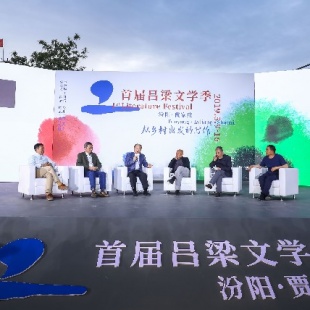
So by holding lectures, conducting dialogues and screening movies related to the countryside and contributed by guest authors, the region's local literary legacy can both be re-examined and extended.
Many modern and contemporary works of Chinese literature touch on common rural issues - childhood upbringing, family inheritance and people's experience of being stuck on the bottom rung of society - that have been rooted in Chinese farming culture for thousands of years.
China's urbanization has been rapidly progressing to the extent that rural life has become something unfamiliar to the majority of the population, which is very different from what it was like just three decades ago, according to Ge Fei, author and a Chinese literature professor at Tsinghua University in Beijing.
He was delivering a speech on the first day of the festival, interpreting what it means to us when rural societies fade away.
"It's important we have both of the visions. One is the vision to look into the future amid urban life, and the other is to look back on rural history - it's our past," he says, adding that this contradiction - resisting urbanization while at the same time embracing progress - has driven the emergence of modern thought and discourse, which has become the internal motivation for change in art, literature and philosophy.
Ethnic Tibetan writer A Lai, famous for his novel Settling Dust, which was also published under the title Red Poppies, says many of the writers today still depict rural life as they imagine it, rather than observing and reflecting on it by honestly facing the challenges posed by globalization.
"We should be aware that many of the problems facing Chinese farmers and villagers today are universal," he says.
While many people doubt whether Mo could top the success of winning the Nobel Prize in Literature in 2012, Zhang Qinghua, professor at Beijing Normal University, believes that Mo's way of dealing with this has been to make a return to his hometown, a village in Gaomi, Shandong province, both in reality and spiritually.
Mo didn't publish any new work in the five years following the award, when in 2017 he released several short stories, poems and theater works, mainly reminiscing about his hometown.
Unlike Mo's former novels, Peking University professor Chen Xiaoming notes that his new works are more reserved, realistic stylistically and employ more simple language. Literary critic Li Jingze is impressed that Mo has remained acutely sensitive to the realities of urban and rural life.