Southern tea grows successfully in the north







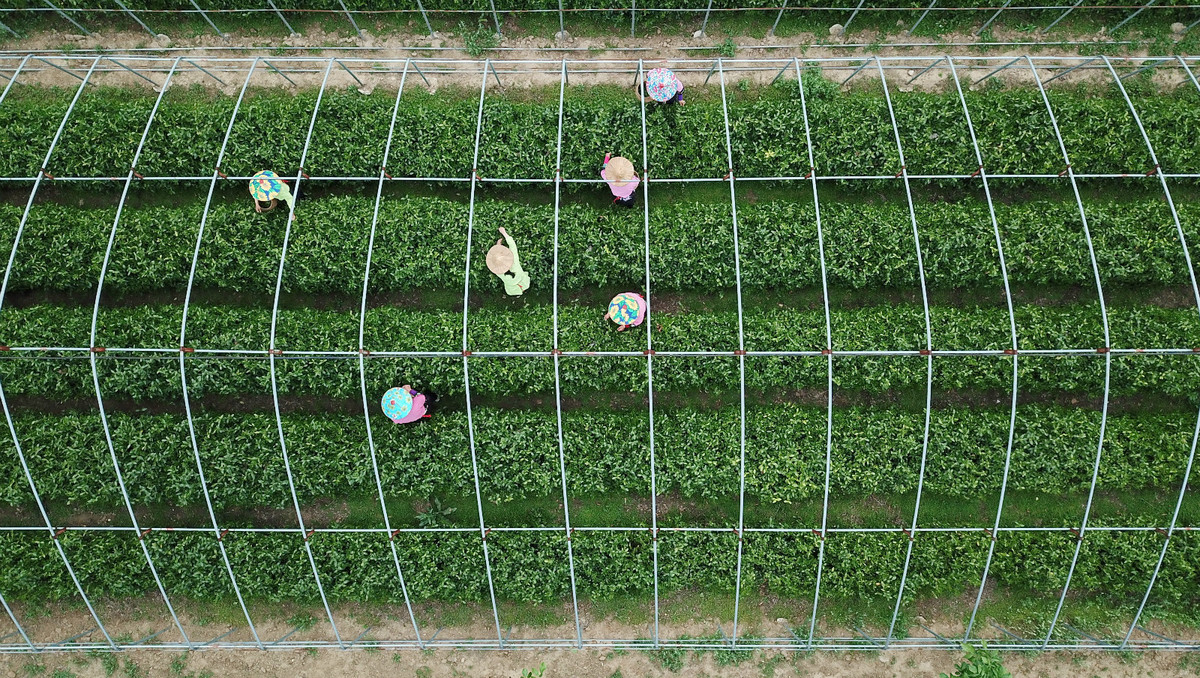
As the spring tea picking season starts, workers on a tea plantation are busy picking and drying tea leaves round the clock deep in the Taihang Mountains in Lincheng county, North China's Hebei province.
"In the past, people considered planting southern tea in North China a dream. However, we made it," said Qu Baomin, a 42-year-old tea planter who successfully brought southern tea to the mountains and started mass production.
Tea has been planted in South China for thousands of years. In the 1950s, people began exploring tea planting in the north of the country, but the latitude and cold weather were always obstacles.
In 2012, Qu and his wife rented 2 hectares of land to plant tea in Tonghua village on Mount Sanfeng, part of the Taihang Mountains, which is at an altitude of nearly 1,500 meters above sea level, with rivers flowing through it.
The resistance of Longjing 43 tea, introduced by Qu, to the cold is relatively strong. However, for southern tea, the most difficult times are still North China's winters, especially in the Taihang Mountains with temperatures as low as-20 C.
"The key factor to the tea plants' survival is to keep them warm during winter, and we chose to grow the plants in a greenhouse," said Qu, adding that it should neither be too cold nor too hot in the greenhouse. He always opens the window when the sun comes out in case the temperature in the shed gets too high.
Since he started to plant tea in 2012, Qu has spent almost all of his time in the tea garden on the mountain and his hard work has finally paid off.
In 2014, the tea quality and supervision testing center at the Ministry of Agriculture and Rural Affairs recognized that the shape, color, aroma and taste of Tonghua tea, which Qu produced, were all of high quality.
"This proves that the north can produce good-quality tea," said Wu Xun, a researcher from the tea research institute at the Chinese Academy of Agricultural Sciences. "The duration of sunshine is long and the temperature difference is large in the north. Once we solve the problem of 'survival' using greenhouses and other facilities, it is possible that the tea quality can surpass that of the south."
Although tea from the Taihang Mountains is not well-known yet, Qu's tea has already earned a reputation for its good quality in the middle to high-end tea market. About 100 grams of tea can be sold for between 1,000 and 3,000 yuan ($145-435) depending on the grade.
"The investment in tea planting is mainly at the early stages. As long as you survive the first five years, the benefits are considerable," Qu said. "The economic age of tea plants is 40 to 70 years. If they are well planted, the financial returns will be several thousand yuan per mu (667 square meters) per year."
Qu's tea planting business has helped almost 100 farmers shake off poverty. It has also spread to other areas of the Taihang Mountains, and Shijiazhuang and Baoding cities.
Gong Qiugen, a 63-year-old farmer from Tonghua village, has been working in Qu's tea garden since it started.
"The people who work here are all from our village," Gong said. "Each month, I can earn 2,000 yuan ($290) and I can earn up to 10,000 yuan during the three-month tea picking season."
Qu said: "My next goal is to lead more people to plant tea trees in the Taihang Mountains and lift more people out of poverty, so the Taihang Mountains can be evergreen with a tea fragrance spreading in the air."
Xinhua



- 'Book of Songs' from Chinese imperial tomb proves oldest complete copy ever found
- Exhibition highlighting the 'Two Airlines Incident' opens in Tianjin
- Average life expectancy in Beijing rises to 83.93 years
- Energy drink overdose sends delivery worker to hospital
- GBA and Hainan deepening cooperation to boost innovation and sustainable growth
- Beijing mulls including the costs of embryo freezing and preservation in medical insurance