Sino-US trade dispute hurts both economies, say experts







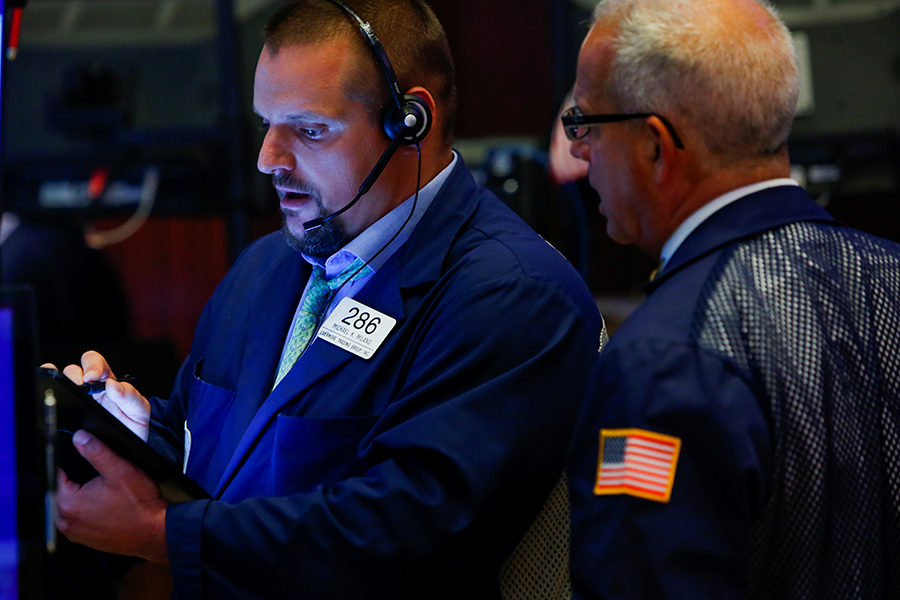
Three indexes surge on decision to delay new tariff on imports from China
The fact that US equity markets reacted warmly to the US administration's decision to delay an additional tariff on certain products imported from China proves that US companies believe the trade dispute between the two countries will hurt both economies, said Chinese academics.
All three major US stock market indexes surged sharply following the news on Tuesday.
"Imposing an additional tariff on Chinese imports will also damage the interest of US consumers, thus causing the US to take a more prudent approach," Guan Tao, a doctoral adviser in economics at Wuhan University, said at a seminar held by the National Institution for Finance and Development in Beijing on Wednesday.
Lou Feng, a researcher at the Institute of Quantitative and Technical Economics under the Chinese Academy of Social Sciences, said according to the estimates of his economic modeling team, imposing an additional 10 percent tariff on approximately $300 billion worth of Chinese imports will lead to a slowdown in US economic growth by 0.06 percentage point, an increase in the US consumer price index by 0.16 percentage point, and a $8.2 billion loss of social welfare, in addition to slowdowns in US export growth and import growth by 0.42 percentage point and 0.85 percentage point, respectively.
"China has a strong ability to withstand economic pressure and huge potential for economic growth. Over the past year, trade frictions between the two countries proved that by continuously imposing additional tariffs on Chinese imports, the US cannot change the fundamental trends of Chinese economic development or obstruct Chinese strategies which are committed to the central task of economic development and aim at comprehensively deepening economic system reform and expanding opening-up," Lou said.
The US Treasury Department labeled China a "currency manipulator" on Aug 5 after the yuan weakened to below 7 against the US dollar.
But Chinese experts noted that it is normal for the yuan to go up and down under a managed floating exchange rate regime.
"The yuan depreciation was driven by market forces but the US regarded it as currency manipulation, which shows a lack of professionalism and common sense. The behavior of unreasonably labeling China a currency manipulator is doing severe and long-term damage to the international reputation of the US," said Guan from Wuhan University.
China reiterated in August that the country will take necessary and targeted measures to maintain the steady operation of its foreign exchange market and stabilize market expectations. This is "for the purpose of preventing a sharp depreciation in the yuan, rather than prompting devaluation of the yuan to gain an edge in exports", he said.
In fact, China has insisted on not taking the move of competitive devaluation of its currency while the country deepens its exchange rate reform. During a keynote speech at the World Economic Forum's Annual Meeting of the New Champions in Tianjin on Sept 19, Premier Li Keqiang said China will not devalue the yuan to stimulate exports.
"Ever since the 2008 financial crisis, China has kept its promise that the country will not start a competitive yuan devaluation," said Guan.
Data from the Bank for International Settlements show that the yuan's real effective exchange rate index went up by 17.1 percent from the beginning of 2009 to June 2019.The increase is larger than a 10.7 percent rise in the US dollar's real effective exchange rate index over the same period. Seeing the complexity of the China-US relations in the long run, experts expressed concerns about the evolution of trade frictions into a financial war and urged policymakers to make plans in advance to protect the safety of Chinese financial assets and interests.
But some of them said the two countries will not plunge into an all-out financial war in the short term due to strong bilateral ties in terms of the economy, trade and investment.
"The US is eager to contain China but we believe that China, if paralyzed economically, would become a disaster for the US and the world," said Hu Zhihao, deputy director-general of the National Institution for Finance and Development.