Hada scarf hub weaves its way into ancient trade







CHENGDU - For hundreds of years, the hada scarf has been an essential ceremonial fabric in the daily life of Tibetans. But where did it originate?
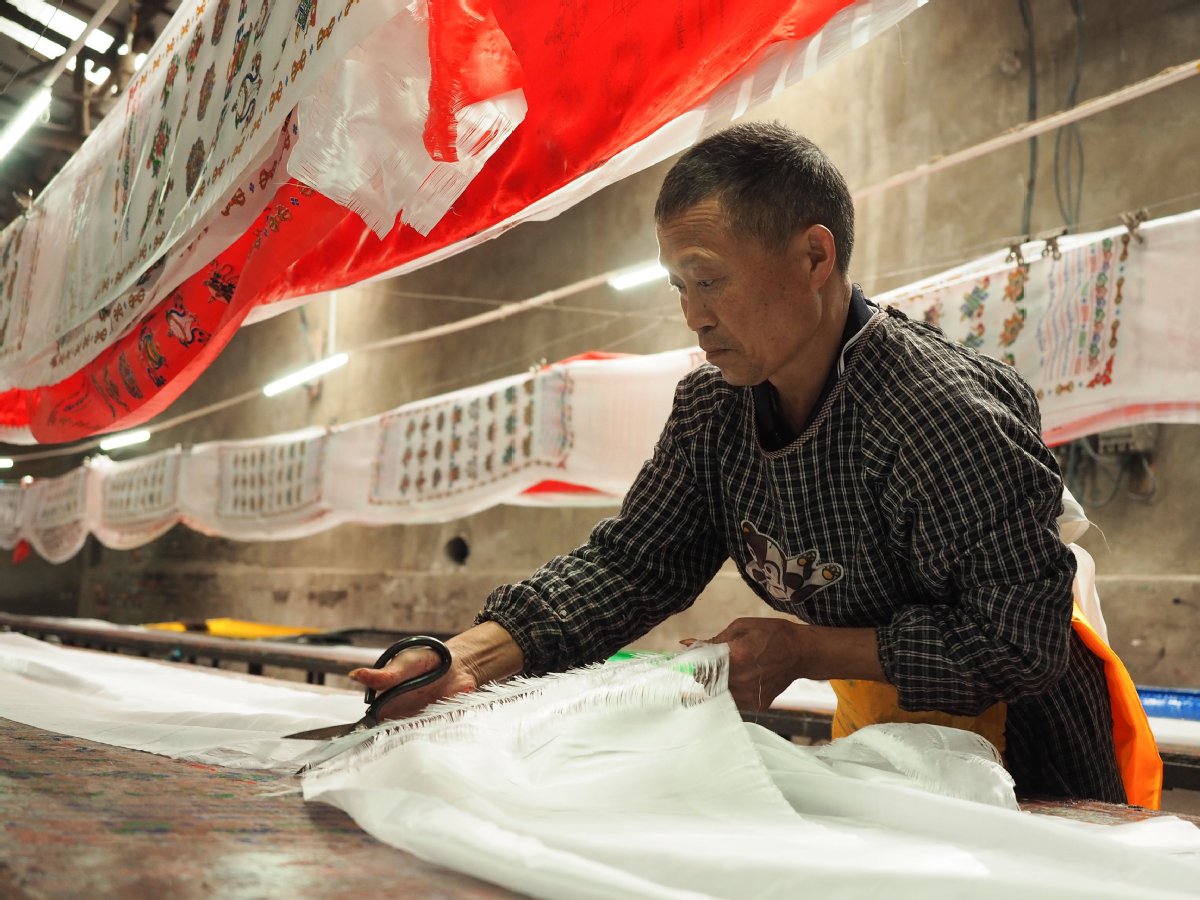
Thousands of kilometers from the Tibetan Plateau, the snow-white satin is woven behind the walls of brick and wood dwellings in the small town of Ranyi, Sichuan province.
For nearly two centuries, hada scarves have been produced in Ranyi before making their way to the Potala Palace in Lhasa, capital of southwestern China's Tibet autonomous region, Tibetan Buddhist monasteries and families across the Tibetan Plateau.
It is estimated that more than 100 million hada scarves are produced every year in Ranyi, where the permanent resident population is no more than 30,000.
The tea-for-horses trade between the Han and Tibetan people was established as far back as the 11th century, and the famous Tea Horse Road linking the Sichuan Basin with the Tibetan Plateau passed by Ranyi.
Tea, hada, silk and grain produced in the Sichuan Basin were transported to Tibet in exchange for medicinal materials, gold, hides and wool.
Some people believe the name hada comes from a Mongolian word meaning "scarf". Italian merchant Marco Polo mentioned in his book that emperors of the Yuan Dynasty (1271-1368) exchanged white items-which some scholars believe were hada scarves-with his entourage to celebrate the new year.
Some others think hada means "to decorate with white items" in the Tibetan language, which evolved from the Tibetan tradition of decorating new houses with white woolen threads.
Although the origins of the word hada are lost in time, Ranyi people know when their ancestors began the hada business.
Hu Pengfei, 36, remembers his grandfather starting to make hada scarves by hand in the 1940s. More than 20 steps-from mulberry planting, silkworm rearing to textile making, starching and packing-must be taken to make hada.
Production was low, and his grandfather was only able to sell hada "once every one to two years". And every time he did, he hired a dozen porters to carry the products to the neighboring cities of Ya'an and Kangding, also in Sichuan province.
In the 1990s, when Hu's father took over the hada business, laborers were replaced by machines and post offices took the place of porters. The narrow and ancient Tea Horse Road was gradually abandoned and buried by weeds.
Hu has now taken over the family business, and a new highway has brought Sichuan and Tibet even closer. Tunnels and bridges have replaced steep and dangerous mountain roads.
A round trip from Ranyi to Kangding used to take up to one month for Hu's grandfather, while it only takes a day for Hu to finish the trip today.
"Overseas orders make up about one-fifth of our business," Hu said. His hada scarves have been sold in India, Nepal, Malaysia and Singapore.
As sales of hada soared, consumer demand for quality and variety also grew.
"High-end hada made of natural silk and wool used to account for no more than 10 percent of our production. Now it's 30 to 40 percent," said Zhi Xuewen, general manager of a hada company in Ranyi.
To attract young consumers, hada producers have been continuously improving the manufacturing process and user experience. Previously, people had to cut hada into appropriate pieces as they were only sold in big rolls. Nowadays, Zhi cuts and packages them.
Besides traditional patterns such as the Eight Auspicious Symbols of Buddhism or blessing words written in Tibetan characters, hada scarves with customized patterns and specific words, even in English, have become popular for various occasions and purposes.
Like Chinese tea, hada scarves will continue to weave new chapters for cultural exchange across China and the world.
Xinhua



- Macron's China visit strengthens ties, boosts cooperation on global issues
- CPC issues revised regulations on its working bodies
- Melodic harmony under gingko tree
- Media tour explores Xiamen's tech surge and smart manufacturing
- Discover Xiamen with beauty of ecological governance
- Conference aimed at strengthening global organ donations opens in Guangzhou