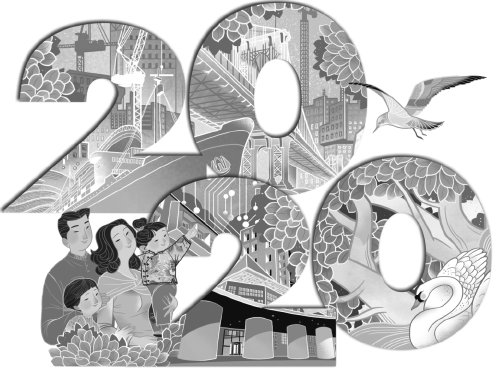
Moderately prosperous society beckons 2020







China's goals for 2020, first proposed in the report of the 16th National Congress of the Communist Party of China in 2002, are: four times the GDP of 2000, significantly enhanced overall national strength and international competitiveness, and basically realizing industrialization.
Zeng Peiyan, then minister of State Development Planning Commission, gave three quantitative indicators in 2002: by 2020, China's per capita GDP would cross $3,000, roughly equivalent to the average level of middle-income countries; the urbanization rate would exceed 50 percent; and the proportion of employment in agriculture would drop from 50 percent of the total in 2000 to about 30 percent.
These quantitative targets were surpassed by 2018. That year China's GDP(calculated according to 2010 constant price) was 4.84 times that of 2000, with an average annual growth rate of 9.2 percent-and per capita GDP reached $7,287(based on 2010 constant price), with an annual growth rate of 8.7 percent. Measured in terms of purchasing power parity (PPP, 2011 international dollar), China's per capita GDP had reached 16,187 international dollars, exceeding the world's average of 15,941 international dollars (PPP, 2011 international dollar).
Furthermore, the urbanization rate reached 60 percent, and the share of the agriculture sector in total employment fell to 26.1 percent. According to US Central Intelligence Agency data, in 2018 China's GDP(PPP) ranked 105 among 228 countries and regions, thus becoming part of the top 46.1 percent in the world.
Despite these figures, many so-called foreign experts continue to suggest that China's total GDP is overestimated.
But the fact is that, according to Fourth National Economic Census data, the revised GDP is even higher, by 2.1 percent, of which the added value of the tertiary industry registered a nearly 2 trillion yuan ($284.50 billion) increase, equivalent to an increase of 0.39 percent of the world GDP(PPP). Consequently, China's per capita GDP for 2018 has been adjusted to 16,527 international dollars, that is, 29.7 percent that of the US.
According to our projection, China's total GDP in 2020 is expected to be 5.45 times that of 2000, with an average annual growth rate of 8.8 percent. GDP (PPP, 2011 international dollar) will rise to 25.98 trillion international dollars. Calculated according to the statistical method of PPP, in 2000 China's GDP was only 36.3 percent that of the US, but in 2020 it will rise to 137 percent. Also, China's per capita GDP will reach 18,622 international dollar (PPP, 2011 international dollar), 5.05 times that in 2000, with an average annual growth rate of 8.4 percent and per capita GDP jumping from 8.1 percent that of the US in 2000 to 32.0 percent in 2020.
And in terms of per capita GDP(PPP), China will occupy the 94th position among 228 countries and regions, thus becoming part of the top 41.2 percent in the world.
What is remarkable is that China has transformed from the world's largest poor country into the world's largest all-round moderately prosperous society (quanmian xiaokang) in the least number of years.
The World Bank measures poverty based on three factors: a lowest-income poverty line of $1.90 per day, a lower-middle income line of $3.20 per day, and an upper-middle income line of $5.50 per day. According to these criteria, in 2015 China's poverty incidence rate was 0.7 percent, 7.0 percent, and 27.2 percent respectively. By 2020, these figures will drop to 0 percent, 3 percent, and below 10 percent respectively.
Which means China will finally bid farewell to absolute poverty in 2020-a major achievement in building a moderately prosperous society in all respects.
In the first two decades of the 21st century, China has developed rapidly from a low-income economy to a lower-middle-income economy and then to a higher-middle-income economy. It now accounts for 52.4 percent of the total population (2.65 billion) of higher-middle-income countries. And in the future when it becomes a high-income economy, it will more than double the total population (currently 1.21 billion) of high-income countries.
China's development has a huge spillover effect on the rest of the world, which is especially reflected in its contribution to global poverty reduction. According to the lowest international poverty line ($1.90 a day), in 1981 China's poverty-stricken population was 884 million. By 2015, the figure had been reduced to 9.62 million, with China's share in the global impoverished population shrinking from 46.5 percent to 1.32 percent, and the incidence of poverty dropping from 88.3 percent to 0.70 percent. This means, in total, China accounted for 74.4 percent of the global poverty reduction.
Measured against the second international poverty line ($3.20 a day), in 1990 China's poverty-stricken population was 1.02 billion. By 2015, the figure had declined to 96.22 million, reducing China's share in the world total from 35.3 percent to 5.0 percent, and the incidence of poverty from 90.0 percent to 7.0 percent. By that measure, China's contribution to global poverty reduction was 94.1 percent.
According to the third international poverty line ($5.50 per day), China's poverty-stricken population was 1.12 billion in 1990. By 2015, the figure had dropped to 374 million, with China's share in the world total declining from 31.5 percent to 10.9 percent and the incidence of poverty falling from 98.3 percent to 27.2 percent. Which means China's contribution to global poverty reduction was overwhelming.
As can be seen from its remarkable contribution rates, China's success in poverty alleviation and economic development is also the success of the global poverty reduction efforts.




Today's Top News
- China-Cambodia-Thailand foreign ministers' meeting held, press communique issued
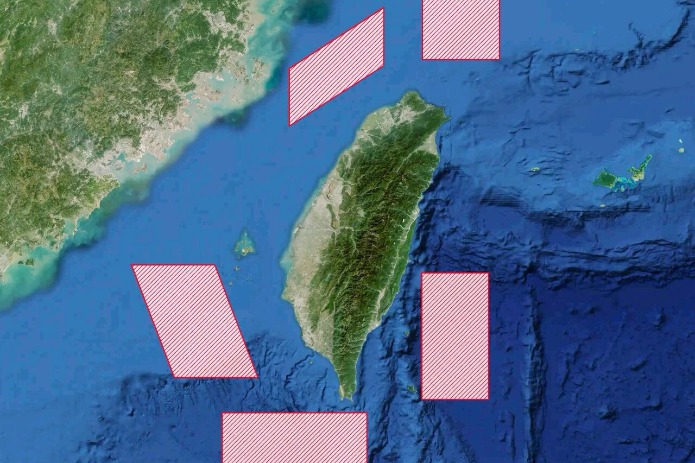
- Drills demonstrate China's resolve to defend sovereignty against external interference
- Trump says 'a lot closer' to Ukraine peace deal
- China pilots L3 vehicles on roads
- PLA conducts 'Justice Mission 2025' drills around Taiwan
- Partnership becomes pressure for Europe